

Historical & Cultural SitesHistorical Sites
Mama Hatun Kervansarayı
8
No ratings yet
Sign in to like and rate
Mama Hatun Caravanserai
Mamahatun Mahallesi, Kervansaray Caddesi No:114, 24800 Tercan / Erzincan
Tercan, Erzincan
Get DirectionsApple MapsAbout Venue
The Mama Hatun Caravanserai is a medieval cut-stone inn standing on the old Erzurum-Erzincan caravan route in the centre of the Tercan district, east of Erzincan. The caravanserai is the largest building of the Mama Hatun Complex, which consists of a caravanserai, a kümbet, a bath and a mosque. The TDV Encyclopaedia of Islam and the Culture Portal write that the complex was built by Mama Hatun, daughter of İzzeddin Saltuk II, who came to the head of the Saltukid Beylik ruling Erzurum and its surroundings in 1191. For a long time Tercan was known by this ruler's name, and the neighbourhood that holds the district centre still bears the name Mamahatun today.
The Provincial Directorate of Culture and Tourism introduces Mama Hatun as a woman ruler who came to the head of the Saltukid Beylik and reigned for about ten years. The same source states that she spent the last years of her life in Tercan and had a large complex built there, consisting of a caravanserai, a bath and a masjid. The caravanserai has no building inscription, so its date is debated. While the TDV Encyclopaedia of Islam and the Culture Portal date the building to the beginning of the thirteenth century, the text of the Provincial Directorate of Culture and Tourism writes that, because of its plan and architectural features, it may have been built at the end of the twelfth century. What is certain is that the building is one of the earliest and largest caravanserais in Anatolia.
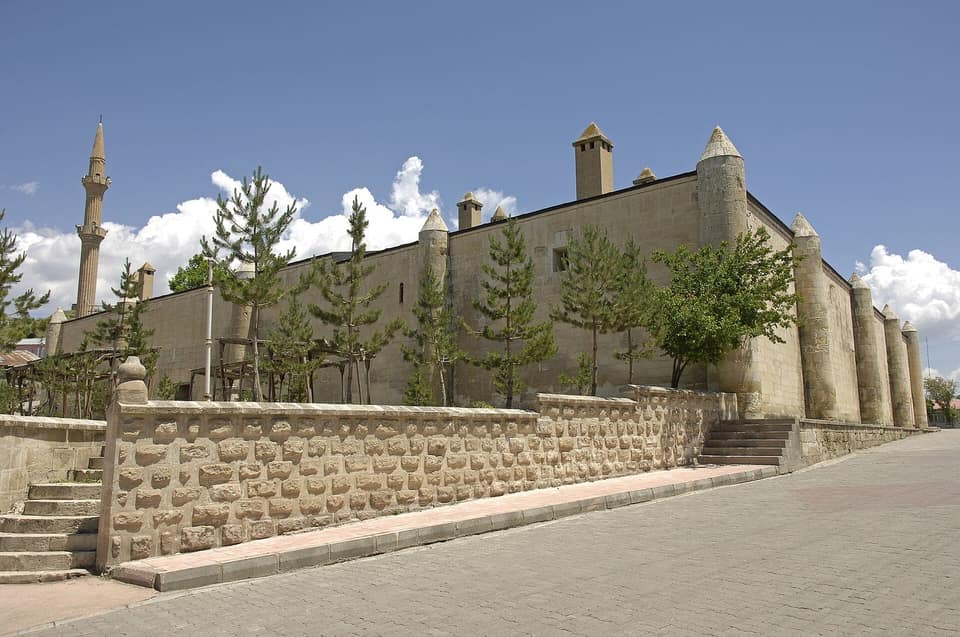
The TDV Encyclopaedia of Islam places the caravanserai in the group of concentric caravanserais and states that, at fifty-one by fifty-one metres, it is the largest building in this group. The same group also includes the Alara Han near Alanya. The square building is made entirely of cut stone, and the Provincial Directorate of Culture and Tourism writes that the stone is a yellowish, neatly dressed limestone. The outer walls are reinforced with cylindrical towers at the four corners and with semi-cylindrical or rectangular buttresses along the facades. This row of round towers with conical roofs makes the building look like a fortress from a distance and is the detail that stands out most in photographs.
The entrance is in a projecting portal in the middle of the east facade. According to the TDV Encyclopaedia of Islam, the portal has a small column at each corner and a niche on each side, and a door with a depressed arch leads inside. At the entrance, rectangular rooms covered with pointed barrel vaults and given over to service line both sides of a short corridor. In the middle there is a large open courtyard, and five rooms and an iwan are arranged along each of its northern and southern sides. To the west there are three iwans, the middle one larger than the others. Along the northern and southern parts are two long stable sections running the length of the building and covered with pointed barrel vaults.
This plan clearly shows the real purpose of the caravanserai. Pack animals were kept in the long stables, travellers stayed in the rooms and iwans around the courtyard, and the rooms at the entrance served as service spaces. Because the whole building apart from the courtyard is covered with pointed vaults, it forms a thick shell of stone that protected travellers in winter on this harsh plateau. The Provincial Directorate of Culture and Tourism also notes that the building partly lost its original form through repairs and was recently restored together with the landscaping around it. Trying to tell apart the stonework of different periods in the walls can therefore be an interesting part of the visit.
The other buildings of the complex stand right next to the caravanserai. The TDV Encyclopaedia of Islam writes that the small bath lies between the kümbet and the caravanserai. On the western side of the bath is a changing room with a hexagonal pool in the centre, followed by a domed warm room and a hot room covered with a vault and a dome. The complex's kümbet, with its fluted body and the circular enclosure wall surrounding it, has, according to official sources, a plan with no other example in Anatolia. The name of the kümbet's architect is known from its inscription as Ebü'n-Nema b. Mufaddal of Ahlat. The old masjid of the complex, by contrast, has changed completely and a new mosque has been built in its place.
The best way to begin a visit is to walk around the caravanserai from the outside and see the rhythm of the corner towers and buttresses. Then you should turn to the east facade and look closely at the small columns and niches of the portal. If the interior can be entered, standing in the courtyard and studying the long vaults of the stables and the pointed arches of the iwans makes the plan easier to understand. In the afternoon the light from the west warms the yellowish stone and gives the best colours for photographs of the facade. It is advisable to check the current visiting conditions and opening times with the Erzincan Provincial Directorate of Culture and Tourism.
The caravanserai is in the centre of Tercan, and the Provincial Directorate of Culture and Tourism writes that the district lies eighty-eight kilometres from Erzincan. Because the building stands on the old Erzurum-Erzincan caravan route, it is still a natural stop on a journey between the two provinces today. The TDV Encyclopaedia of Islam notes that near the complex there is also the Kötür Bridge, attributed to Mama Hatun because it gave access to the caravanserai, but that its deck is completely ruined today. Together with Altıntepe on the Erzincan Plain, the caravanserai offers the chance to see in a single day the story of this old caravan route, stretching from the Urartians to the Middle Ages.
Comments
Loading...
Location - Mama Hatun Kervansarayı
Venue Info
AddressMamahatun Mahallesi, Kervansaray Caddesi No:114, 24800 Tercan / Erzincan
VenueTercan, Erzincan
TypeHistorical & Cultural Sites