

Historical & Cultural SitesArchaeological Sites
Magnesia Antik Kenti
35
No ratings yet
Sign in to like and rate
Magnesia Ancient City
About Venue
Magnesia is a large ancient city in the Germencik district, lying beside the highway between Ortaklar and Söke, near the junction for the village of Tekin. The words on the Maeander added to its name were used to distinguish it from another ancient city of the same name near Manisa. The city was founded at the foot of the ancient Mount Thorax, also known as Gümüş Dağı, on the banks of the Lethaios, a small tributary of the Maeander. Ancient writers describe the surrounding plain as very fertile and famous for its figs and cucumbers.
According to legend, the city was founded by the Magnetes who came from the Thessaly region of Greece. Kültür Portalı notes that the site of the first Magnesia is unknown and that the city was moved to its present location around 400 BC. The reasons given for the move are the diseases spread by the constantly shifting and flooding Maeander and the Persian threat. The sources attribute the relocation to the commander Thibron. The city we visit today is this second, refounded Magnesia.
Magnesia held a valuable position for trade and transport in the middle of the triangle formed by Priene, Ephesus and Tralleis. The city came first under the Persians, after 334 BC under Alexander the Great, and then under the Seleucids and the Kingdom of Pergamon. The Athenian commander Themistocles spent his last years in this city, which the Persian king had given him, and was buried here. The city passed to Rome together with the Kingdom of Pergamon in 133 BC and was rewarded with freedom by Sulla for resisting the Pontic king Mithridates in 87 BC. Its city walls are said to have run for about one and a half kilometres, but only part of them can be seen today.
Magnesia's real fame comes from the architect Hermogenes. Hermogenes is remembered as the first architect to apply the temple plan known as pseudodipteros and to define temple types by the spacing of their columns. His masterpiece is the Temple of Artemis Leukophryene in the city, built in the Ionic order. Kültür Portalı presents the building as the fourth largest temple of Hellenistic Anatolia. The ancient geographer Strabo also wrote that it fell behind the temple at Ephesus in size but surpassed it in proportion and craftsmanship.
Another great building of the city is the agora. According to Kültür Portalı, with an area of about 26 thousand square metres and 414 columns, the agora was among the largest marketplaces of its time. It was entered through a monumental gateway, a propylon, which has been fully uncovered in the excavations. The Roman-period column capitals of the agora carry reliefs telling the story of Scylla from Homer's Odyssey. These reliefs are among the finest examples of craftsmanship to look for while touring Magnesia.
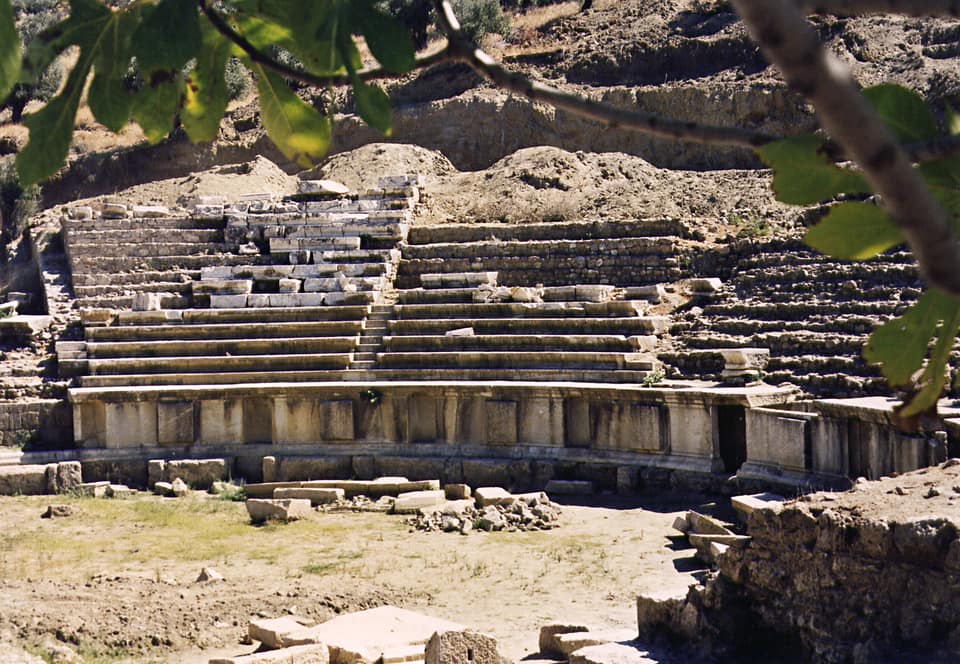
Other buildings can also be partly seen on the site. Among them are a theatre, an odeon, a stadium, a gymnasion, a Roman bath and a public latrine for 32 people. The stadium lies in the southwestern part of the city, and English Wikipedia gives its length as a little over 185 metres. The bath is described as similar to the Baths of Faustina at Miletus. A building known as the theatron, left unfinished during construction because of a landslide, also stands on the site.
The first excavations at Magnesia were carried out between 1891 and 1893 by a German team led by Carl Humann, the discoverer of the Pergamon Altar. These excavations uncovered parts of the theatre, the agora and the temples. After a gap of almost a hundred years, excavations resumed in 1984 through the cooperation of Orhan Bingöl of Ankara University and the Ministry of Culture. The finds are now displayed in museums in Istanbul, Aydın, Berlin and Paris. Four marble statues of women found in the excavations are in the Aydın Archaeology Museum, so visiting Magnesia together with the museum is a good idea.
Because the site is large and mostly flat, it is explored on foot; there is little shade in summer. Coming early in the morning or in the late afternoon protects you from the heat and also shows the reliefs on the marble surfaces better. Kültür Portalı notes that the site can be reached from central Efeler by municipal buses and by the Söke minibuses. Driving from Ortaklar towards Söke, the entrance to the site can be seen beside the road. Since visiting conditions and hours may change, check the Ministry's museum and site page before you go.
Comments
Loading...
Location - Magnesia Antik Kenti
Venue Info
AddressMagnesia, Tekin Mahallesi, 09330 Germencik / Aydın
VenueGermencik, Aydın
TypeHistorical & Cultural Sites