

Historical & Cultural SitesCastles & Palaces
Maden Hükümet Konağı ve Saat Kulesi
No ratings yet
Sign in to like and rate
Maden Government Building and Clock Tower
About Venue
The Maden Government House and the Clock Tower beside it are two stone buildings that form the historic administrative centre of the Maden district in south-eastern Elazığ. GoTürkiye presents Maden as a district famous for its copper deposits and counts the mansion and the clock tower among its main historic buildings. The District Governorship of Maden writes that the copper deposits of the district have been known since very ancient times, and that the region joined the Ottoman lands in 1515 under Yavuz Sultan Selim. According to the District Governorship, Maden was administered as a district attached to Diyarbakır until 1889. The district was a sub-province between 1889 and 1924 and a province between 1924 and 1927, and after 1927 it became a district of Elazığ. The District Governorship records that Reşit Mehmet Paşa, who was charged with reforms in the eastern provinces in 1834, was also governor and commander of the Maden Province. The government house is the most visible surviving witness of this administrative past.
The sources give different information about the date of the building. The District Governorship states that there is no official information on who had the mansion and the clock tower built, or how. The same source writes that the old government house is known to have been built in 1895 and the clock tower in 1898, and GoTürkiye gives the same dates. Other sources, however, link the mansion to the middle of the 18th century, to the period of the Maden Eminliği set up for copper mining, and describe it as one of the oldest civil administration buildings in Türkiye. This contradiction has not been resolved, so it is best to read the building as an administrative building shaped within the last two centuries of the Ottoman period. The District Governorship records that the mansion and the clock tower were placed under protection by being annotated as historic monuments in the land register.
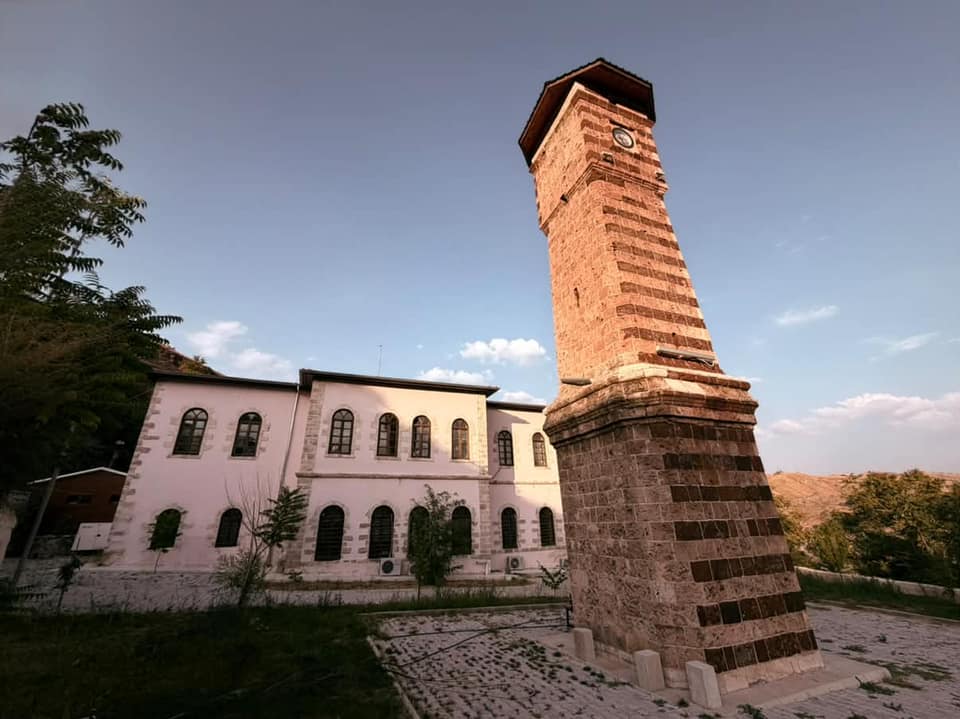
The mansion is a two-storey building of cut stone. Round-arched windows set in two rows on the façade, light-coloured stone frames and the stonework at the corners catch the eye at first sight. GoTürkiye writes that the clock tower was built with a technique known locally as alacalı, in which dark and light cut stones are used together. According to the same source, the mansion too reflects the architectural features of the region and its period through similar features. The clock tower stands in the garden of the mansion, next to the building, as a tower of square section, and the dark and light courses of its shaft make it recognisable even from afar. At the top of the tower there is a clock face and a small roof covering it.
Both buildings have been thoroughly repaired in recent years. The District Governorship writes that the Diyarbakır Directorate of Surveying and Monuments, part of the General Directorate of Cultural Heritage and Museums, put the restoration of the clock tower out to tender on 7 November 2017. According to the same source, the restoration of the tower was completed and the tower was handed back to the district. The District Governorship states that restoration work has also begun on the mansion, and that once completed the building will open as the district government house in keeping with its historic role. For this reason the building should be thought of not as a museum but as an administrative building used for public services.
Plan your visit around seeing the outside of the building and its garden. First look at the symmetrical façade of the mansion from across the garden, then walk to the foot of the clock tower and study up close how the courses of stone are laid. To get the tower and the mansion in the same frame, take a wide-angle photograph from a corner of the garden. Because official business is carried out in the building, ask the staff before going inside and respect working hours. For current visiting conditions you can consult the official website of the District Governorship of Maden. According to the District Governorship, the district centre was first founded at a place called Arpameydanı. Because the Arpameydanı quarter lay within the mining area it was expropriated, and its residents settled at Kortik on the Diyarbakır to Elazığ highway, founding the Bahçelievler quarter. Today the district is reached by car along this highway. On the way to Maden you can combine the visit with Lake Hazar on the same day.
Comments
Loading...
Location - Maden Hükümet Konağı ve Saat Kulesi
Venue Info
VenueMaden, Elazığ
TypeHistorical & Cultural Sites