

Natural BeautiesNature Hiking Areas
Kula Peribacaları
10
No ratings yet
Sign in to like and rate
Kula Fairy Chimneys
About Venue
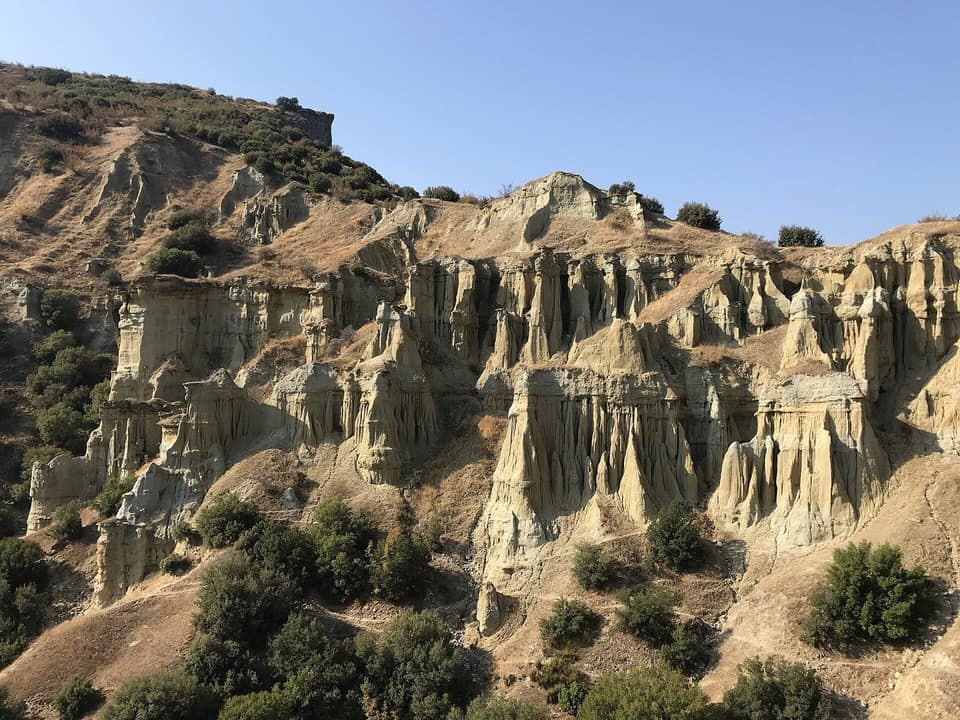
The Kula Fairy Chimneys are a natural formation of capped earth pillars rising in the upper valley of the Gediz River, east of Kula. Kula Municipality states that these chimney-like structures are in the Burgaz area on the upper course of the Gediz, 18 kilometres from the district centre. According to the municipality's directions, the area is reached by a path that turns left 100 metres after crossing the Gediz Bridge on the Kula-Ankara road. The formations lie within the boundaries of the Kula-Salihli UNESCO Global Geopark and are listed among the natural features highlighted in UNESCO's presentation of the geopark.
The municipality describes the pastel-coloured slopes of the valley as forming a magnificent landscape. Light green, cream and beige tones blend on the bodies of the pillars, while caps of dark hard rock sit on their tops. This difference in colour shows, even from a distance, that the structures are made of two different materials. The municipality states that these structures were shaped by the combined effect of temperature changes, rain, wind and erosion. The same source also relates that the surroundings of Kula have a volcanic structure and that there are about 80 volcanic cones of various sizes in the district.
The fairy chimneys of Kula formed from a different material than the Cappadocian examples whose name they share. According to the Go Türkiye page of the Türkiye Tourism Promotion and Development Agency, their bodies are made of poorly consolidated, sandy and clayey lake deposits. The caps are made of cemented permeable sandstone or basalt. UNESCO's geopark page also states that these pillars, shaped by erosion, carry caps of basalt or sandstone. In other words, here a hard rock protects the soft deposit beneath it from the rain like an umbrella.
Go Türkiye explains that the formation arose from the combined effect of raindrop erosion, surface erosion and tunnel or pipe-shaped wear developing inside the soft layer. The soft, pale green deposits are very sensitive to raindrops and surface runoff. Rain falling on the surface flows along cracks and opens deep, narrow gullies. Over time these gullies grow both sideways and downwards and divide the mass of sediment into separate pillars. What remains in the end are free-standing fairy chimneys with caps of hard rock and bodies of soft sediment. Because the same process continues today, every rainy season changes the shape of the slopes a little more.
The valley is important not only for geology but also for human history. The geopark management writes that a stone tool shaped by Homo erectus people about 1.24 to 1.17 million years ago was found in this valley, within the alluvium deposited by the Gediz. Made of quartzite, the tool is 6 centimetres long and 4 centimetres wide. According to the management, it was found by chance during the work that Turkish, British and Dutch earth scientists had carried out in the region for about twenty years. Before this find, the oldest human traces in western Anatolia went back about 510,000 years. The geopark management states that the find shows that early humans used Anatolia, and the Gediz Valley among its migration routes, as they moved from Africa into Eurasia. UNESCO also lists the Homo erectus Valley among the cultural features of the geopark.
The best light for the fairy chimneys is in the early morning and late afternoon; the low sun brings out the lines of the sediment layers and the shadows of the caps. Because the slopes are very soft and fragile, do not climb the pillars and do not go near the edges. Right after rain the clayey ground becomes slippery, so it is best to choose dry weather and wear shoes with firm soles. There is little shade in the valley, so take water and a hat in summer. Reaching the area by public transport is difficult; following the road from Kula towards Uşak by private car is the most practical way. Coming from Kula, visiting it on the same day as the Divlit Volcanic Park lets you see the volcanic and sedimentary faces of the geopark together.
Comments
Loading...
Location - Kula Peribacaları
Venue Info
AddressBurgaz mevkii, Gediz Vadisi, Kula / Manisa
VenueKula, Manisa
TypeNatural Beauties