

Historical & Cultural SitesHistorical Sites
Koyunbaba Köprüsü
10
No ratings yet
Sign in to like and rate
Koyunbaba Bridge
About Venue
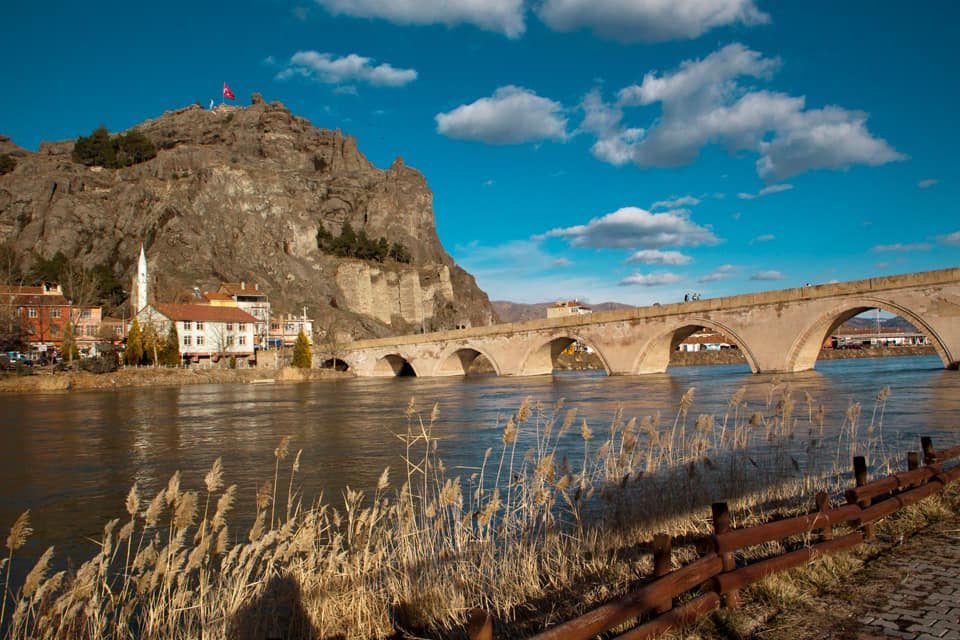
Koyunbaba Bridge is a stone bridge in the centre of the Osmancık district that joins the two banks of the Kızılırmak River and has been in use for more than five hundred years. In the sources it also appears as the Bayezid II Bridge. The bridge is known as Koyunbaba Bridge after the name of the place the road across it leads to.
Date of construction
The Culture Portal writes that construction of the bridge began in 1484 and was completed in 1489. According to the article in the TDV Encyclopedia of Islam, the inscription shows that work began in September 1484. The year 894 of the Hijri calendar, that is 1488-1489, is accepted as the completion date. The encyclopedia also notes that the long five-line Arabic inscription has been read in different ways by different researchers. The starting date is considered more certain, while there are doubts about the reading of the phrase that gives the completion date. The inscription states that the bridge was commissioned by Sultan Bayezid II, but it does not give the name of the architect.
The position of the inscription is also interesting. According to the encyclopedia, the inscription was not placed on the central inscription kiosk as on other bridges. Instead it was set into a pointed-arched niche cut at the foot of the steep rock on which the castle stands, outside the bridge itself. When you visit the bridge, you should look for the inscription not on top of the bridge but on the rock side.
Architecture
The bridge is built of finely worked cut stone, and the Culture Portal notes that the stones are yellow and rectangular in section. It is 250 metres long and 7.5 metres wide. Built with pointed arches, the bridge in fact has nineteen arches. However, as deposits brought by the river have filled some of them, fifteen arches can be seen today. According to the encyclopedia, the widest arch span is 16.35 metres and the narrowest is 9.20 metres. On both sides there are stone parapets sixty centimetres high. Both ends of the bridge are anchored to rock ground. A hidden passage was taken down near the pier on the northern side so that water could be drawn from the castle to the north. Studies have shown that tarred piles were driven under the foundations to prevent subsidence. Retaining walls about 250 metres long were also built on both sides to stop the river from shifting its bed.
Through the eyes of travellers
Over the centuries, the bridge caught the attention of the travellers who passed along this road. Evliya Çelebi, who crossed it around 1640-1641, mentions it as having nineteen arches and praises it, saying it has no equal in the land of Anatolia. The French traveller Tavernier gives the number of arches more accurately as fifteen. In 1810, a miniature in the travel account of Osman Şakir Efendi, secretary of the Ottoman embassy travelling to Iran, also shows this bridge in front of the town of Osmancık.
Repairs
According to the encyclopedia, the bridge was repaired in 1938, and at that time the weirs and mills that were damaging the structure were removed. In the repair carried out by the Highways Directorate in 1967, the deck of the bridge was widened, and the inscription and its arch were cleaned.
How to visit
As the bridge is in the centre of Osmancık, you can reach it on foot once you arrive in the district. To see the full length of the bridge, you need to look from the river bank, from some distance. From this angle, Osmancık Castle rising on the rock behind also enters the frame, and the bridge and the castle meet in the same photograph. According to the provincial directorate's travel guide, the castle on the bank of the Kızılırmak dates to the Seljuk period, while the rock tombs to its south show that the first settlement began in the Roman period. Another structure to see in Osmancık is the surviving one of the four fountains built by Baltacı Mehmet Pasha in 1705.
Comments
Loading...
Location - Koyunbaba Köprüsü
Venue Info
AddressOsmancık ilçe merkezi, Kızılırmak üzeri, Osmancık / Çorum
VenueOsmancık, Çorum
TypeHistorical & Cultural Sites