

Historical & Cultural SitesArchaeological Sites
Kibyra Antik Kenti
No ratings yet
Sign in to like and rate
Kibyra Ancient City
About Venue
Kibyra Ancient City lies in the Gölhisar district of Burdur, within the boundaries of Horzum Mahallesi. According to the Culture Portal entry, the city was built on three commanding hills separated by deep ravines. The settlement area is quite large. The buildings were laid out symmetrically, the hills were terraced, and the structures face the lake and plain views. The source states that no building was placed so as to block the view of another. For that reason the landscape can be read as part of the city's plan as you walk. All the architectural remains visible today belong to the Roman Imperial Period.
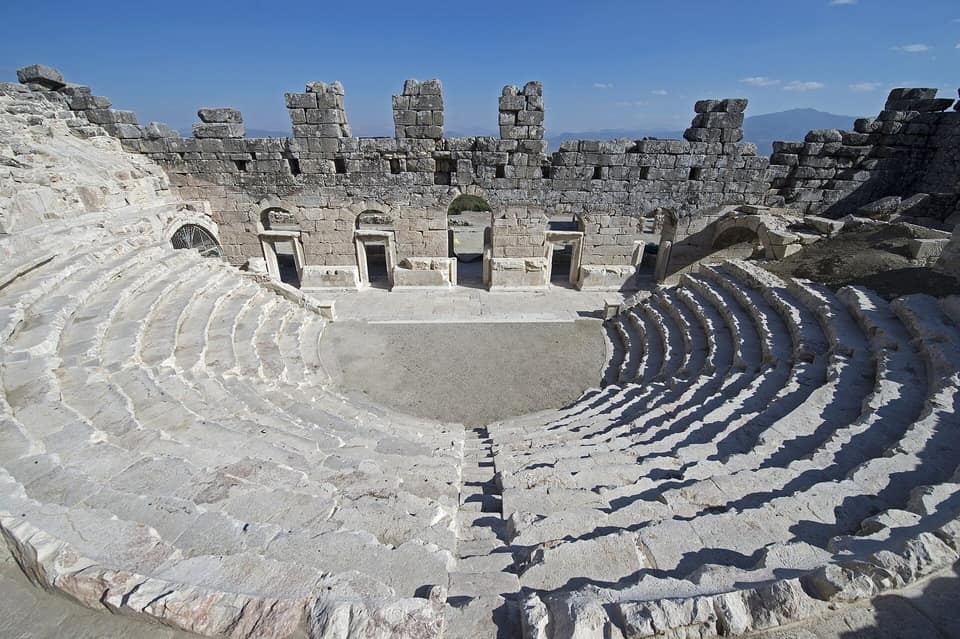
On entering the city you find a monumental gate and the stadium on the left. The Culture Portal gives the stadium's capacity as 12-13 thousand people; this figure is the one in the source and may be updated as excavations continue. Further on you see the basilica, the upper and lower agora, the bath, the gymnasion, the theatre and the council building. The same account also lists a planned monumental tomb, an arch with a round tower and water channels. The best-known building of the city is the council building, which the source calls both a council house and a music hall. The building is presented with a capacity of 3,600 people. At the very center of the orchestra lies a Medusa mosaic made of red, green and white marble. With its hair of snakes, this mosaic is one of the most closely watched details of the visit.
In 2011 a wide mosaic area of 540 square meters was uncovered in front of the council building. In the same area a Roman bath and a ceramic workshop dating to the Late Roman Period, meaning the 6th and 7th centuries AD, were found. In the 2016 excavations a round fountain structure was uncovered at the center of the third terrace of the Agora. The findings show that this fountain was built after the earthquake of 23 AD. Through later additions, the fountain served both the appearance of the city and its water needs for a long time.
Historically, Kibyra appears under the sovereignty of the Kingdom of Pergamon in the time of Eumenes II, between 197 and 159 BC. Soon afterwards a four-city joint council was formed with Boubon, Balboura and Oinoanda. The source dates this union to the 2nd and 1st centuries BC. The union was dissolved in 82 BC by the Roman general Murena. After the great earthquake of 23 AD, the city was rebuilt by the Roman Emperor Tiberius. Kibyra lived its most brilliant period between the 1st and 3rd centuries AD. The city is known for blacksmithing, leatherworking, pottery and horse breeding.
The finds from Kibyra are displayed in the Burdur Museum, so it makes sense to plan the visit together with the museum. The Kibyra hall of the museum helps you read the structures on site more easily. The site appears in the 2026 list of museums and archaeological sites of the Burdur Provincial Directorate of Culture and Tourism. Because opening hours and entrance fees can change, check this information on the current pages of the directorate and of muze.gov.tr.
The city stands on a terraced slope, so comfortable shoes and water are necessary. Shade may be limited in the open, so a hat is also useful in summer. Early morning or late afternoon hours suit seeing the buildings on the slope in soft light. The address record reads Horzum, Gölhisar/Burdur; you go by car, and typing the name of the site into your navigation is enough. On a day route from Burdur via Lake Salda, Kibyra can be planned as the final stop.
Comments
Loading...
Location - Kibyra Antik Kenti
Venue Info
AddressHorzum, 15400 Gölhisar/Burdur
VenueGölhisar, Burdur
TypeHistorical & Cultural Sites