

Historical & Cultural SitesHistorical Sites
Karatay Hanı
11
No ratings yet
Sign in to like and rate
Karatay Inn
About Venue
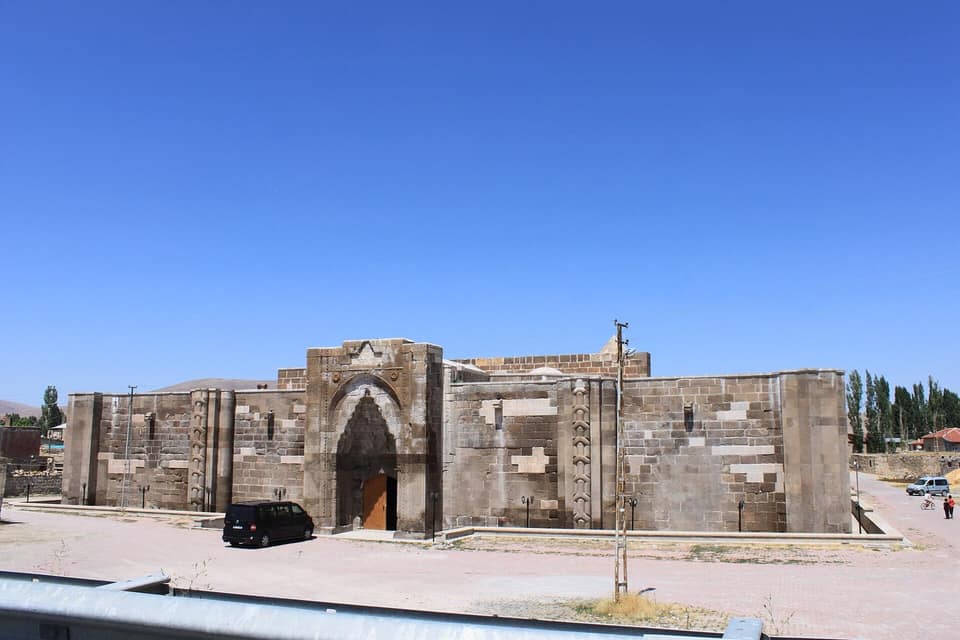
The Karatay Hanı is an Anatolian Seljuk caravanserai standing inside the village of Karadayı in the Bünyan district, on the route that ran from Kayseri towards the old Malatya road. The inn was commissioned by the Seljuk vizier Celaleddin Karatay. According to the TDV Encyclopaedia of Islam, the inscriptions show that the covered section was completed in the reign of Alaeddin Keykubad I and the courtyard section in the reign of Gıyaseddin Keyhüsrev II, in 1240-41. The Kayseri Provincial Directorate of Culture and Tourism explains that the inn served the Silk Road route running through Kayseri, Maraş, Malatya and Gaziantep.
The building follows the sultan han plan, which had taken its classical form in the first quarter of the 13th century. At the front there is a large courtyard surrounded by various rooms, and at the back a smaller covered section. The walls and roofing are faced with smooth cut stone. Eighteen towers, six of them at the corners, support the outer walls; their sections are triangular, square, octagonal, round or star-shaped. Stone waterspouts are placed between the towers.
The best-known face of the inn is the tall courtyard portal that projects from the facade. The TDV Encyclopaedia of Islam writes that besides its geometric and floral borders this gate stands out for its human and animal figures. At one end of the border framing the hood there are facing lions, and at the other end bull and human heads. Bird and lion reliefs are carved on the corner colonnettes, and siren reliefs on the panels inside the niche. In the upper frame of the gate sits an inscription of four lines in white marble. One of the waterspouts on the entrance facade takes the form of a winged lion.
Passing through the portal you enter a wide entrance iwan. On the arch of the fountain iwan to one side, fifteen small animal figures are lined up in muqarnas niches. The Culture Portal notes that among these figures it counts a dragon, a dog, a hare, a bull, a tiger, a lion, an elephant, a deer, a wolf and a bird. The arch of the iwan facing the courtyard is framed by a knotted interlace motif ending in dragon heads. To see these details you need to pause in the iwan for a while and let your eyes adjust to the level of the arch.
The domed room on the other side of the entrance iwan is the inn's prayer room. A corridor east of the prayer room leads to the bathhouse; the Culture Portal explains that it consists of a changing room, a cool room, two private hot rooms, a water tank and a furnace. The TDV Encyclopaedia of Islam notes that hot water was distributed to the rooms through clay pipes inside the walls. One side of the courtyard is lined by an arcaded gallery and the other by vaulted rooms. A stone staircase in the southwest corner of the courtyard leads up to the roof.
The covered section at the back is a hall of seven bays with a higher central aisle, and in its middle rises a dome covered outside with a pyramidal roof. Feeding troughs carved from stone on the benches and ring holes cut into the arch piers for tying animals can still be seen. The Culture Portal relates that the inn's endowment deed of 1245-48 lists officials such as an innkeeper, a farrier, a cook and a shoemaker. According to the same deed, it was stipulated that travellers should be given bread and food and that straw and barley should be set aside for their animals. The TDV Encyclopaedia of Islam writes that a trading centre grew up around the inn because of its closeness to the international trade fair called the Yabanlu Bazaar, and that the building was turned into a dervish lodge in the 16th century.
The inn's original roof of compacted earth was removed after repairs carried out between 1958 and 1962 and was renewed with cut stone. The best time to visit is spring or autumn; in summer the courtyard is exposed to the sun, and in winter the covered section is very cold. Since most of the reliefs sit high up, a camera with a zoom lens or a pair of binoculars makes the visit easier. The Culture Portal notes that the inn can be reached by minibuses and buses from the eastern bus terminal of Kayseri heading towards Sarıoğlan, Gemerek and Tuzhisar. For those who want to combine it with Sultan Han a private car is more practical; check visiting conditions before you go with the provincial directorate of culture and tourism.
Comments
Loading...
Location - Karatay Hanı
Venue Info
AddressKaratay Mahallesi, Bünyan / Kayseri
VenueBünyan, Kayseri
TypeHistorical & Cultural Sites