

Historical & Cultural SitesArchaeological Sites
Kalekapı Kaya Mezarı
28
No ratings yet
Sign in to like and rate
Kalekapi Rock Tomb
About Venue
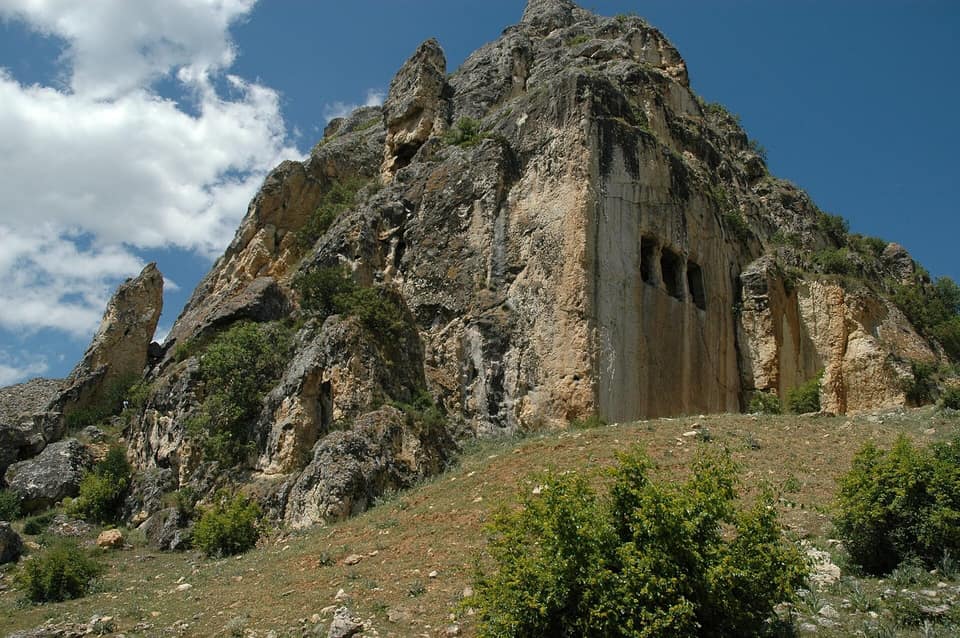
Kalekapı Rock Tomb is a monumental tomb carved into the face of a large, solitary rock mass in the village of Donalar, in the Taşköprü district. Academic sources place it in Donalar (Süleyman) village, at the point where the Gökırmak stream reaches the plain. The tomb was first identified by Prof. R. Leonhard and was later examined and published by Ahmet Gökoğlu, director of the Kastamonu Museum. The Kastamonu Provincial Directorate of Culture and Tourism writes that the monument is thought to have been made by the Paphlagonians in the 7th century BC. A tourism study on Taşköprü published in 2025 gives the same construction date and reports the view that the reliefs on the facade were added in the 4th century BC. Latife Summerer and Alexander von Kienlin, who mapped the rock tombs of the region starting from their excavation at Pompeiopolis, published the Donalar, Salarköy and Terelik tombs in detail for the first time and placed the owners of these tombs at the end of the 5th century BC. The dating is therefore debated, but all sources link the tomb to pre-Roman Paphlagonia.
The tomb is cut about 8 metres above the ground, and its facade is crowned by a pediment formed where three horizontal and sloping beams meet. At the entrance stand two columns with rounded mouldings set on square bases. Unlike the rectangular capitals seen on other rock tombs in the region, the column capitals take the form of bull figures resting on square slabs; similar capitals are found on the Direklikaya Tomb in Boyabat. The pediment shows an eagle, with two lions below it and griffins facing each other; a relief of a humped ox also stands out on the facade. The summary of Summerer and von Kienlin's study notes that the tomb facades in this valley bear lions, bulls and hybrid creatures, and that the tomb owners drew on both Greek and Achaemenid (Persian) art.
Inside there are two chambers. The first chamber measures 4.60 by 2.30 metres and is 1.80 metres high; it contains a funerary bench, known as a kline. From here a narrow door measuring 1.20 by 0.45 metres leads into the second chamber, which measures 3.80 by 2.70 metres. The provincial directorate also mentions tunnels carved into the same rock mass: the entrance of the tunnel at the very top of the rock is horseshoe shaped, and this passage, about 2.2 metres wide, descends into the rock at a slope of 50 degrees.
The tomb stands in open country, and since the reliefs sit high up, binoculars are useful for anyone who wants to make out the details; the facade is best seen from the slope in front of the rock, standing back a little. The tourism study on Taşköprü notes that the road to the Donalar Rock Tomb needs improvement, so it is wise to ask locally about road conditions before setting out. This is not the only rock tomb in Taşköprü: the provincial directorate writes that the Urgancı, Aygır Kalesi, Direkli and Bademci rock tombs have been identified in the district, along with some 70 tumuli at 13 different locations. A visit can be planned together with Pompeiopolis, the capital of the province of Paphlagonia in the Roman period, which lies on Zımbıllı Tepesi just north of the district centre, and with the Kastamonu Archaeological Museum, where finds from excavations in the region are displayed.
Comments
Loading...
Location - Kalekapı Kaya Mezarı
Venue Info
AddressDonalar Köyü, Taşköprü, Kastamonu
VenueTaşköprü, Kastamonu
TypeHistorical & Cultural Sites