

Religious & Spiritual PlacesMosques
İznik Yeşil Cami
No ratings yet
Sign in to like and rate
Iznik Green Mosque
About Venue
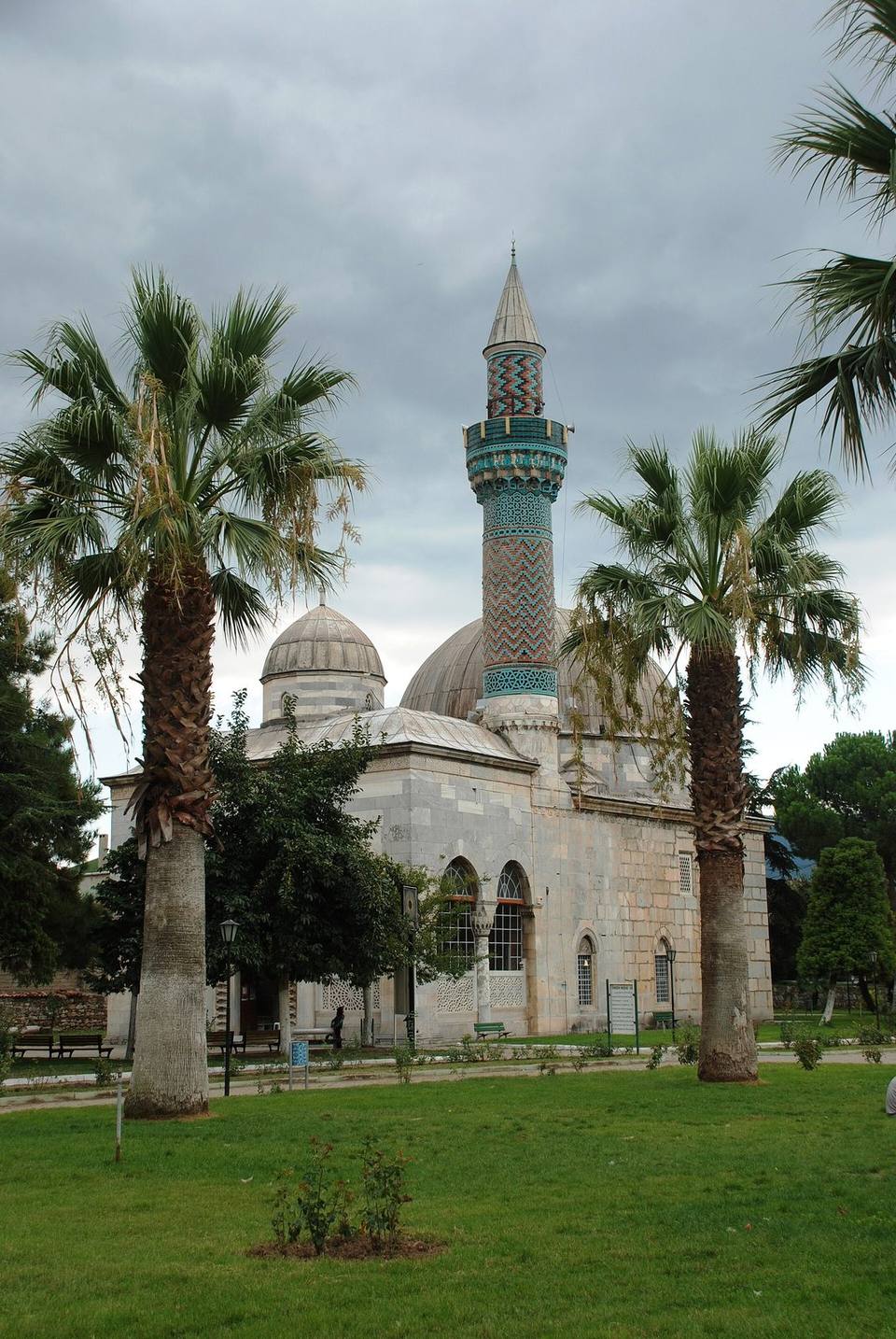
İznik Yeşil Cami, in the district centre, is an early Ottoman mosque built in the last quarter of the 14th century and named after its tiled minaret. According to the inscription over the inner door, construction began under Murad I in 1378-79 by order of Çandarlı Halil Hayreddin Pasha. The three-line inscription on the outer door records that the building was completed around 1391-92; after Hayreddin Pasha's death his son Ali Pasha had it finished. The same inscription names the architect as Hacı b. Musa. Because the two inscriptions record both the start and the end of the work, they document the date of the mosque in concrete terms.
The mosque consists of a square main space on a north-south axis and a three-part porch on an east-west axis. The main space measures roughly 11 by 11 metres and is covered by a dome about eleven metres across, resting on an octagonal drum outside and a band of triangles inside. The deep porch has three pointed-arch openings on its front and two on each side, and the column capitals are carved with muqarnas. The entrance has the look of a crown portal, and the building's inscription sits above the door lintel. The facades are clad in lightly yellowish, smoothly cut marble blocks. The central unit of the porch is covered by a sixteen-segment dome on a tall octagonal drum with muqarnas transitions.
Inside, a floral medallion in painted decoration appears at the centre of the dome, and the walls are covered up to a height of 3.34 metres with grey-veined marble slabs. To the north the space is widened by three units, and the middle unit is covered by an eight-segment dome. The minaret that gives the mosque its name rises from a marble-clad twelve-sided base. On the shaft, zigzag, hexagon and nonagon patterns are formed from manganese-purple and turquoise glazed bricks and tiles. Turquoise and cobalt-blue tiles are used on the railing of the muqarnas balcony, and the minaret is reached from inside the building through a window. The complex once had an educational building and a soup kitchen that have not survived; southeast of the mosque are the ruined remains of a double bath thought to have been added in the 15th century.
The mosque fell into ruin through neglect from the late 19th century and was damaged during the Greek occupation. The building underwent a thorough repair between 1956 and 1960, and the minaret between 1961 and 1965. When visiting, avoid disturbing those at prayer, choose clothing that covers shoulders and knees, take off your shoes at the entrance and take photographs quietly. The tiled bands of the minaret are best seen up close and in daylight. To see İznik's tile tradition more broadly, you can add the İznik Museum and the İznik city walls in the same district to your route. Because visiting hours can change, check current information on the pages of the İznik Municipality and the relevant institutions.
Comments
Loading...
Location - İznik Yeşil Cami
Venue Info
Venueİznik, Bursa
TypeReligious & Spiritual Places