

Historical & Cultural SitesArchaeological Sites
İkiztepe Höyüğü
10
No ratings yet
Sign in to like and rate
Ikiztepe Mound
About Venue
İkiztepe Mound rises at the edge of the Kızılırmak Delta, within the boundaries of İkiztepe village, about 7 kilometres from the Bafra district centre. Its name, meaning "twin hills", comes from the way it looks like two hills from a distance, but the settlement actually consists of four natural rises. The Provincial Directorate of Culture and Tourism describes the site as an area of 66 decares, about 375 by 175 metres, made up of two large and two small hills. The excavation team names these hills with Roman numerals as İkiztepe I, II, III and IV. The mound is counted among the most important excavation sites shedding light on the prehistory of the Black Sea coast.
The mound's entry into the scholarly world goes back to the 1940s. According to the report of the Istanbul University team, the Turkish Historical Society team of Kılıç Kökten, Nimet Özgüç and Tahsin Özgüç made İkiztepe known through surveys around Bafra and Alaçam after the excavations of 1940 and 1941. Between 1971 and 1977 a team led by U. Bahadır Alkım carried out a broad survey in Samsun province and in 1974 began systematic excavations at İkiztepe. After Alkım's death in 1981, Önder Bilgi took over the direction of the excavation. The Provincial Directorate of Culture and Tourism states that the excavations which began in 1974 ended in 2012 and restarted in 2021 under the direction of Aslıhan Beyazıt of Istanbul University.
The excavations have revealed a long sequence of settlement. Alkım's 1977 report describes Chalcolithic layers in the trench at İkiztepe II, dug down to virgin soil, and above them the phases of the Early Bronze Age. At İkiztepe I, in the layers representing the transition to the Hittite period, vessels resembling the pottery of Boğazköy and Kültepe in Central Anatolia were found. One of the most striking details in the report is the building technique. Horizontal timber beams were laid on flat stones, framed with vertical beams and supported with wooden posts driven into the ground. During the excavation, traces of this technique were seen in place as charred beams and foundation stones. The report also records that many of the buildings went through violent fires.
The best known feature of İkiztepe is its cemetery. The Provincial Directorate of Culture and Tourism writes that the mass cemetery with 690 skeletons found in the excavation area is one of the largest of its kind in Anatolia. According to the report of the Istanbul University team, a large number of arsenical copper objects came from this Early Bronze Age cemetery. To find the copper and arsenic deposits used in making these objects, Önder Bilgi carried out separate surveys around Bafra, Havza and Vezirköprü between 1987 and 1999. The Directorate stresses that the people of the area knew metalworking and weaving far better than their contemporaries, and that this sets İkiztepe apart from other excavation sites. The many terracotta loom weights and spindle whorls listed in Alkım's report are also traces of this weaving tradition.
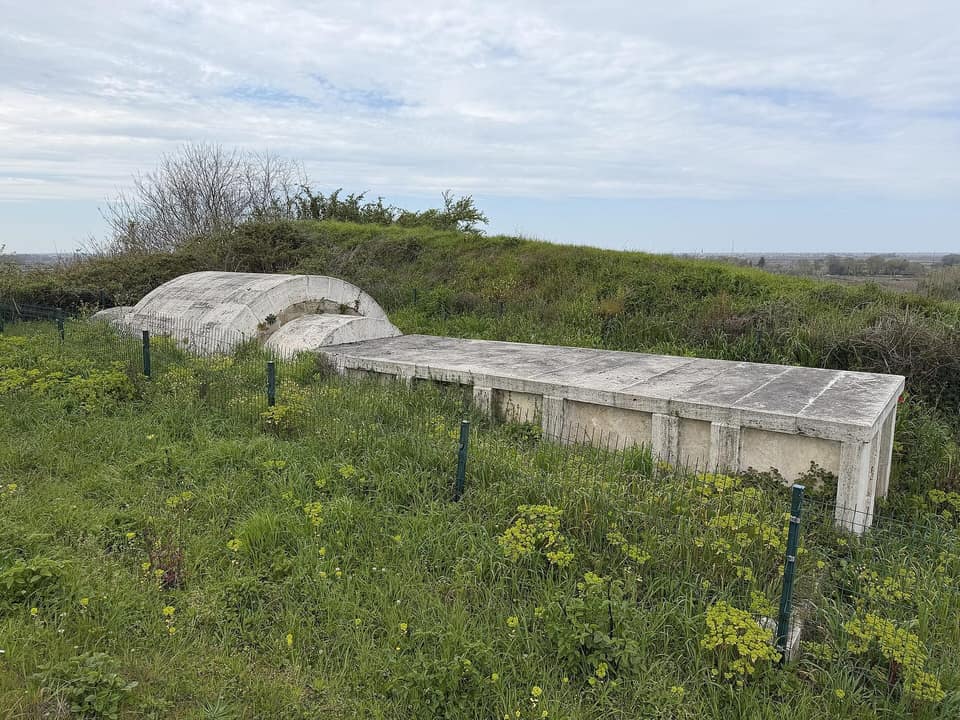
Today some of the excavated areas on the mound are covered by protective roofs. According to the Provincial Directorate of Culture and Tourism, 10,728 pieces of metal, terracotta, bone and stone recovered in the excavations are displayed in the Samsun Museum and the Bafra Museum. As you walk round the mound, notice the position of the hills in relation to the delta plain; during the period of settlement it lay very close to the point where the Kızılırmak flowed into the sea. From the top of Hill I you get a wide view over the delta plain and the valley of the Kızılırmak. Because the site is an active excavation, do not enter the trenches or the protective covers. During the excavation season it is possible to watch the teams at work from a distance, but you should check the visiting conditions in advance with the Provincial Directorate of Culture and Tourism.
The mound is reached by road from the centre of Bafra; since public transport is limited, coming by your own vehicle is easier. The ground is meadow and earth and can be muddy after rain. There is little shade, so do not forget a hat and water in summer. Combining İkiztepe on the same day with the Bafra Museum and the Kızılırmak Delta is the best way to see the finds and the natural setting of the settlement together.
Comments
Loading...
Location - İkiztepe Höyüğü
Venue Info
Addressİkiztepe Köyü, Bafra / Samsun
VenueBafra, Samsun
TypeHistorical & Cultural Sites