

Religious & Spiritual PlacesReligious Complexes
Hüsrev Paşa Külliyesi
No ratings yet
Sign in to like and rate
Hüsrev Pasha Complex
About Venue
The Hüsrev Pasha Complex stands in the middle of Old Van, the largely ruined former city that stretches south of the Van Fortress rock. The Van Provincial Directorate of Culture and Tourism states that the complex was commissioned in 1567-1568 by Köse Hüsrev Mehmet Pasha, governor-general of Van and one of the viziers of Sultan Süleyman the Magnificent. According to the TDV Encyclopedia of Islam, the mosque's Persian and Arabic inscription, signed by a certain Yusuf, gives the Hijri year 975, which is the same date. The city history published by the Governorship of Van also records that Hüsrev Pasha, appointed governor-general of Van, built a mosque bearing his own name.
The mosque and the madrasa appear in the Tuhfetü'l-mimarin, one of the lists naming the works of the architect Sinan. The TDV Encyclopedia of Islam notes that construction may have been carried out by a master builder whom Sinan sent to Van. The complex follows the classical Ottoman layout; the mosque stands in the centre, the madrasa to its north, the soup kitchen and the primary school behind it, and the inn to the east. The provincial directorate adds a double bath, a fountain, a guesthouse, a bakery and shops to these buildings, although the sources disagree on whether the bath belonged to the complex.
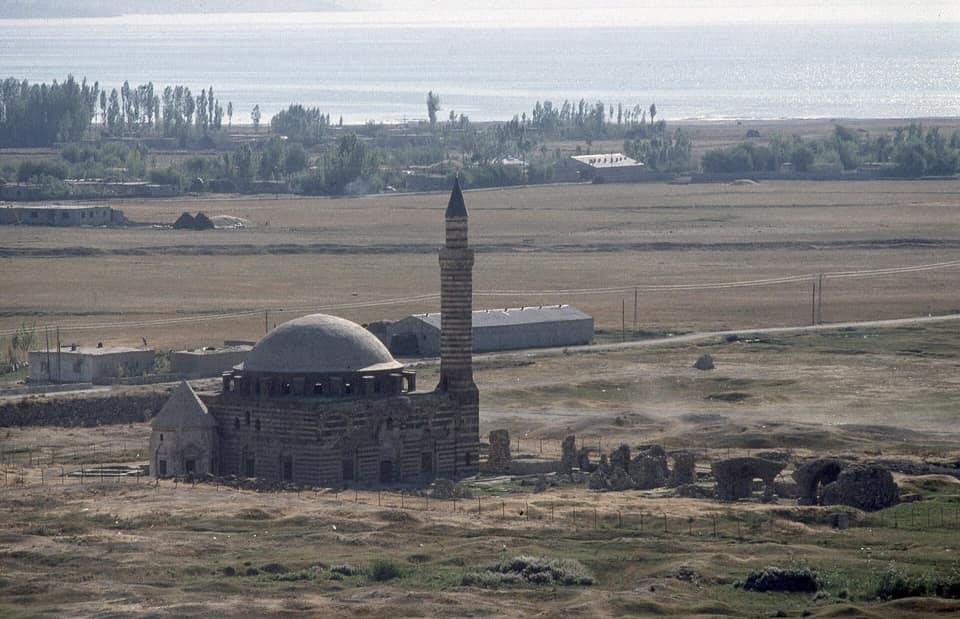
The mosque has a square plan and is covered by a large dome whose drum is supported by buttresses. Cut stone was used for the walls, squinches for the transition to the dome and brick for the dome itself. The minaret and the outer facades stand out at once, with bands of regular cut stone in the two colours, dark and light, that are common in the region. The minaret, rising at the northwest corner, has a square base and a cylindrical shaft. The TDV Encyclopedia of Islam points to the small windows opened in groups of three in the upper part of the facades as an innovation rarely seen in classical mosques.
Inside, the walls are clad with tiles up to a certain height, and Baroque-style painted decoration can be seen on the entrance arch, the squinches, the mihrab and the arches. The mihrab, made of limestone, has a five-sided niche with muqarnas, crowned by a trefoil arch. When Evliya Çelebi saw the mosque in 1655, he spoke admiringly of its gilded finials, its chandeliers and its windows of coloured glass.
Old Van was abandoned after it was largely burned and destroyed during the First World War, and the new city was founded about 5 kilometres away, on land that had once been gardens. The neglected mosque began to be repaired in 1975, and in the following years excavations and extensive restorations brought the mosque, the madrasa, the soup kitchen, the ablution fountain and the courtyard back to life. During the repairs, some tile fragments recovered from the infill of the windows were placed under protection in the Van Museum. Today the restored parts of the complex are used for religious, social and cultural purposes.
Since the Kaya Çelebi Mosque lies just to the east and the rock of the Van Fortress to the north, a visit can easily be combined with a walk through Old Van and the fortress. Seen from the upper parts of the fortress, it is one of the first buildings to stand out in the ruined fabric, with its two-coloured minaret and large dome. As the mosque is open for worship, visitors should enter outside prayer times and in suitable clothing.
Comments
Loading...
Location - Hüsrev Paşa Külliyesi
Venue Info