

Religious & Spiritual PlacesReligious Complexes
Hunat Hatun Külliyesi
5
No ratings yet
Sign in to like and rate
Hunat Hatun Complex
About Venue
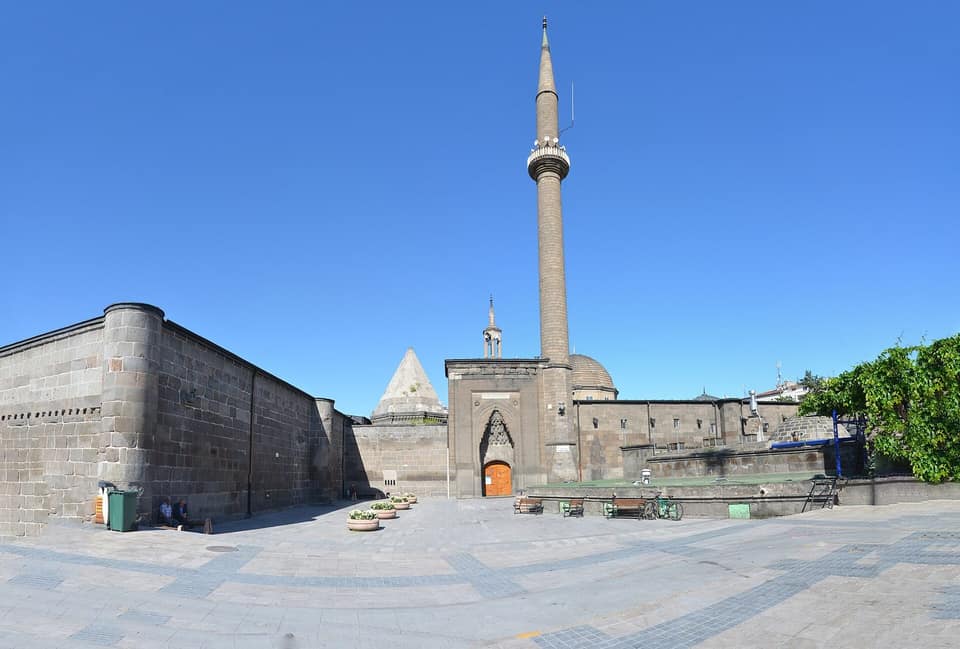
The Hunat Hatun Complex is a group of Seljuk buildings in the centre of Kayseri, east of the Inner Citadel and outside the old line of the city walls. It was commissioned by Mahperi Hunat Hatun, wife of the Seljuk Sultan Alaeddin Keykubad I and mother of Gıyaseddin Keyhüsrev II. According to the TDV Encyclopedia of Islam, the inscriptions over the mosque doors show that construction was completed in June 1238. The Kayseri Provincial Directorate of Culture and Tourism presents the complex as a whole made up of a mosque, a madrasa, a bath and a tomb, and counts it among the finest examples of Seljuk stonework.
The mosque, the main building of the complex, measures about 56 by 46.5 metres; the prismatic buttress towers at its corners and along its walls give it the look of a fortress from outside. Inside, the wide central aisle, the dome in front of the mihrab and the vaulted side aisles rest on fifty-four piers. The dome covering the central opening and the slender Ottoman-style minaret were added in 1899, in the reign of Abdulhamid II, according to its inscription. The west and east portals of the mosque are monumental entrances decorated with geometric borders and muqarnas hoods. Starting the visit in front of the west portal lets you study this stone carving up close. The marble-colonnetted mihrab and the wooden pulpit made in the kündekari technique are the main details to look at inside. The buildings are carefully built of cut limestone, and masons' marks can be seen on the stones.
The madrasa consists of porticoes surrounding the courtyard on three sides, a summer classroom iwan and cells; according to the provincial records there are sixteen cells, eight on each side of the courtyard. The madrasa portal and its lion-head waterspouts are other notable details. For many years in the Republican period this building served as a museum, and according to the provincial records the Archaeology Museum was founded here in 1930 and the Ethnography Museum in 1983. The double bath of the complex shows the features of Seljuk architecture, and the TDV Encyclopedia of Islam relates that figural tiles were uncovered in the women's section during restoration.
On the Ministry of Culture and Tourism's long city tour of Kayseri, the complex is one of the stops reached after the Seraceddin Madrasa, and it lies within walking distance of Cumhuriyet Square. As the mosque is an active place of worship, it is best visited quietly and outside prayer times. For the current use of the madrasa and visiting conditions, check the latest information with the provincial directorate of culture and tourism.
Comments
Loading...
Location - Hunat Hatun Külliyesi
Venue Info
AddressHunat Mahallesi, Melikgazi
VenueMelikgazi, Kayseri
TypeReligious & Spiritual Places