

Historical & Cultural SitesHistorical Sites
Hıdırlık Köprüsü
7
No ratings yet
Sign in to like and rate
Hıdırlık Bridge
About Venue
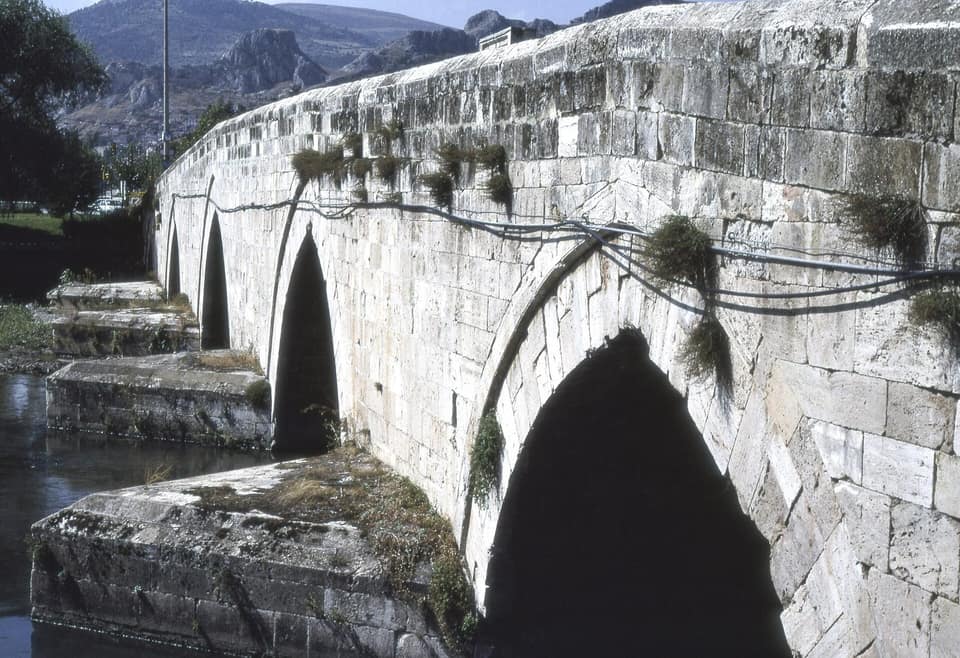
Hıdırlık Bridge is a Seljuk bridge crossing the Yeşilırmak north of Tokat city centre, also recorded in the cultural inventory under the name Yeşilırmak Bridge. The bridge stands on the old post road linking the Black Sea to Central Anatolia by way of Tokat. The inventory record on the Culture Portal gives its address as the Old Turhal Road. The Provincial Directorate of Culture and Tourism describes it as a typical Seljuk bridge and notes that it is very well preserved and still in use today.
The bridge's own inscription tells its history. According to the inventory record, there is a five-line inscription in the inscription kiosk on the west side. According to this inscription, the bridge was built in the year 648 of the Hijra, 1250 AD, during the joint reign of the brothers İzzeddin Keykavus II, Rükneddin Kılıçarslan and Alaeddin Keykubat. The builder was the statesman named in the inventory as Hamid bin Ebu'l Kasım bin Ali el-Tusi; the TDV Encyclopedia of Islam gives his name as Pervane Seyfeddin Hamid b. Ebü'l-Kasım-ı Tusi. The encyclopedia also records that the architect of the bridge was Bahaeddin Mehmed b. Ferec. The provincial directorate stresses that the inscription is written in Seljuk thuluth script. Below this inscription there is a second, two-line inscription, and according to the provincial directorate this second text states that the bridge was built in the time of Gıyaseddin Mesud, son of Keykavus.
The bridge runs north to south and is 151 metres long. Its width is given as 7 metres by the provincial directorate and as 7.40 metres by TDV. The sources use different wording on the number of arches: the inventory record describes the bridge as having four pointed arches resting on five piers, while the provincial directorate and TDV call it five-arched. On site you can see this difference for yourself by counting the arches. Along both edges of the bridge there are parapets about 50 centimetres high. According to the inventory, the piers have triangular cutwaters on the east side and semicircular buttresses on the west side. The whole structure is built of smooth cut stone.
The importance of the bridge comes from Tokat's position at a crossroads. According to TDV, in the Seljuk period Tokat lay at the meeting point of two international trade roads crossing Anatolia east to west and north to south, and in this period about eleven inns and caravanserais were built in and around the city. For the caravan road coming from Amasya and continuing to Sivas to cross the Yeşilırmak, two bridges were built, one at Pazar and one at Tokat. Hıdırlık Bridge is the Tokat link of this pair. The encyclopedia also notes that locally the river is called the Tozanlı stream along this stretch.
For a long time the bridge stayed outside the city. TDV writes that Tokat, a small Anatolian town until 1950, stretched north towards the bridge but had not yet crossed to the north of the Yeşilırmak. The Behzat stream, which flows through the old city, also joins the Yeşilırmak in this section. Today the bridge lies inside the city that has grown northward, and it has been carrying the same crossing for more than seven hundred years.
Start your visit at the southern end of the bridge and first walk across it to the opposite bank. As you walk, notice the stonework of the parapets on both sides and the width of the deck. Then go down to the bank and look at the bridge from the side; the pointed shape of the arches and the cutwaters in front of the piers are best seen from here. Finding the inscription kiosk on the west side and looking closely at the lines of thuluth script turns the bridge from a road structure into a dated document. In the background the city's mountains and the castle rock appear; since Tokat Castle is closed to visitors because of restoration, you can only watch it from a distance.
Since the bridge is still in use today, watch your surroundings while walking on it. For photographs, the morning or late afternoon hours, when the water reflects the light, show the colour of the stone more warmly. If you return to the city centre from here and go down Gaziosmanpaşa Boulevard, you reach Taşhan and Sulusokak; this sequence from a Seljuk bridge to an Ottoman inn lets you read the city's caravan road past in a single walk.
Comments
Loading...
Location - Hıdırlık Köprüsü
Venue Info
AddressEski Turhal Yolu, Tokat Merkez
VenueTokat Merkez, Tokat
TypeHistorical & Cultural Sites