

Historical & Cultural SitesArchaeological Sites
Hattuşa
No ratings yet
Sign in to like and rate
Hattusa
About Venue
Hattusa is the ancient city in the Boğazkale district of Çorum, stretching right beside the district centre, that served as the capital of the Hittite state. According to the travel guide of the Provincial Directorate of Culture and Tourism, the city was the capital of the Hittite Empire between the 17th and 13th centuries BC. The site was added to the UNESCO World Heritage List in 1986 and is today regarded as one of the most important archaeological sites in Türkiye. The area covering Hattusa and the remains of Alacahöyük in the Alaca district was declared the Boğazköy Alacahöyük Historical National Park in 1988.
Discovery and excavations
The person who introduced the ruins to the scholarly world was the French architect and archaeologist Charles Texier. As the provincial directorate relates, Texier reached Boğazköy on 28 July 1834 while searching for the city of Tavium mentioned by the ancient author Strabo. He stayed here for ten days, measured the ruins, drew up a city plan and made drawings of the gates and the walls. After Texier published what he had seen in 1839, many researchers began to come to Boğazköy. Between 1893 and 1894 Ernest Chantre made a few soundings and published the first cuneiform tablets found here. The first scientific excavations were started in 1906 on behalf of the Istanbul Archaeological Museum by Theodor Makridi Bey and the cuneiform specialist Hugo Winckler. Among the tablets they found were treaty drafts and letters exchanged between the Egyptian pharaoh Ramesses II and the Hittite king Hattusili III. Thanks to these documents it became clear that the ruins belonged to Hattusa, the Hittite capital. The excavations carried out between 1931 and 1939, and resumed in 1952 after the break caused by the Second World War, have been continued ever since by the German Archaeological Institute.
Thousands of years of settlement
The excavations showed that the earliest traces of settlement on the site go back to the 6th millennium BC, to the Late Neolithic and Early Chalcolithic Age. Continuous settlement began towards the end of the 3rd millennium BC, and the Hattians, the native people of the region, named the city they founded here Hattush. According to Hittite written sources, Hattusa became the capital of the Hittites in 1665-1640 BC, when Hattusili I came to power. With the collapse of the empire shortly after the 1200s BC the Bronze Ages of Anatolia also came to an end, but life on the site went on. In the 8th century BC the settlement grew into a provincial town reflecting Phrygian influences, and it also left traces from the Persian, Hellenistic, Galatian, Roman and Byzantine periods. When a Turkmen tribe settled here in the 16th century, today's Boğazkale was founded, and Boğazköy, the old name of the village, gave its new name to the Hittite capital as well.
Walls and gates
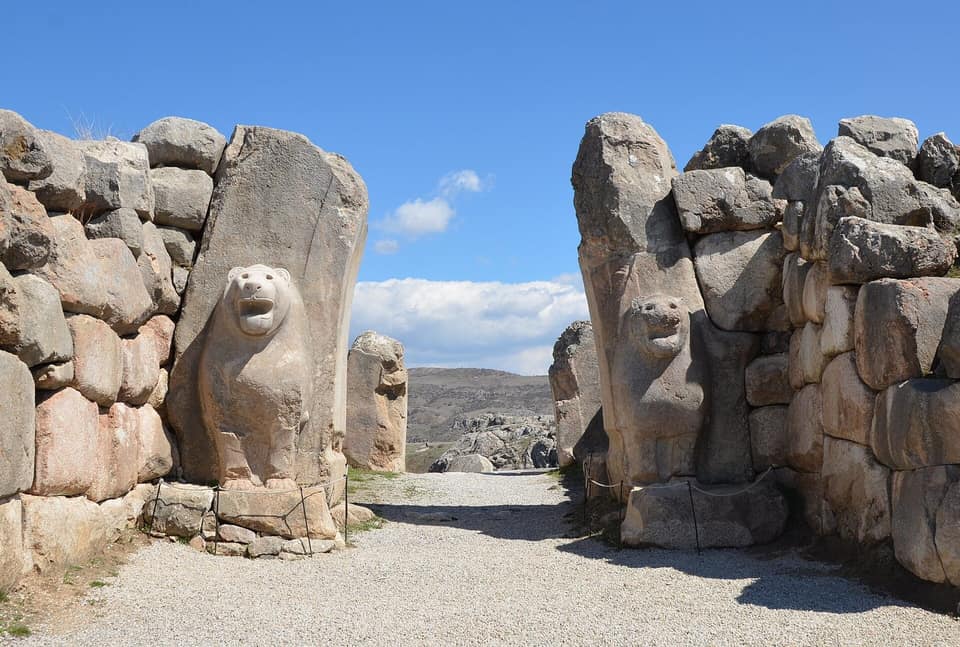
In the imperial period the city was surrounded by a wall about six kilometres long, reinforced at regular intervals by tall towers. The different quarters of the city were entered through monumental gates opened in these walls, and most of the gates have survived in rather good condition. The best known among them are the Lion Gate, with lion sculptures on its outer face, and the King's Gate, which carries a relief of an armed figure on its inner face. At the southernmost end of the wall and at the highest point of the city stands Yer Kapı, where the wall runs over an artificial ridge 20 metres high. A 250 metre long section of the sloping face of this artificial ridge, the side facing out of the city, was clad with limestone blocks. On top of the ridge is the Sphinx Gate, and right beneath it lies the only postern of Hattusa that can still be walked through today, in other words a tunnel under the wall. You can walk through this tunnel, seventy-one metres long and three metres high, and come out beyond the wall. The two sphinxes of the Sphinx Gate are no longer on the site but are displayed in the Boğazköy Museum in the district centre.
Büyükkale and the Lower City
The country was ruled from the palace built on the steep rock outcrop now called Büyükkale. The palace did not consist of a single building but of large and small structures arranged around courtyards surrounded by colonnaded galleries. Besides the king and his family, palace officials and the guard soldiers known in the sources as the "golden spearmen" also lived here. In the Lower City the stone foundations of the large building complex known as the Great Temple show how regularly the city plan was laid out. The Hieroglyphic Chamber, which holds the inscription describing the deeds of the Great Hittite King Suppiluliuma II, is considered the best preserved example of its kind to have reached our day. Huge granaries were also uncovered on the site, together with the partly worn Nişantepe Inscription, which carries the longest hieroglyphic text of the Hittites. The cuneiform tablet archives found in the city, which represent the oldest known Indo-European language, have been on the UNESCO Memory of the World Register since 2001.
Visiting
The site lies 90 kilometres from Çorum, 29 kilometres from Sungurlu and only 1 kilometre from the centre of Boğazkale. Because the ruins are spread over a large area and divided by steep rock outcrops, it is best to tour them by car and to set aside at least half a day. In summer the sun is harsh on the open ground, so bring a hat, water and comfortable shoes, and come early in the morning if you can. Check the official museum website of the Ministry of Culture and Tourism for up-to-date information on opening hours and entry conditions. To see the finds side of the city, plan to stop at the Boğazköy Museum in the district centre on the same day.
Comments
Loading...
Location - Hattuşa
Venue Info
AddressBoğazkale ilçe merkezinin yanı, Boğazkale / Çorum
VenueBoğazkale, Çorum
TypeHistorical & Cultural Sites