

Historical & Cultural SitesHistorical Sites
Hafsa Sultan Darüşşifası
11
No ratings yet
Sign in to like and rate
Hafsa Sultan Hospital
About Venue
The Hafsa Sultan Darüşşifası is Manisa's Ottoman-period hospital and stands within the Sultan Külliyesi as one of the best preserved health buildings in the city. According to the TDV Encyclopaedia of Islam, construction of the complex was begun by Hafsa Sultan, wife of Selim I, during the years when her son Prince Süleyman was in Manisa as governor of the Saruhan province, that is between 1513 and 1520. The complex consisted of a mosque, a soup kitchen, a madrasa, a primary school, a lodge, a hospital and a bathhouse. According to the encyclopaedia, part of the mosque and its attached buildings was completed in 1523. The bathhouse was added to the complex in 1538 and the hospital in 1539 by Süleyman the Magnificent, after Hafsa Sultan's death in 1534.
The Manisa Provincial Directorate of Culture and Tourism writes that, according to the hospital's inscription, the building was erected by Süleyman in the name of his mother in the hijri year 946, that is 1539-1540. According to the provincial directorate, Acem Ali, the architect of the complex, must also have planned the hospital; however, Acem Ali died before he could complete it. The location of the complex is also interesting for the history of the city. According to the TDV, the waqf records show that the buildings were set up on an empty site known as the garden of Timurtaşoğlu Ali Bey, in a position meant to let Manisa expand towards the plain. Over time a neighbourhood formed here and the direction of the city's growth was set by this complex.
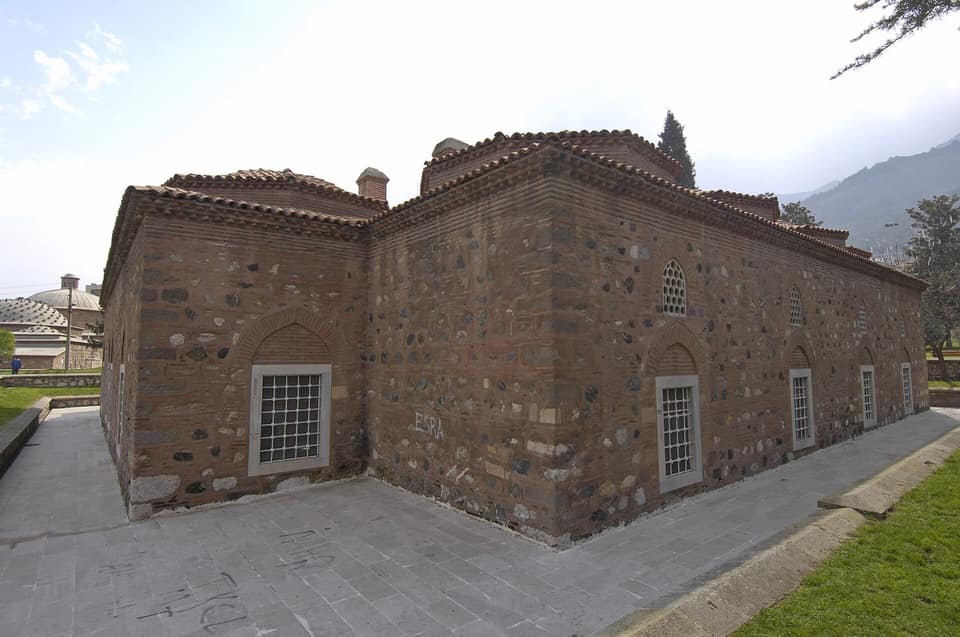
The architecture of the building is plain but legible. According to the TDV, the hospital has a nearly square plan and its walls are built entirely of rubble stone and brick. A roof system of shallow domes with double rows of saw-tooth eaves gives the building an appearance reminiscent of early period works. Above the main gate, with its depressed arch and brick tympanum, there is a six-line inscription written in thuluth script. The gate leads into a three-domed portico resting on two reused columns. The section opposite the portico is designed as an iwan. There are ten rooms in total; two stand beside the portico, the others line the eastern and western sides of the courtyard, and those at the corners are larger than the rest. Each room has a pointed brick arched door and a window facing outwards with a brick arch and marble frame. As you look at it from outside, follow the texture formed by the courses of stone and brick and the rhythm of the windows; the whole character of the building lies in this simple order.
The staff of the hospital is a good document for understanding how a hospital worked in the Ottoman world. As the TDV relates, the waqf register of 1575 records a chief physician, a second physician, a steward, an eye doctor, a surgeon and about twenty-five attendants serving in the hospital on the western side of the mosque. The endowment deed lists a chief physician, a surgeon, two eye doctors, a specialist in mental illness, two pharmacists and two assistant pharmacists. Two of the four nurses worked at night; there were also an administrator, a clerk, two cooks and a launderer. The provincial directorate explains that Ottoman physicians treated mental illnesses in various ways such as medicines, rest, diet, flowers, music and occupation.
The building is also closely tied to Manisa's best known tradition. According to the provincial directorate, when Hafsa Sultan fell ill, Merkez Efendi, chief physician of the Sultan Camii Madrasa, prepared a paste of forty-one kinds of herbs and spices, and this mixture has come down to us as mesir macunu. The tradition of distributing the paste to the public every year in the week of Nevruz has continued for about four hundred years. The Mesir Macunu Festival was inscribed on the UNESCO Representative List of the Intangible Cultural Heritage of Humanity in 2012. According to the provincial directorate, the cultural space where the festival takes place was declared a protected site in 1988.
The recent history of the building was difficult. According to the provincial directorate, the hospital was burned in 1922 and restored in 1962-1963. Having stood empty for a long time, the building was allocated to Celal Bayar University in 1996 and opened by the university as the Hafsa Sultan Museum of the History of Medicine on 30 November 2013. A 2026 announcement by the Manisa Provincial Directorate of Family and Social Services also refers to the building as the Manisa Celal Bayar University Ayşe Hafsa Sultan Museum of the History of Medicine.
The hospital stands on the western side of the Sultan Külliyesi in Şehzadeler and is easily reached on foot from the city centre. Before you go, confirm the days and hours when the museum is open in the university's current announcements. You can walk around the courtyard to see the other buildings of the complex from outside. During the Mesir Macunu Festival the surroundings become very crowded; if you want to see the building in peace, choose another week. Moving on from here to the Akpınar rock relief and Mount Spil completes a day that stretches from the history of the city to nature.
Comments
Loading...
Location - Hafsa Sultan Darüşşifası
Venue Info
AddressSultan Külliyesi, Şehzadeler / Manisa
VenueŞehzadeler, Manisa
TypeHistorical & Cultural Sites