

Historical & Cultural SitesArchaeological Sites
Hadrianopolis Antik Kenti
32
No ratings yet
Sign in to like and rate
Hadrianopolis Ancient City
Budaklar Köyü, Hacı Ahmetler Mahallesi (Viranşehir mevkii), Eskipazar / Karabük
Eskipazar, Karabük
Get DirectionsApple MapsAbout Venue
Hadrianopolis was a city founded in the southwest of the ancient region of Paphlagonia, and its remains lie today in the Eskipazar district of Karabük, about 3 kilometres west of the district centre. The Culture Portal writes that the city is spread over the land of the villages of Budaklar, Büyükyaylalar, Çaylı and Beytarla. The remains are densest in the Hacı Ahmetler quarter of Budaklar village, and local people call this place Viranşehir. The Culture Portal and the Turkish Wikipedia also spell the city's name Hadrianapolis, and an announcement by the provincial directorate calls it "the Zeugma of the Black Sea".
The sources give different details about the history of the city. The English Wikipedia writes that the settlement was used at least from the 1st century BC to the 8th century AD and that it took its name from the Roman emperor Hadrian in the 2nd century AD. According to the same source, the city was also known by the names Kaisareia and Proseilemmene. The Karabük Provincial Directorate of Culture and Tourism explains that the region came within the borders of the Paphlagonian state founded after the death of Alexander the Great and passed under Roman rule in 63 BC. The remains belong to the late Hellenistic, Roman and Early Byzantine periods. When the Seljuks came to the region the city was in ruins, and for this reason it began to be called Viranşehir, the ruined city.
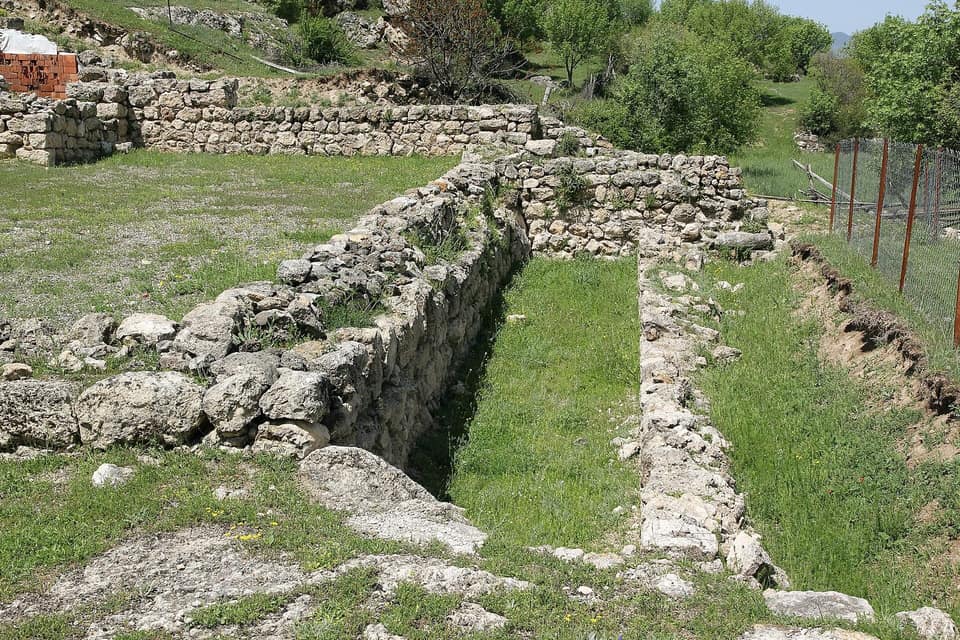
Excavations began in 2003 and are carried on today by a team from the Archaeology Department of Karabük University. The English Wikipedia writes that surface surveys identified 14 public buildings and other structures. Among them are two baths, a defensive structure, rock tombs, a theatre, an arched and domed building, a monumental niche, city walls and a villa. The Culture Portal states that a cistern is still standing with its vaults. In later centuries the stone blocks of the city were reused as building material in various places in Eskipazar.
What really makes Hadrianopolis known is its floor mosaics. The Culture Portal writes that the most important mosaics were found on the floor of a church ruin measuring 15 by 23.5 metres and dated to the 6th century. These mosaics depict figures of women and men, animals and fruit. Four great rivers, among them the Euphrates and the Tigris, are shown personified together with their names. The Culture Portal states that no such composition has been found anywhere else in Anatolia. An inscription on the floor names Himerios, who bore the title skholarios, meaning imperial guard, together with Valentina. The fact that this title appears only in the 6th century helped to date the building.
The excavations continue to bring other mosaics to light. The English Wikipedia reports that in 2022 polychrome mosaics with figures of peacocks and amphorae with grape baskets were found in a Roman fort. In 2019 a limestone slab about 1,800 years old, carved with the figure of a woman holding ears of wheat, was uncovered. The many marble columns and capitals show that the city was quite developed in its time. The Turkish Wikipedia writes that sources mention a mint striking coins in the city's name and that many coins have been found on the site.
The rock tombs around Eskipazar can also be part of the visit. The Provincial Directorate of Culture and Tourism writes that the Delik and Hisariçi rock tombs lie within and around the ruins of Hadrianopolis. The Delik Rock Tombs are arranged in two rows, with burial couches between them. The chambers of the Hisariçi tombs are vaulted and about 2 metres high, and the inscriptions found there show that they belong to the Roman period.
The site is reached from the centre of Eskipazar, on the road between Ankara and Karabük, by the asphalt road to Hacı Ahmetler. The sources give the distance from the district centre as between 3 and 5 kilometres. Public transport information is limited, and going by car is the most practical option. This is an active excavation site, and part of the mosaics has been covered for protection. So do not expect to see every mosaic in the open, and do not enter the excavation trenches or the closed sections. Before you go, check the visiting conditions with the Karabük Provincial Directorate of Culture and Tourism. The site is open and shadeless, so the morning is more comfortable than summer noon. Hadrianopolis is the strongest proof that Karabük has a deep past beyond Safranbolu as well.
Comments
Loading...
Location - Hadrianopolis Antik Kenti
Venue Info
AddressBudaklar Köyü, Hacı Ahmetler Mahallesi (Viranşehir mevkii), Eskipazar / Karabük
VenueEskipazar, Karabük
TypeHistorical & Cultural Sites