

Religious & Spiritual PlacesMosques
Hacı Kılıç Camii ve Medresesi
No ratings yet
Sign in to like and rate
Haci Kilic Mosque and Madrasa
About Venue
Hacı Kılıç Mosque and Madrasa is a Seljuk-period complex on İstasyon Avenue in the Kocasinan district of Kayseri, combining a mosque and a madrasa in a single building. It stands north of the city centre, in the area outside the old castle walls. According to the two inscriptions on its portals, it was built in 1249 by the emir Abu'l-Qasim ibn Ali al-Tusi on the order of the Seljuk sultan İzzeddin Keykavus II. Where the name of the complex comes from is not known; the TDV Encyclopedia of Islam notes that Hacı Kılıç may have been a nickname of al-Tusi, who had the building made. The Culture Portal points out that the small towers at its corners make the building resemble a castle.
A cylindrical tower with a conical cap at the south-east corner and a second tower in the form of a square prism at the north-west corner act as buttresses for the building. The walls are of cut stone, reused material was also used on the south facade of the mosque, and the walls of the madrasa have been largely renewed in later repairs. The mosque is divided into five aisles running perpendicular to the mihrab wall, and the aisles are covered with pointed barrel vaults. Above the part of the wider and taller central aisle in front of the mihrab rises a dome on pendentives. This plan, also seen in the Great Mosque of Kayseri, the Kölük Mosque and the Huand Hatun Mosque, was tried here in a new form by merging it with a madrasa.
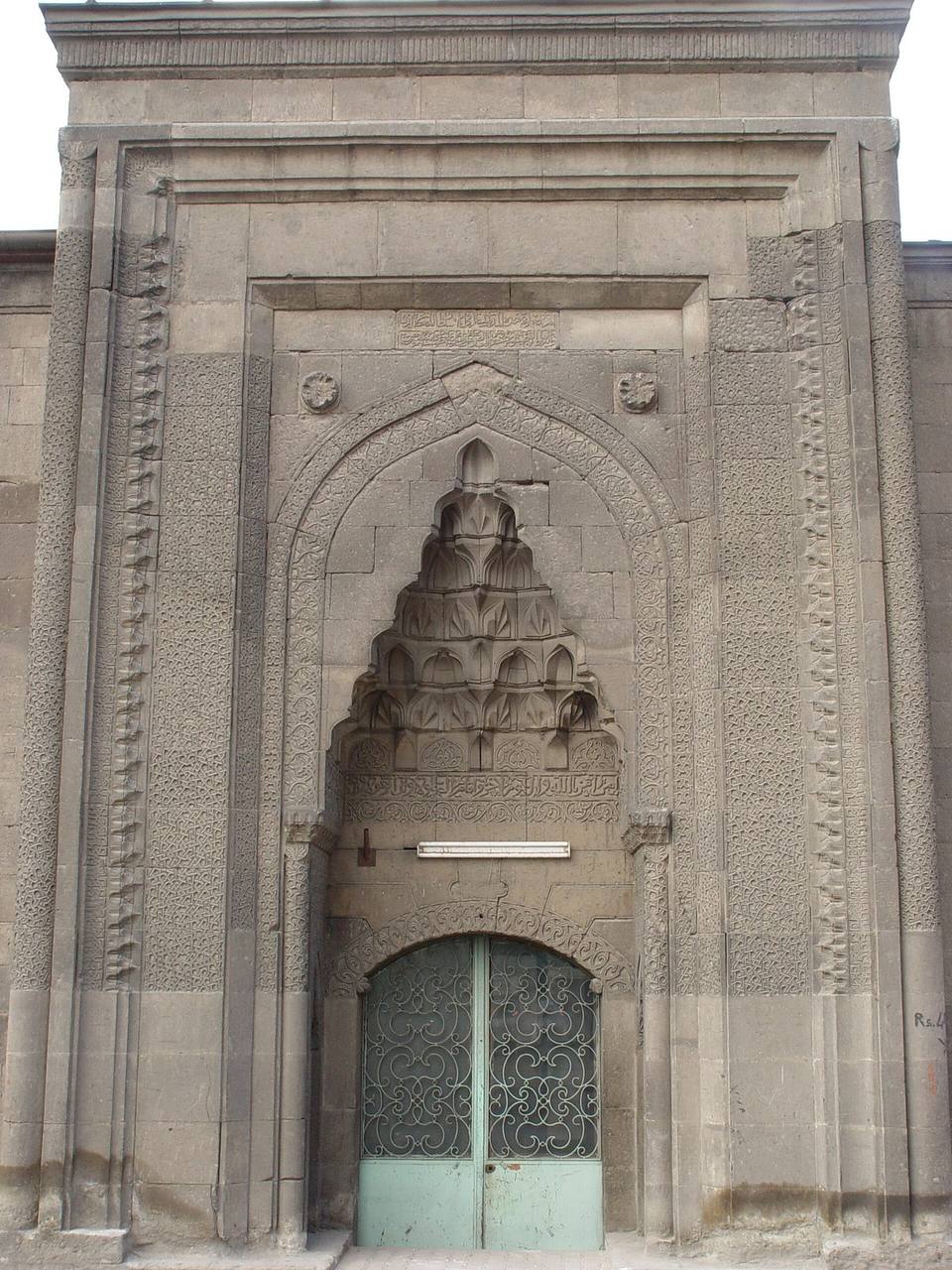
The main facade is the east facade, and the separate portals of the mosque and the madrasa stand side by side on it. The projecting, tall portal of the mosque is crowned with a muqarnas hood and carries an inscription of white marble. The geometric interlace framing the portal is carved in the shallow style typical of stonework in the Kayseri region. The mihrab, with its muqarnas hood and star-interlace border, is also the most carefully worked part of the interior. Three arches in the north wall of the mosque open onto the courtyard of the single-storey madrasa, which has two iwans and an arcaded courtyard; a winter classroom and student rooms with fireplaces are lined up in the madrasa. The present minaret was added to the building later, and the original call-to-prayer kiosk is thought to have stood on the roof between the two portals.
The building was repaired in the middle of the 16th century and has been restored in recent times by the General Directorate of Foundations. The mosque is open for worship; for a visit, choose a time outside prayer hours, stay quiet inside and wear clothing that covers the shoulders and knees. You can view the stonework of the portals as a whole from the pavement across the avenue and then examine the details up close. Easily reached on foot from the city centre, the building lets you see Kayseri's Seljuk-period monuments side by side when visited together with the Sahabiye Madrasa and the Double Madrasa a few hundred metres away.
Comments
Loading...
Location - Hacı Kılıç Camii ve Medresesi
Venue Info
AddressSahabiye Mahallesi, İstasyon Caddesi, Kocasinan
VenueKocasinan, Kayseri
TypeReligious & Spiritual Places