

Natural BeautiesLakes & Waterfalls
Gökgöl Mağarası
31
No ratings yet
Sign in to like and rate
Gökgöl Cave
Zonguldak-Ankara karayolunun Zonguldak girişi, Erçek Mahallesi, Zonguldak
Zonguldak Merkez, Zonguldak
Get DirectionsApple MapsAbout Venue
Gökgöl Cave is a dripstone cave that opens right beside the road as you enter Zonguldak from the direction of Ankara, and it is the natural attraction closest to the city centre. The cave inventory of the Ministry of Environment, Urbanisation and Climate Change places it about five kilometres southeast of the city, along the Zonguldak-Ankara highway. A study published at Zonguldak Bülent Ecevit University locates it within Erçek Mahallesi, at the city entrance of the highway. Because it sits on the edge of the main road, it is one of the easiest places to find even for someone touring the province for the first time.
The Zonguldak Provincial Directorate of Culture and Tourism notes that the province is one of the richest regions of the country in terms of cave formation and that the first speleological studies here began in the early 1970s. In the directorate's list of the longest caves in the province, Kızılelma with 6,630 metres and Gökgöl with 3,350 metres stand out. The ministry's inventory also presents Gökgöl, with a total length of 3,350 metres including its branches, as the second longest cave in the province. The Zonguldak Tourism Infrastructure Service Association, which runs the Zonguldak Coal Geopark project, describes it as the tenth longest cave in Türkiye.
The cave is not a single corridor; it consists of four separate levels that record different geomorphological stages of the region. According to the description on the Kültür Portalı, the first level, made up of the mouth and its surroundings, and the second level, which holds the dripstones of the Great Collapse Hall, are completely fossilised. The youngest part of the cave, the third and fourth levels, contains the Dripstone Hall, the underground stream and a small branch that is still active. The cave has three mouths, two of them fossil and one active. Visitors enter through the large fossil mouth, while the narrow and wet active mouth is not suitable for entry.
The main gallery runs from the east and southeast towards the west and northwest and joins two large side branches. The main gallery ends in a narrow, wet siphon, and the waters coming from the side branches meet in the Great Collapse Hall to form an underground stream. This stream, which the walkway crosses on bridges, leaves the cave through its active mouth and flows into Erçek Deresi. The ministry's inventory notes that the flow of the stream increases in rainy periods, so after a wet week the sound of the water is much more noticeable inside.
According to the geopark description, the rocks that contain the cave are marine limestones, shales and dolomites from the Late Devonian and Early Carboniferous, formed roughly 372 to 328 million years ago. Groundwater eroded and dissolved these limestone layers to open the void, and the redeposition of the calcium carbonate carried by the water formed the dripstones. The same source writes that as the water wore through limestones left from an ancient seabed it exposed the fossils of organisms such as corals, and that these fossils can still be seen in the walls. That is why it is worth looking at the matt wall surfaces as well as the shining dripstones as you walk.
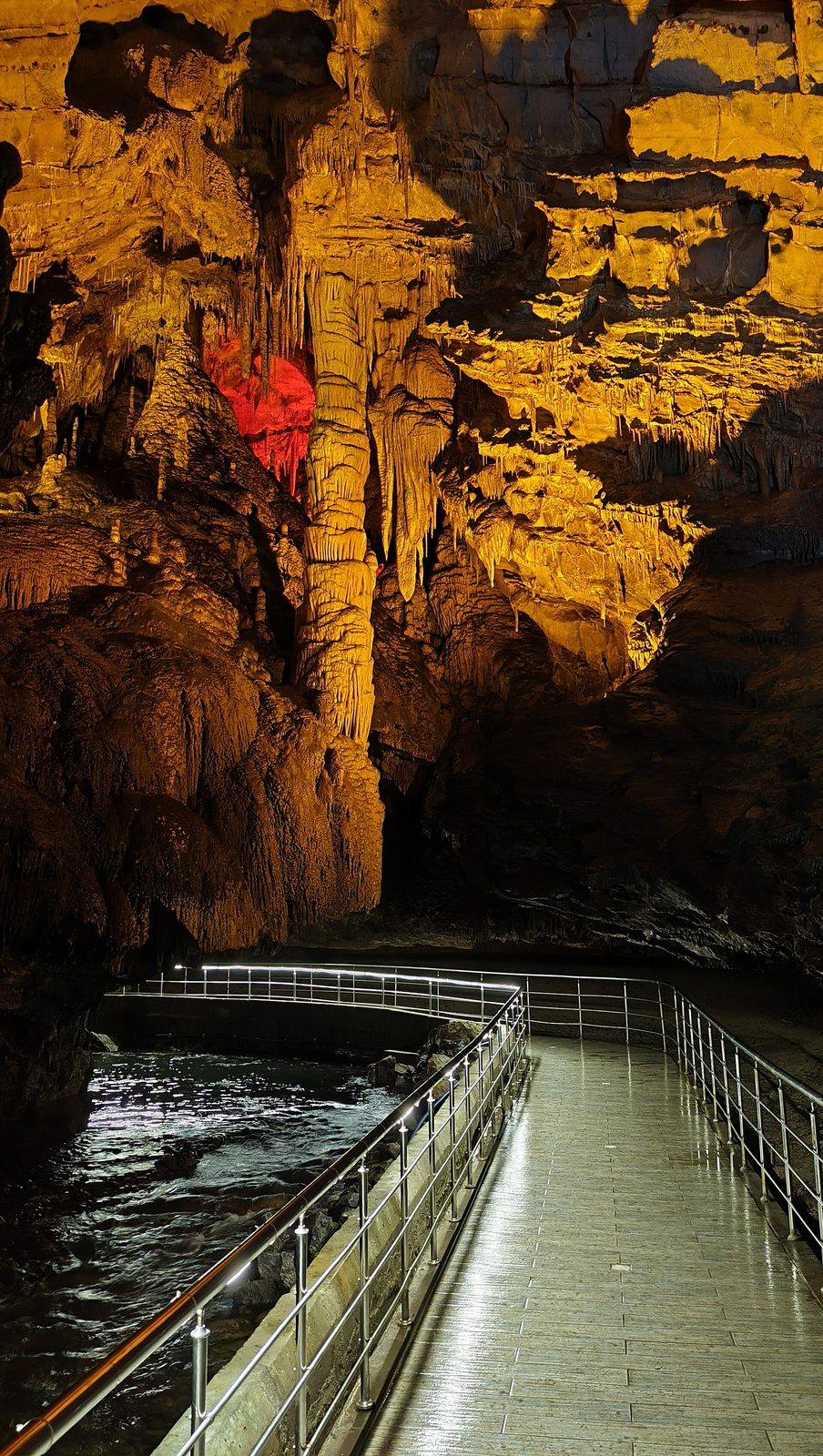
Gökgöl is exceptionally rich in dripstone deposits. Alongside travertine, stalactites, stalagmites and columns there are flag, curtain and flowstone formations. The active and semi-active levels hold wall dripstones, thin soda straws, cave roses, cave needles and dripstone pools filled with water. The Kültür Portalı stresses that these growing dripstones show that formation in the cave is still continuing. The geopark description also counts the dense soda straws above the stream among the structures most worth seeing.
The first 875 metres of the cave are open for tourism. Between the entrance and the Great Collapse Hall this section varies from 2 to 15 metres in width and from 1 to 18 metres in height. The Kültür Portalı names the parts of this section with titles such as the Fossil Entrance, the Dripstone Gallery, the Collapse Hall, the Magnificent Hall, the Great Collapse Hall and the Hall of Wonders. The lit area has a walking trail, bridges and viewing terraces.
According to the university study, the cave was taken up by the Zonguldak Provincial Tourism Directorate in 1994, and the following year a report published by the General Directorate of Mineral Research and Exploration set out its natural features and tourism value. In December 1997 the Zonguldak Special Provincial Administration began investing, and the design was prepared by the cave research group of Mineral Research and Exploration. In this process a walkway, bridges, water channels, lighting and sound equipment were installed, and the cave was opened to tourism on 21 June 2001. The same study reports that the cave has walkways suitable for visitors with disabilities, glass bridges, viewing terraces, a visitor centre and a car park.
The walkway sets the pace of the visit; stopping on the viewing terraces in front of the groups of dripstones to look at the surface where the light falls is the best way to observe. The floor and the railings can be damp, so non-slip shoes and free hands make the walk easier. The dripstones should not be touched, because formation is still under way and the oil from hands disrupts deposition on the surface. The geopark description writes that temperature and humidity in the cave change little through the year; in summer heat you will notice the coolness as soon as you step in, and in winter the relatively mild air, so keep a light layer with you.
Opening hours and the admission fee can change from season to season, so check the current information on the page of the Provincial Directorate of Culture and Tourism or with the operating institution before you go. Because the cave is very close to the city centre it can be reached by urban transport or a short taxi ride, and there is a car park by the road for those arriving by car. Visiting Gökgöl in the morning and spending the afternoon in the city centre around the harbour and the Fener district is an easy way to build a balanced day in Zonguldak.
Comments
Loading...
Location - Gökgöl Mağarası
Venue Info
AddressZonguldak-Ankara karayolunun Zonguldak girişi, Erçek Mahallesi, Zonguldak
VenueZonguldak Merkez, Zonguldak
TypeNatural Beauties