

Historical & Cultural SitesCastles & Palaces
Gaziantep Kalesi
6
No ratings yet
Sign in to like and rate
Gaziantep Castle
About Venue
Gaziantep Castle stands on a hill in the city centre, on the southern bank of the Alleben stream. The Kültür Portalı notes that the hill rises roughly 25 to 30 metres above its surroundings. It is not a natural ridge but a mound built up by settlements laid one on top of another over many centuries. The Gaziantep Metropolitan Municipality traces the mound's history back to the Early Bronze Age, around 4000 BC.
The first core of the castle dates from the Roman period. According to the municipality, the tower on the northern corner of the mound was probably built in the late 1st century as a guard post or watchtower. The structure took its present form in the 6th century under the Byzantine Emperor Justinian, whom the Kültür Portalı calls the "Architect of Castles". The municipality places this construction within his reign between 527 and 565.
Every state that ruled the region added its own mark to the castle. Besides Roman and Byzantine remains, the castle carries inscriptions recording repairs commissioned by Mamluk, Dulkadirid and Ottoman rulers. In 1481 the Mamluk Sultan Qaitbay had the castle overhauled for the second time. According to the inscription above the main gate, the gate and the towers on either side of the bridge were rebuilt in 1557 under Sultan Süleyman the Magnificent.
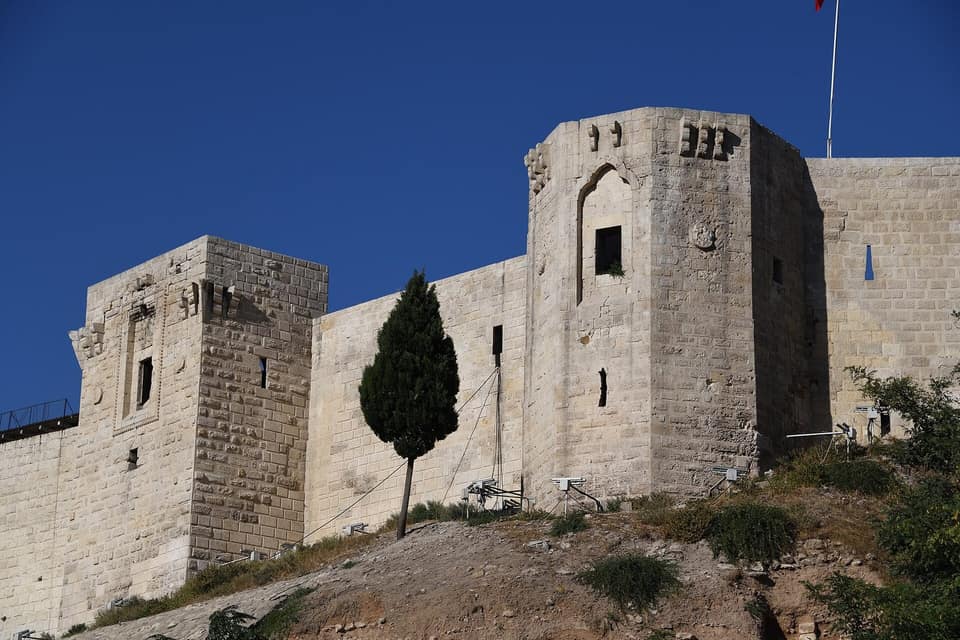
The castle forms an irregular circle about 100 metres across, with a circumference of 1200 metres. Twelve towers rise along its walls, and according to the municipality four of them were built by different sultans and emirs. A moat once surrounded the castle and a bridge led inside. Neither the moat nor the bridge has survived. Here and there the cut-stone towers show carved decoration and projecting stones, so walk around them to see these details from different angles.
Inside the main gate the path divides in two. The left-hand path climbs to the upper parts of the castle and to the points that look down over the city. The path that continues straight on from the gate leads to the gallery, the passageway, the castle rooms and the springs of bitter and sweet water. The municipality reports that the gallery, a 140-metre wall walk, was cleaned, lit and opened to visitors.
For centuries the inside of the castle lived like a small neighbourhood. In his travel book Evliya Çelebi describes two baths, a small mosque, twenty houses and the house of the castle warden here. Excavations by the Gaziantep Museum brought these two baths and the mosque to light. The museum also carried out excavations on the castle's southern slope with the participation of the Archaeology Department of Ankara University's Faculty of Language, History and Geography.
Since 2009 the castle gallery has housed the Gaziantep Defence and Heroism Panorama Museum. According to the municipality's description, it presents the organisation and fronts of the Defence of Antep in 1920 and 1921 in chronological order. The display consists of 79 panels, 41 reliefs, 52 sculptures, 13 busts and 125 portrait reliefs. The Panorama 25 Aralık Museum at the foot of the castle treats the same subject on a larger scale, so seeing both on the same day rounds out the story.
Check the current status with official sources before you go, both for the sections open to visitors and for entry conditions. Because the castle sits right in the middle of the city, it is easy to reach on foot from the centre. The Zincirli Bedesten, the Coppersmiths' Bazaar and the district of old inns at its foot are only a few minutes' walk away. To see the high walls at their best, circle the castle along the green area by the Alleben stream or on the road around it. In the afternoon, when the sun turns the cut stone golden, the towers look their best for photographs.
Comments
Loading...
Location - Gaziantep Kalesi
Venue Info
VenueŞahinbey, Gaziantep
TypeHistorical & Cultural Sites