

Historical & Cultural SitesArchaeological Sites
Elaiussa Sebaste Antik Kenti
13
No ratings yet
Sign in to like and rate
The Ancient City of Elaiussa Sebaste
About Venue
Elaiussa Sebaste is a large ancient port city on the Mediterranean coast in the Ayaş neighbourhood of Erdemli district. According to the portal of the Ministry of Culture and Tourism, the city was founded in the late 2nd century BC. As reported by Strabo, part of the city stood on the mainland and part on the small island opposite, and the city was born from the union of Elaiussa and Sebaste. The name Elaiussa derives from the Greek word elaion, meaning olive, while Sebaste is the name dedicated to the Roman emperor Augustus.
Its position on the coastal road linking Anatolia with Syria and its rich agricultural resources explain the long life of the city. The Ministry sources write that Elaiussa Sebaste was an important centre of trade, production and seafaring from the 2nd century BC to the early 7th century AD. According to the excavation summary in the Türkiye Turizm Ansiklopedisi, timber from the forests and olives were among the main resources of the city. Excavations in the island section, the site of the first settlement, yielded large numbers of amphorae as well as a late antique kiln and locally produced amphorae. These finds show that the city produced goods such as olive oil in its own containers and distributed them by sea.
The Ministry portal lists a theatre, temple, agora, necropolis, palace, production areas and baths among the buildings of the city. The remains also include aqueducts, olive oil and water cisterns, and a palace with two marble columns together with its gate. The same source mentions a floor mosaic with various animal figures to the north of the palace gate. Today the D400 highway runs through the remains, and the theatre lies on the inland side of the road, on the slope of a hill.
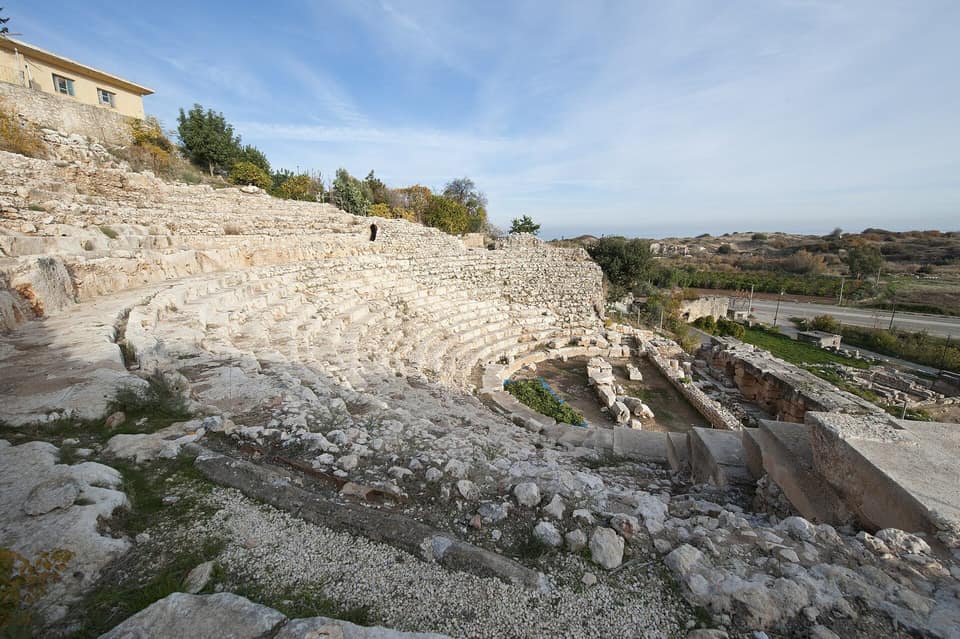
The theatre is set into a south facing slope, and according to the excavation summary it measures about 55 metres across. A western section of the seating was restored in 1999 so that the original appearance of the rows could be understood. The steps were rebuilt using the only surviving original as a model, so the rows starting from the bottom became usable again. From the upper rows of the theatre you can see the peninsula, the two bays and the urban fabric stretching along the shore at the same time.
The cemetery of the city lies to the east and north and consists of sarcophagi and monumental tombs lined up on both sides of an ancient road. The Ministry portal reports that the inscription on one sarcophagus records a father building the tomb for his daughter and setting a heavy fine if anyone else were buried in it. On the facade of a two storey monumental tomb you can see a relief of an eagle with spread wings, a snake beneath its feet and two children bound with chains on either side. The excavation director Asena Kızılarslanoğlu told the Anadolu Agency that the necropolis is one of the largest collective burial grounds in Cilicia. According to the same report, the tombs were built in the Roman period and were also used in the Late Byzantine period.
Water was brought to the city from the Lamas stream, today called Limonlu Çayı, about 10 kilometres to the east. According to the Ministry portal, this system consists of gallery channels cut into the rock, open channels, tunnels and aqueducts. The arches are thought to have been built in the 1st and 2nd centuries AD and to have been extended in the 5th and 6th centuries to carry water to Korykos. The same source writes that Elaiussa Sebaste lost its importance after its harbour filled with sand dunes, while Korykos rose thanks to its own harbour. The aqueduct at the western entrance of the city is still one of the most striking structures that can be seen from the roadside.
The history of the excavations is long and international. According to the Türkiye Turizm Ansiklopedisi, the excavations were directed by Eugenia Equini Schneider of Sapienza University of Rome from 1995 to 2014, and from 2015 by Annalisa Polosa of the same university. According to an announcement by Kastamonu University, the 30th excavation season took place under the scientific direction of this university, led by Assoc. Prof. Dr. Hatice Asena Kızılarslanoğlu. The work is supported under the Heritage for the Future project of the Ministry of Culture and Tourism. Burial structures have been uncovered in the northern necropolis, and the aim is to open the area to visitors after landscaping.
When touring Elaiussa Sebaste, first walk around the theatre and the agora, then explore the peninsula on the sea side of the highway. Since excavations are ongoing, some areas may be closed to visitors, so check the visiting conditions on official sources before you go. The site offers little shade, so in summer choose the early morning hours and take water with you. Because the D400 highway between Mersin and Silifke passes through the city, the site is easy to reach by car. Kız Kalesi lies a few kilometres to the west and Kanlıdivane a short drive to the north, and the three can be combined on the same day.
Comments
Loading...
Location - Elaiussa Sebaste Antik Kenti
Venue Info
AddressAyaş Mahallesi, Erdemli / Mersin
VenueErdemli, Mersin
TypeHistorical & Cultural Sites