

Natural BeautiesLakes & Waterfalls
Dupnisa Mağarası
8
No ratings yet
Sign in to like and rate
Dupnisa Cave
About Venue
Dupnisa Cave is an underground system that opens among the dense forests of the Istranca (Yıldız) Mountains, south-west of Sarpdere village in the district of Demirköy. Kültür Portalı describes it as lying in a wild-looking landscape where the Rezve stream, which marks the border between Turkey and Bulgaria, cuts the mountains with deep valleys. According to the provincial yearbook, it is the first and only cave in Thrace opened to tourism, and it is registered as a natural and archaeological protected site.
This is not a single hollow but a system of three caves on two connected levels, which is why sources refer to it as a cave system. Kuru Cave and Kız Cave lie on the upper level, while Sulu Cave runs about 50 to 60 metres below them. Official sources give the total length of the system as 2,720 metres; the Wikipedia articles, counting all the branches, give figures of more than three kilometres. The entrance to Sulu Cave lies 345 metres above sea level, and the far end of the cave is a further 61 metres higher than the entrance.
The rock that forms the system is marble. The provincial yearbook says the cave developed within the marble around 180 million years ago, while Kültür Portalı notes that the underground system has been forming and developing for about four million years. The water regime, period of formation, air and dripstones of the three caves differ greatly; three contrasting caves stacked on top of one another is what makes the system so unusual.
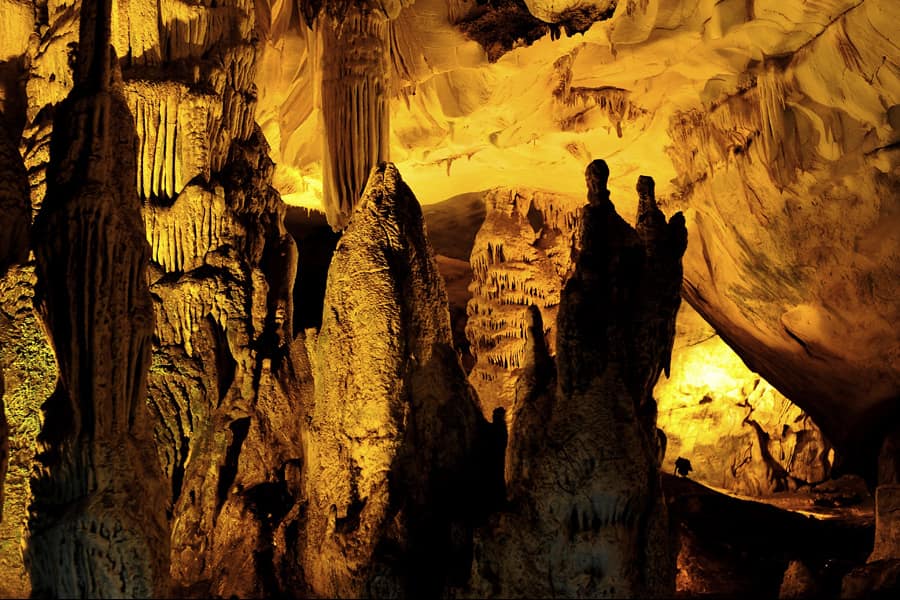
Kuru Cave has finished developing and is the richest section in dripstones. Stalactites, stalagmites, columns and wall dripstones of enormous size are concentrated here. A permanent underground stream flows through Sulu Cave, forming pools that in places are more than two metres deep. In this section the curtain and flag-shaped dripstones and the dripstone basins stand out. The colours range from milky white to red and every shade of brown.
The inside of the cave has a different climate from one section to the next. According to Kültür Portalı, the upper levels average around 17 degrees and are drier, while the main cave is cool and very humid at around 10 to 12 degrees. This difference creates a noticeable air current between the upper level and the main gallery; the breeze you feel on your face while walking comes from it. A light jacket or raincoat and shoes that do not slip are the simplest way to stay comfortable inside.
Dupnisa is also an important underground habitat. The governor's office page says about 60,000 bats of 11 species and 184 cave invertebrates live here. Kız Cave is completely closed to visitors because of the density of the bats. The official page states that Sulu Cave also closes between 15 November and 15 May, when the bats gather, while Kuru Cave stays open all year; however, since sources disagree on which section closes, it is best to ask the Kırklareli Provincial Directorate of Culture and Tourism before you go.
The section open to visitors is short and well organised. A stretch of about 450 metres across Kuru and Sulu caves has been opened to tourism, with a walkway and lighting. Sources differ on how this stretch is divided between the two caves, but the total length is the same. According to English Wikipedia, the main entrance leads into Sulu Cave, a staircase at the end of the railed path climbs to Kuru Cave, and the visit ends outside, returning to the starting point along a marked trail through the forest. Beyond this section the cave is open only to experienced cavers.
The name of the cave is of Bulgarian origin; Turkish Wikipedia and the English article both say it comes from a word meaning hole. The spring water that emerges from Sulu Cave joins the Rezve stream along the border. According to the provincial yearbook, finds from the Neolithic, Roman and Byzantine periods have been recovered in the cave, so these hollows were also visited by people for thousands of years.
Visitor interest grows every year. According to the provincial yearbook, 58,500 people visited the cave in 2021, 64,133 in 2022 and 65,333 in 2023. Summer weekends can be crowded, so weekday mornings make for a quieter visit. Day picnics and nature walks are also possible around the cave; the governor's office page presents the area as suitable for such trips.
The cave is about 60 kilometres from the centre of Kırklareli, 26 kilometres from Demirköy and 6 kilometres from Sarpdere village. You need your own vehicle; you arrive either by heading towards Dereköy from Kırklareli and continuing through Sarpdere, or from the south via Demirköy on forest roads. There is no direct public transport connection. Because the opening season, visiting hours and entrance fee can vary, check the current information with the official sources. If you want to combine the visit with the floodplain forests at İğneada, the road again passes through Demirköy, and two very different landscapes can be seen on the same day.
Comments
Loading...
Location - Dupnisa Mağarası
Venue Info
AddressSarpdere Köyü yakını, Demirköy / Kırklareli
VenueDemirköy, Kırklareli
TypeNatural Beauties