

Religious & Spiritual PlacesMosques
Divriği Ulu Camii ve Darüşşifası
9
No ratings yet
Sign in to like and rate
Divriği Grand Mosque and Darüşşifa (Hospital)
About Venue
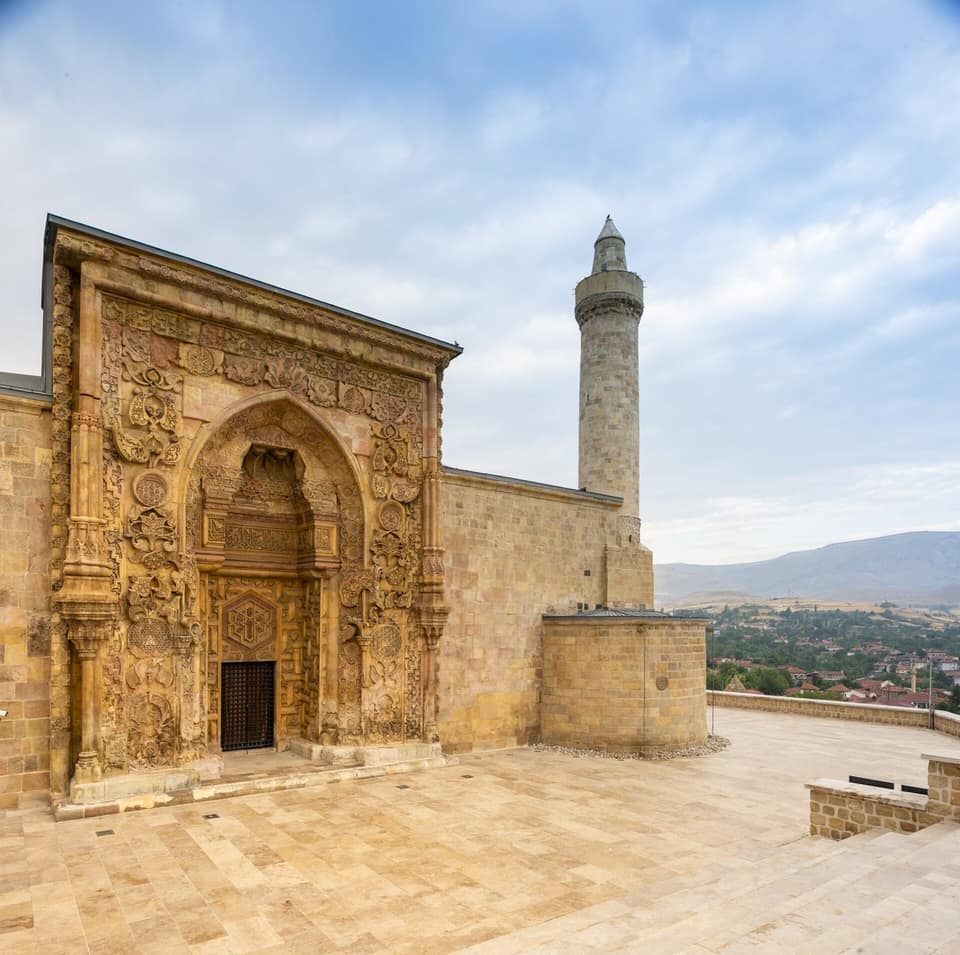
The Divriği Great Mosque and Hospital is a complex made up of a mosque, a hospital (darüşşifa) and a tomb, standing on a slope above the valley of the Çaltı stream in the Divriği district of Sivas. The Culture Portal states that it was inscribed on the UNESCO World Heritage List as a cultural property in 1985 and that it was the first architectural work from Türkiye to enter that list. Its number on the list is 358. The complex was commissioned by the Mengücek ruler Ahmed Şah and his wife Melike Turan. The Divriği entry of the TDV Encyclopedia of Islam records that the complex was founded in 1228 and that its architect was Hürremşah of Ahlat.
According to the route page of Sivas Municipality, the mosque was built by Ahmed Şah between 1228 and 1243, while the adjoining hospital was commissioned by his wife Melike Turan Melek. The same page notes that craftsmen from Tbilisi also worked on the building. The complex is therefore described as a charitable work undertaken at the same time by a ruler and his wife. The Ottoman traveller Evliya Çelebi wrote about how hard it was to describe this work in words, and the literature has also called it the Alhambra of Anatolia.
Seen from outside, the building is remarkably plain. As the Culture Portal puts it, four monumental portals rise from this simple mass: the hospital portal, the north and west portals of the mosque, and the portal of the royal gallery. Each of these portals carries its own decorative programme and none of them repeats another. Plant and geometric motifs are carved in high relief close to sculpture, in a three dimensional and asymmetric manner. The north portal is one of the most densely decorated, and its depth changes as the angle of the light changes. The west portal is known in the literature as the Textile Portal because the fine patterns on its stone surface recall carpets and kilims.
The municipality notes that although the ornament looks symmetrical at first glance, a closer look shows that every motif differs from the one next to it. The mosque itself has a rectangular plan and is built entirely of cut stone. Inside, the columns, the capitals and the inner surfaces of the domes each show a different approach to ornament. The wooden pulpit, made of ebony in the kündekari interlocking technique, is counted among the important examples of Anatolian woodwork, and the TDV source dates it to 1241. The cut stone minaret at the northwest corner of the mosque was added in the Ottoman period in 1565, according to its inscription.
The hospital adjoins the south side of the mosque and is a two storey building with a courtyard and iwans. A large iwan stands opposite the entrance with smaller iwans on either side, and the patients' rooms are set out in an orderly way around the courtyard. According to the municipality, the sound of water rising from the octagonal pool in the centre was considered a complementary part of the treatment. For a time in the Ottoman period the building was also used as a madrasa. One of the rooms inside the hospital holds the graves of those who commissioned the complex.
According to an announcement by the Governorship of Sivas, the restoration carried out by the General Directorate of Foundations was completed and the building reopened for worship and visits on 6 May 2024. To see the north portal, first step back in the open area in front of it and look at the portal from a distance, then up close. Then move to the west portal and study its kilim-like surface from a side angle. Because the hospital has its own portal, you should also walk around to the south face. The shadows on the stone look different in the morning and in the afternoon, so coming at two different times of day is a good idea for photography.
Since the building is open for worship, visitors should stay quiet inside during prayer times and follow mosque etiquette in dress and behaviour. Check the current announcements of the official institutions for visiting conditions and any arrangements. Divriği town centre can be reached from Sivas by road or by rail. The municipality's route page notes that once you reach the town centre, the building is easy to reach on foot. As the municipality stresses, the building is read together with the valley of the Çaltı stream; from around it the houses of the town and the valley can also be seen.
Comments
Loading...
Location - Divriği Ulu Camii ve Darüşşifası
Venue Info
AddressDivriği ilçe merkezi, Sivas
VenueDivriği, Sivas
TypeReligious & Spiritual Places