

Historical & Cultural SitesArchaeological Sites
Didyma ve Apollon Tapınağı
31
No ratings yet
Sign in to like and rate
Didyma and the Temple of Apollo
About Venue
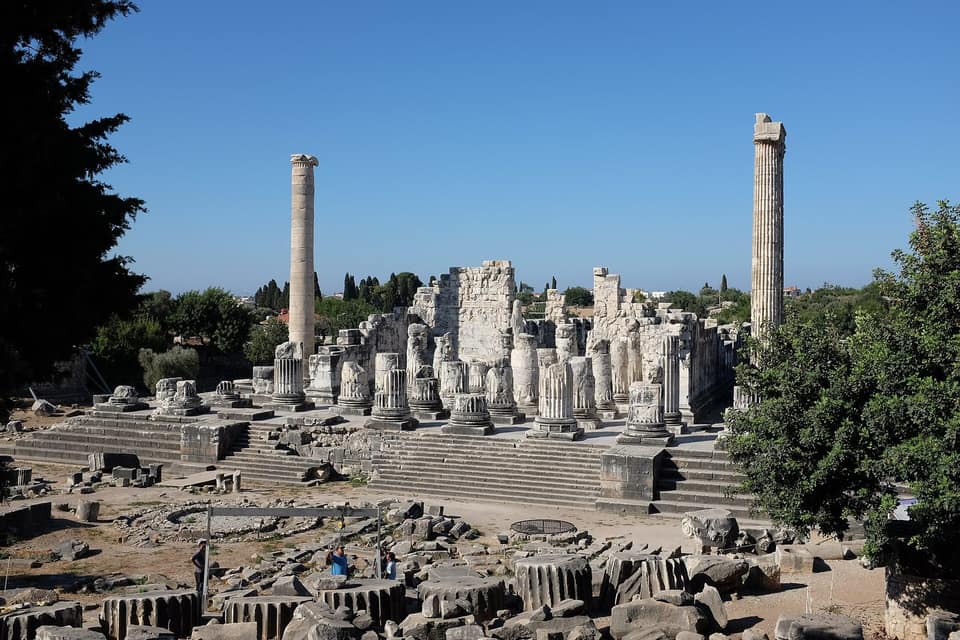
Didyma is the ancient site in the Hisar neighbourhood of Didim where the Temple of Apollo rises among the houses of the town. The Kültür Portalı writes that the site belonged to the harbour city of Miletos and was linked to that city by a road from the 7th and 6th centuries BC onwards. English Wikipedia says this road was about 20 kilometres long and was renewed under Emperor Trajan in AD 101. The oldest remains on the site date to the end of the 8th century BC. Didyma was a famous oracle centre in the ancient world, and the unusual plan of the temple grew out of this role.
The Ministry's page presents the building as the third largest temple in the world built in the Ionic order. The older temple, built in the 6th century BC, was destroyed by the Persians at the start of the 5th century BC. Construction of the building seen today began in the 4th century BC, but it was never completed. Turkish Wikipedia writes that the work went on for more than 600 years, that the main body was finished around 100 BC, and that the columns of the east front were raised in the reign of Emperor Hadrian. The Roman writer Vitruvius records a tradition that the architects were Paionios of Ephesus and Daphnis of Miletus.
The dimensions are truly vast. According to English Wikipedia, its seven-stepped base platform measures about 60 by 120 metres. The building is surrounded by a double row of Ionic columns, each 19.70 metres high, which places it in the dipteral plan type. Ten columns were planned on each short side and twenty-one on each long side, but not all of them had been raised even by the end of antiquity. The columns standing today and the huge drum fragments let you feel this scale on the spot.
As you approach the front, you reach an entrance hall made of three rows of four columns. Here, in place of the door that would normally open into an inner hall, there is a large opening whose sill stands 1.5 metres above the floor. This opening was not passed through; one could only look inside. You go down into the inner court through two long, narrow, sloping tunnels built within the thickness of the walls. According to the Ministry, the court is open to the sky and its floor is not paved with stone. A small inner temple, the naiskos, stood in this court, and its foundations can still be made out today.
The walls of the court reach 25 metres, and they hide one of the most interesting archaeological finds in the world. English Wikipedia recounts that the German building researcher Lothar Haselberger found construction drawings scratched into the walls in 1979. These are full-scale drafts drawn for columns and pediments. Because the building was never completed, the wall surfaces were not polished and the drawings have survived without being erased. A careful observer in the court can make out these traces of straight and curved lines on the upper parts of the wall.
The temple's best known ornament is the head of Medusa. One of these monumental heads from the frieze now lies on the ground in front of the temple and is the most photographed piece. The Ministry page notes that the head of Medusa was used in the ancient Greek world as a protective symbol on shields, buildings and temples. Research on the temple's marble is also interesting: English Wikipedia writes that Milesian marble from around Lake Bafa was mostly used in the building.
A Hellenistic stadium ran along the south side of the temple. The steps of the crepidoma served as seating for spectators on its northern side, and many place inscriptions were carved into these steps. These inscriptions can still be seen on the steps today. About 100 metres north of the temple the foundations of another small temple were found in 2013, and a theatre has also been uncovered nearby.
The excavation history of the site goes back to the start of the 20th century. According to the Ministry, the temple was fully brought to light and partly re-erected through scientific excavations between 1906 and 1913. The protective wall around the site was also arranged during this first work. Turkish Wikipedia writes that the village over the temple ruins was called Jeronda until the early 20th century, and Yoran in Turkish.
The visit is short but intense; an hour is enough for most people. The temple stands on level ground, but the tunnels down to the inner court are narrow and sloping, so walk carefully. The east-facing front gives the best photographs in the morning light. Check visiting hours and entry conditions on the Ministry's museum page before you go.
The Kültür Portalı notes that you can get here from the Efeler district of Aydın by metropolitan municipality buses and Didim minibuses. The Ministry page also lists nearby Lake Bafa and the Dilek Peninsula National Park among the places worth seeing.
Comments
Loading...
Location - Didyma ve Apollon Tapınağı
Venue Info
AddressHisar Mahallesi, Apollon Tapınağı, 09270 Didim / Aydın
VenueDidim, Aydın
TypeHistorical & Cultural Sites