

Historical & Cultural SitesHistorical Sites
Cacabey Medresesi
7
No ratings yet
Sign in to like and rate
Cacabey Madrasa
About Venue
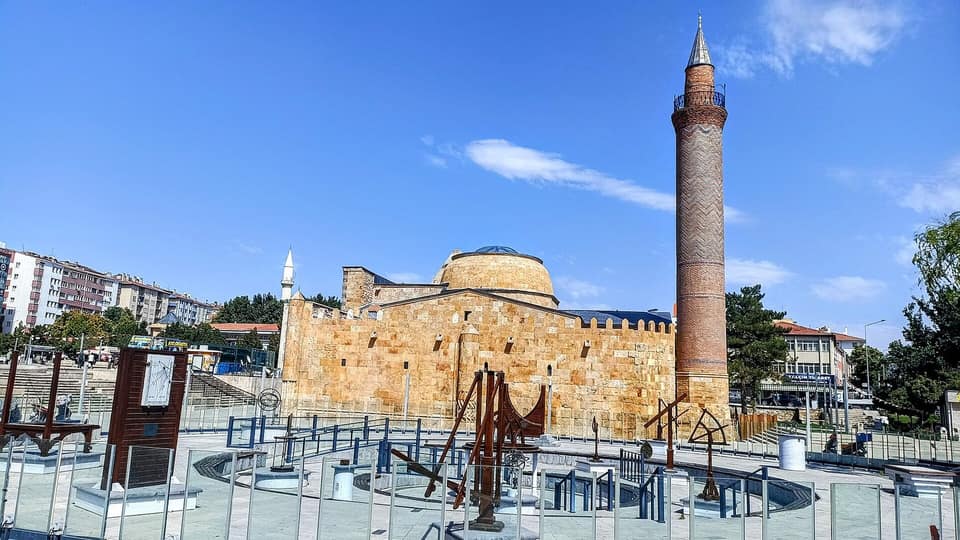
The Cacabey Madrasa stands in the very centre of Kırşehir and is regarded as the city's best known historic building, a madrasa from the Seljuk period. The Kırşehir Provincial Directorate of Culture and Tourism presents it as the Cacabey Astronomy Madrasa and writes that mathematics, science and astronomy were taught here. For this reason the madrasa has become one of the first buildings mentioned when the history of science in Anatolia comes up. The building, which is used as a mosque today, is also known locally as the Cıncıklı Mosque.
Construction
According to the entry in the TDV Encyclopedia of Islam, the two-line inscription above the portal states that the madrasa was built in 1272-73 in the reign of Kaykhusraw III. It was commissioned by Nureddin Cibril bin Caca, who was the emir of Kırşehir during the years of Mongol rule in Anatolia. The endowment deed drawn up to fund the madrasa is dated 10 May 1272, and alongside the original Arabic text its Mongolian summaries written in the Uyghur script have also survived. The deed shows that fields, mills, vineyards, inns and shops in many parts of Central Anatolia were tied to the madrasa as sources of income. The same document also lists in detail the rules that students were expected to follow. The provincial directorate notes that the building was added to the UNESCO World Heritage Tentative List in 2014.
Later centuries
Over time the madrasa lost its teaching role. According to the TDV entry, A. D. Mordtmann, who passed through Kırşehir in 1858, wrote that the building was being used as an ammunition store. The Ankara Provincial Yearbook of 1907 records that part of the ruined building had been opened for worship. After an extensive repair by the foundations administration the building took on its present use.
Architecture
The Cacabey Madrasa belongs to the closed-courtyard madrasa type, in which the central courtyard is covered by a dome. The plan follows a scheme of four iwans opening onto a courtyard, and the iwans are roofed with barrel vaults. Small student cells line the iwans, and the provincial directorate speaks of eight student rooms built for teaching. A stone staircase rising from a cell beside the entrance iwan leads to the upper rooms behind the front facade. The facade is of cut stone, and the area around the portal is faced with bands of stone in two different colours. The portal, framed by a broken pointed arch, has a muqarnas hood. At the two outer corners of the facade, twisted colonnettes with bases that recall hanging lamps catch the eye. The colonnettes at the corners of the main iwan also have shafts made of stacked knobs.
The minaret and the observation tower reading
The part of the building seen from farthest away is the brick minaret rising outside the qibla wall. The TDV entry reports that, according to measurements by A. Saim Ülgen, this minaret is about 21 metres high and stands 22 centimetres apart from the main body. In the lower part of the shaft the bricks are laid in plain rings, while higher up they form zigzag patterns. The turquoise tiles set among these plain bands gave the building its local name Cıncıklı. The provincial directorate interprets the minaret as an observation tower and presents the well in the middle of the courtyard as an observation shaft opened for astronomical study.
The observatory debate
The idea that the madrasa was an observatory has also attracted historians of science. In July 1947 W. Ruben and Aydın Sayılı of Ankara University excavated the floor of the domed central space and found a well reaching a depth of about 6 metres. Semavi Eyice, the author of the TDV entry, argues instead that neither the endowment deed nor the inscription hints at astronomical work, and that the well may simply have been a water well taking the place of a fountain. The provincial directorate, on the other hand, describes the well, the colonnettes and the opening in the dome as signs of the building's link with astronomy. Visiting with both views in mind makes it possible to read the building more carefully. The centre of the dome is closed with glass today, and old photographs are known to show a lantern with a wooden roof in this place.
Visiting
First look at the facade as a whole from the square, then walk up to the portal and study the two-coloured stone bands and the corner colonnettes. The zigzag brickwork of the minaret and the tiles between them stand out more clearly in the afternoon light. Because the building is also used for worship today, it is best to keep prayer times in mind before entering and to stay quiet inside. As the madrasa is in the city centre, it is easy to reach on foot. According to the provincial directorate, the bus station is about 2 kilometres from the city centre, and municipal buses and minibuses run there. Check the current visiting conditions on the provincial directorate's page.
Comments
Loading...
Location - Cacabey Medresesi
Venue Info