

Historical & Cultural SitesHistorical Sites
Büyük Ağa Medresesi (Kapı Ağası Medresesi)
No ratings yet
Sign in to like and rate
Grand Agha Madrasa (Gatekeeper Agha Madrasa)
Şehit Alper Kalan Caddesi, Bahçeleriçi Mahallesi, Amasya
Amasya Merkez, Amasya
Get DirectionsApple MapsAbout Venue
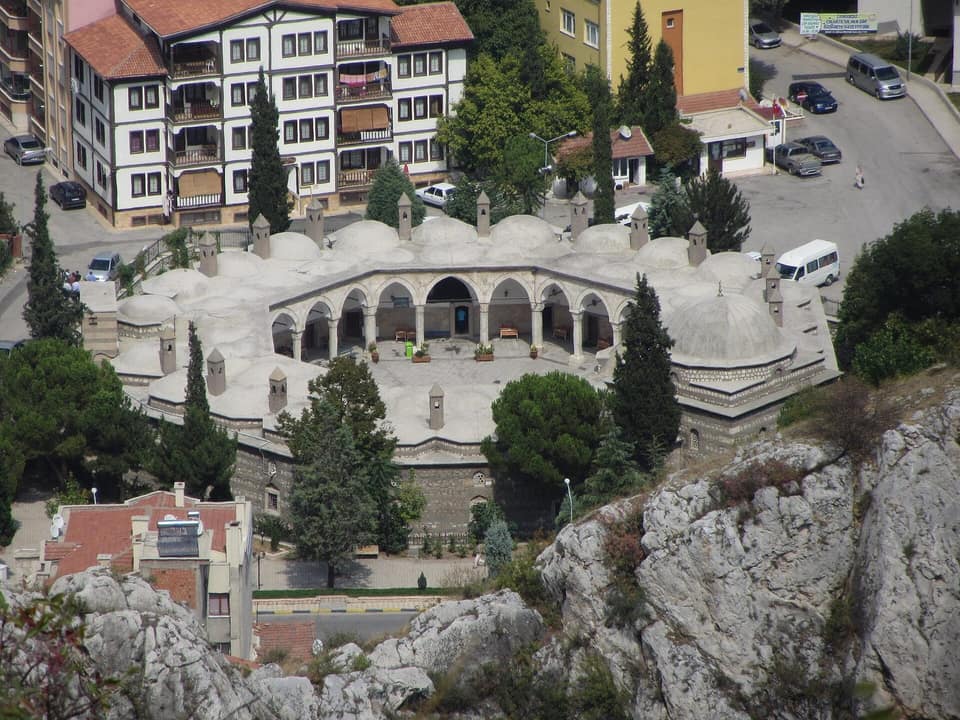
The Büyük Ağa Madrasa is a 15th-century building on the bank of the Yeşilırmak in Amasya, and with its octagonal plan it has almost no parallel in Ottoman madrasa architecture. It is also known as the Kapı Ağası Madrasa and the Medrese-i Hüseyniyye, and sources place it in the Şamlar quarter. It was commissioned by Hüseyin Ağa, the chief gatekeeper of Sultan Bayezid II; sources give its date of construction as 1488, while according to its inscription it is 1489. The standing of the madrasa rose over time: in its first years it was counted among the madrasas of the thirty rank, and later it was named among madrasas of a higher rank.
The Amasya Provincial Directorate of Culture and Tourism emphasises that the octagonal plan scheme seen in Seljuk funerary monuments was applied to a madrasa here for the first time. The originality of the plan comes not only from a search for form but also from the topography of the site, which is why the entrance gate and the lecture hall do not stand on the same axis. The madrasa is entered through a segmental-arched gate on the northwest; the inscription above the gate was removed when the building was abandoned after 1940 and taken in pieces to the Amasya Museum. The octagonal courtyard in the middle is surrounded by pointed-arched porticoes resting on four piers on each side, and domed student rooms are lined up behind the porticoes. Each room has lower and upper windows, cupboard recesses, a lamp niche and a fireplace. The lecture hall on the south side rises higher than the rest of the building and projects outward; its facade facing the courtyard is carefully worked and the upper part of its door has muqarnas decoration. The walls are built with three courses of brick alternating with one course of stone.
Many scholars taught at the madrasa, the best known of them being Taşköprülüzade Muslihiddin Mustafa Efendi. The dome of the lecture hall, damaged in the 1942 earthquake, collapsed after 1965, and the portico in front of the lecture hall was largely destroyed. In the 1980s the building was restored by the Foundations Administration, the ruined dome, the portico arches and the columns were rebuilt, and a fountain was placed in the middle of the courtyard. In front of the madrasa stands a plain classical fountain with an arch built of alternating courses of red stone and white marble, and in front of it a trough carved from a single block of stone.
As the building is used today as a Quran course, visitors should ask the staff for permission before entering the inner courtyard and keep quiet during lesson hours. The best way to understand the octagonal mass and the row of domes is to walk around the building and look at the facades from different angles. Since the madrasa lies in the city centre, it can be visited on foot together with Amasya's other historic buildings along the river.
Comments
Loading...
Location - Büyük Ağa Medresesi (Kapı Ağası Medresesi)
Venue Info
AddressŞehit Alper Kalan Caddesi, Bahçeleriçi Mahallesi, Amasya
VenueAmasya Merkez, Amasya
TypeHistorical & Cultural Sites