

Historical & Cultural SitesCastles & Palaces
Babakale Kalesi
7
No ratings yet
Sign in to like and rate
Babakale Castle
About Venue
Babakale Castle is an Ottoman fortress rising at Cape Baba, regarded as the westernmost tip of Anatolia, in the village of Babakale in the Ayvacık district of Çanakkale. The Çanakkale Provincial Directorate of Culture and Tourism presents Cape Baba as the farthest point of Anatolia and at the same time of the Asian continent. The castle was built in the 1720s, during the reign of Ahmed III, to clear the region of pirates and bandits and to secure it. In the Ottoman classification of fortresses it is not a border fortress but a small and plain inner-region fortress.
This cape is a very old geographical landmark. According to an article based on archival documents by researchers from Çanakkale Onsekiz Mart University, the place appears in the Iliad and in antiquity under the name Lekton. Strabo writes that this was the first place where those heading for Mount Ida set foot from the sea, and that it formed the outermost foothill of the mountain. Piri Reis describes this point as Emek Yemez Cape. In Ottoman documents it is first called Baba Burnu, and after the castle was built, Baba Kalesi and Hırzü'l-bahr.
Before the castle was built, the cape was known as a refuge for pirates and there was no permanent settlement on the shore. The inscription above the castle gate also explains the reason for its construction; according to it, this was a safe ambush spot for pirates, and when the grand admiral Mustafa Pasha learned of the situation he had walls built and the place settled. Kaymak Mustafa Pasha, who had the castle built, was the son-in-law of Nevşehirli İbrahim Pasha and served as grand admiral from 1721 to 1730.
According to the article, construction was completed in a short time, and the workers were gathered from the districts of the region. At first the people of Tuzla and Ezine were assigned, and when they were not enough, the people of the districts of Edremit, Lesbos, Molova, Kolonya, Bayramiç and Çan were also called in. The work was carried out in shifts and as communal labour. Materials such as lime, roof tiles, timber, rubble stone and brick were supplied from the region, and stones taken from the ruins of the nearby ancient cities of Behramkale and Eski İstanbulluk were also used.
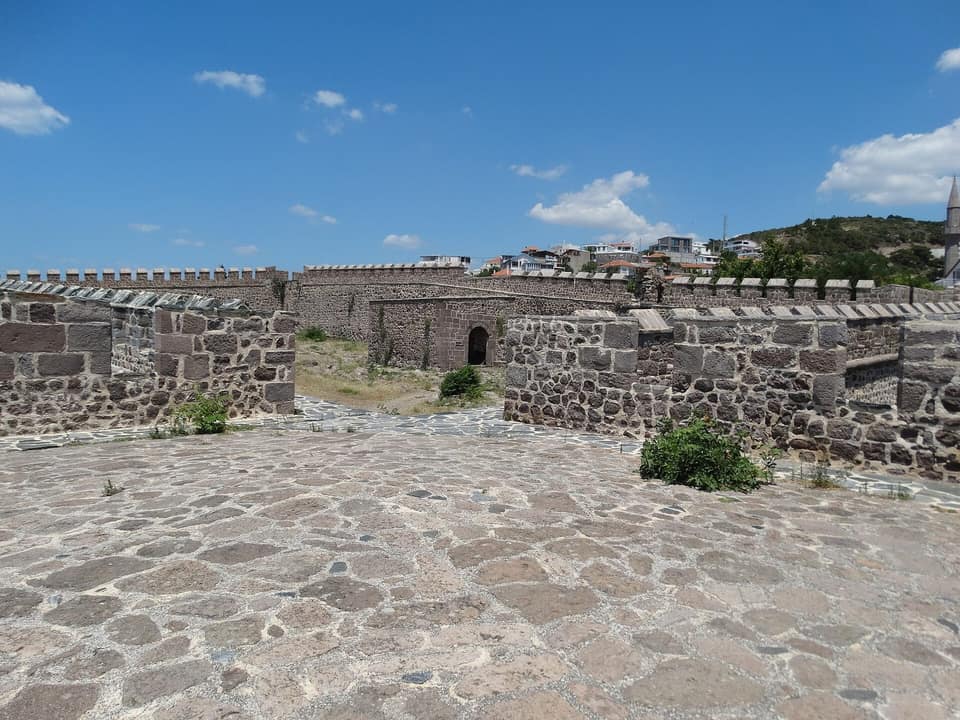
The castle is a rectangular structure stretching along the very tip of the cape, and according to the article it covers an area of about 3508 square metres. The curtain walls are about eight metres high and two and a half metres thick. Because the sides facing the sea are cliffs, there was no need to build a moat or an outer wall. There is a bastion at each corner; an inspection record dated 1830 states that there were 28 cannons in the castle and that most of them were placed on the bastions facing the sea.
The main entrance is through the gate in the middle of the north-eastern facade. The present iron-clad wooden door was made later, and the remains of the original door stand at the entrance. At the entrance you can see niches thought to have been made for guards to wait in. Besides the main gate, there is another small postern gate on the south wall next to the powder store, used to send out messengers during an attack. Inside the castle a mosque, a fountain, a bath, an oven, a powder store and barracks were built for the needs of the soldiers. The remains of a fountain stand to the left of the entrance, and the spaces under the north-eastern and south-eastern bastions were used as dungeons.
Over time a village grew up next to the castle and served as its outer quarter. According to the article, about a thousand people lived in Babakale in 1839, and by the end of the century the population had reached three thousand. A market was set up opposite the castle, stretching in from the village square, to meet the needs of the soldiers in the castle. The most common trade in the village was knife-making, and 19th-century sources mention Babakale for its yataghan knives. Kaymak Mustafa Pasha also had a harbour built together with the castle, and over time the village came to have two mosques, two baths and five fountains.
In the following centuries the castle went through many inspections and repairs. Documents dated 1773 record in detail the expenses for renewing the gun carriages. When piracy increased again in the region in the early 19th century, the villagers reported to the capital in petitions that the castle had been left unprotected, and the defences were strengthened as a result.
Start your visit at the square in front of the gate and first look closely at the arched entrance with its inscription. Inside, you can use the ramp leading up to the walls to walk along the curtain walls and see both the village and harbour and the open sea from the corner bastions. Because the castle stands at the westernmost tip of Anatolia, the walls facing west are a good place to watch the sunset. When walking in the courtyard, take care not to step on the foundation traces of the old buildings. The harbour just below the castle is worth a short walk to understand how the castle looks from the sea. Babakale is reached by road via Ayvacık and can be combined with Smintheion and Assos on the same day. It is best to get current information on visiting conditions from the local administration or the provincial directorate.
Comments
Loading...
Location - Babakale Kalesi
Venue Info
AddressBabakale köyü, Ayvacık / Çanakkale
VenueAyvacık / Çanakkale, Çanakkale
TypeHistorical & Cultural Sites