

Historical & Cultural SitesHistorical Sites
Babaeski Köprüsü
7
No ratings yet
Sign in to like and rate
Babaeski Bridge
Babaeski Deresi üzeri, Babaeski'nin Lüleburgaz çıkışı, Babaeski
Babaeski, Kırklareli
Get DirectionsApple MapsAbout Venue
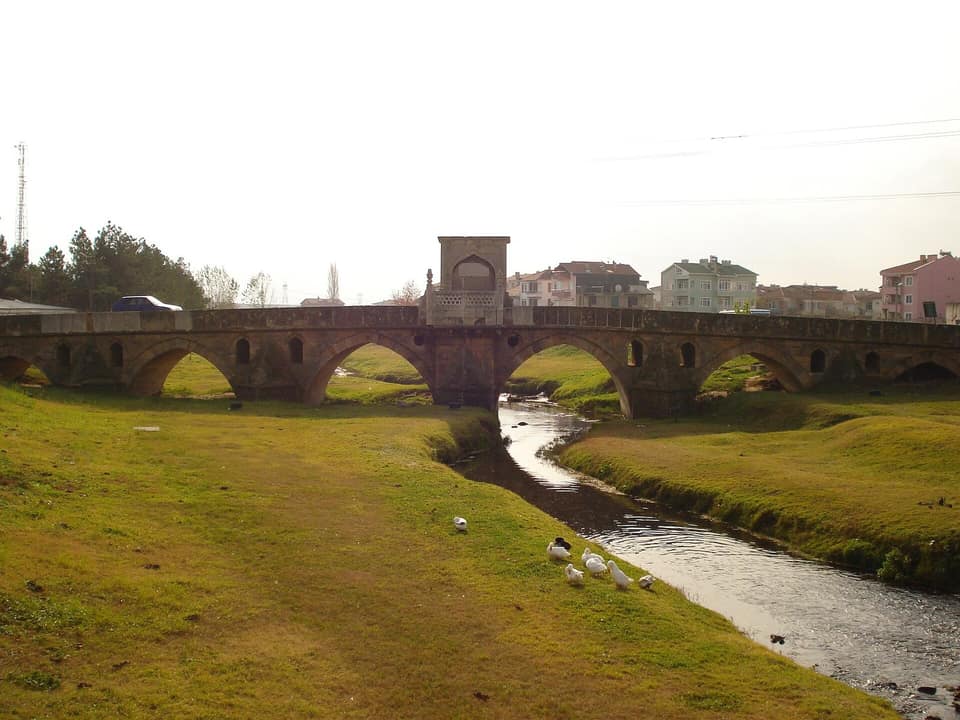
Babaeski Bridge is an Ottoman stone bridge over the Babaeski Stream, one of the tributaries of the Ergene River, in the Babaeski district. The stream is also popularly known as the Devil's Stream, and the bridge stands at the Lüleburgaz exit of the town. In the sources it is also called the Murad IV Bridge. The bridge lies on the military and trade road running from Anatolia to the Balkans, that is, on the old main route between Istanbul and Edirne.
In the inscription kiosk at the middle of the bridge there is a verse inscription of five couplets. According to the Culture Portal and Wikipedia, this inscription records that the bridge was built in 1043 in the Hijri calendar, that is 1633, during the reign of Sultan Murad IV. The provincial yearbook notes that the inscription is written in five lines on a white marble panel, with its edges decorated with rosette and flower motifs. Some promotional texts attribute the bridge to Mimar Sinan, but since Sinan died in 1588 the attribution of this structure dated 1633 is disputed.
According to Wikipedia, Evliya Çelebi, who lived in the period when the bridge was built, describes it as a charitable work of Çoban Veli Kasım Ağa. The story goes that Kasım Ağa once grazed sheep on these banks, vowed to build a bridge here if he was freed from prison, and later rose to the rank of steward in the Janissary Corps. A line in the inscription stating that the bridge was built by one of the sultan's servants fits this account. The names Mimar Kasım Ağa or Mimar Davud Ağa are put forward as the architect, but since Davud Ağa died in 1599 he is thought not to be the builder.
Wikipedia reports that foreigners coming from Rumelia on their way to Istanbul were inspected here by the Head Gardener of Rumelia. According to the same source, an archive document dated 1690 shows that an official was assigned to clean the bridge. These details show that the bridge was not only a crossing but also a checkpoint that kept order on the road.
The bridge is a masonry structure faced with regularly cut stone. According to the provincial yearbook it is about 72 metres long and 5.85 metres wide. It has six pointed arches, and large flood openings were placed between the arches so that it would not be damaged when the river overflowed. According to Wikipedia there are ten relief openings, eight with pointed and two with round arches. Although Evliya Çelebi wrote that the bridge had seven arches, six are counted today.
According to the yearbook, the cutwaters are pointed on the north side and rounded on the south side. In the middle of the bridge there is the inscription kiosk on the side facing south and a balcony or viewing kiosk on the north. The Culture Portal describes the guard cells as stonework carved like lace. The northern guard cell was rebuilt faithfully to its original form. According to Wikipedia, wheel of fortune, tulip and flower motifs are concentrated on the keystones and on the inscription and viewing kiosks.
The bridge is still open to vehicles and pedestrians today, and its deck is covered with asphalt. That is why the finest view of the bridge is not from its deck but from the meadow on the bank of the stream. Going down to the bank and looking at the facade with the inscription kiosk rising in the middle shows the arrangement of the arches and relief openings at a glance. Watch out for traffic when crossing the bridge; standing on the pavement is enough to see the inscription kiosk up close.
Babaeski lies south of the provincial centre on the highway between Istanbul and Edirne, and the bridge is easy to find at the roadside on the east side of the town. On the same route lie Alpullu Bridge to the south and the Sokullu Mehmed Pasha Bridge in Lüleburgaz to the east. Visiting the three bridges by car on the same day is a good way to see the water crossings of the old road in the Ergene basin together. In the morning or late afternoon, when the light falls sideways on the stone facade, the texture of the arch stones is easier to read.
Comments
Loading...
Location - Babaeski Köprüsü
Venue Info
AddressBabaeski Deresi üzeri, Babaeski'nin Lüleburgaz çıkışı, Babaeski
VenueBabaeski, Kırklareli
TypeHistorical & Cultural Sites