

Historical & Cultural SitesArchaeological Sites
Assos Ören Yeri (Behramkale)
10
No ratings yet
Sign in to like and rate
Assos Archaeological Site (Behramkale)
About Venue
Assos is an ancient port city in the Ayvacık district of Çanakkale, living side by side with the village that today bears the name Behramkale. It lies about 87 kilometres by road from the centre of Çanakkale, and its ruins share the same hill with the village houses. The city was built on and around an extinct volcanic cone that faces the Gulf of Edremit and whose height above the sea is given in the sources as between 234 and 238 metres. The stone of the hill, andesite, is a volcanic rock that is hard to work but extremely durable, and almost every building in the city was made of it.
According to the Provincial Directorate of Culture and Tourism, archaeological evidence shows that Aeolians from the island of Lesbos (Midilli) opposite settled here from the 7th century BC onwards. Recent excavations have pushed the history of the site back to the Bronze Age. Over time the people of Assos grew strong enough to found the city of Gargara to the east. Coming under Lydian rule around 560 BC, the city was regarded as the most powerful settlement north of the Gulf of Edremit. Persian rule, the Athenian naval league, Alexander the Great, the Kingdom of Pergamon and, after 133 BC, the Roman period followed.
One of the names that made Assos known in the ancient world is Aristotle. The city's ruler Hermias was a student of Plato and invited his friends to Assos. Aristotle lived and taught here for about three years, between 347 and 345 BC; the Governorship page writes that he founded a school of philosophy here and worked on the natural sciences. The Roman author Pliny records that in the Roman period the city was also called Apollonia and that its sarcophagi carved from local stone were famous.
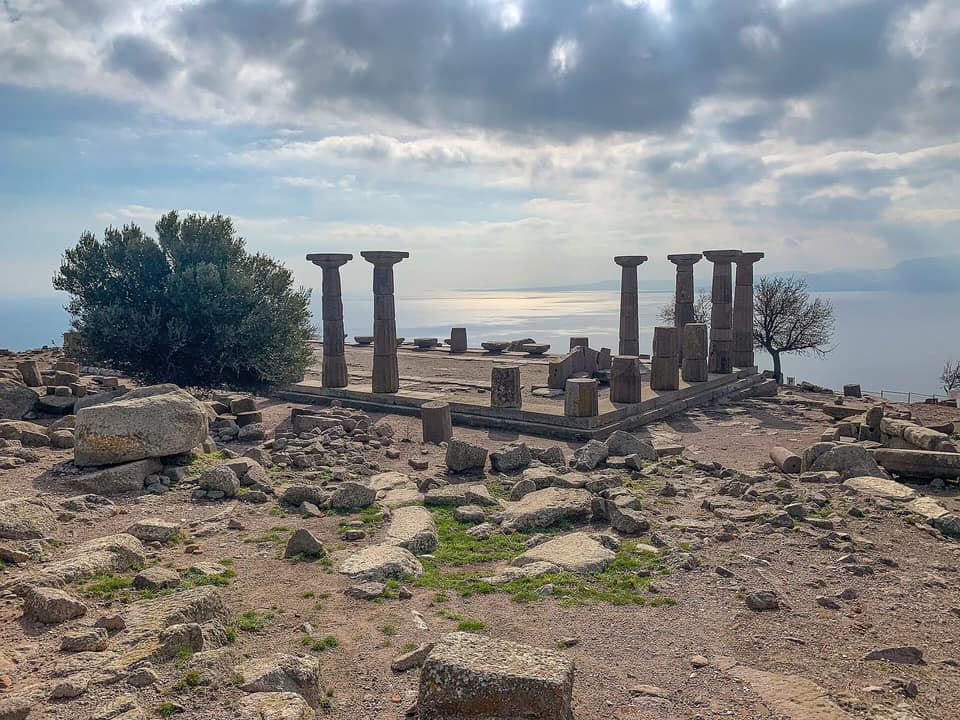
The most important building of the site is the Temple of Athena on the highest level of the acropolis. Ministry sources date it to the 6th century BC, and the provincial directorate to around 530 BC. The temple is regarded as the first and only known example built in the Doric order in Anatolia during the Archaic period. Its place in architectural history is also defined by being the first building in which a relief frieze and decorative elements from Ionic architecture were added to the Doric style. Mythological scenes and animal combats are carved on its friezes and metopes. Today the view between the re-erected andesite columns towards the Gulf of Edremit and the coast of Lesbos is the most photographed image of the site.
Excavations have also revealed single-storey houses from the 6th century AD around the temple. These houses belong to a period when the city had shrunk and the acropolis was defended like an inner citadel against pirate raids. At the northern corner of the acropolis stands the single-domed Hüdavendigar Mosque, built by Murad I in the 14th century. Below the village, the early Ottoman bridge over the Tuzla Stream is still in use today.
The public buildings of the city line the terraces that descend south from the acropolis towards the sea. A two-storey stoa stands on the north side of the agora, and the official buildings are grouped on its eastern side. Here you can see the remains of the bouleuterion, where the city council met, and of a platform built for speakers. Between the agora and the great western gate lies the gymnasium of the Hellenistic period. The stone road descending from the west of the agora reaches first the baths and then the theatre, which faces Lesbos. The capacity of this Roman-era theatre is given in the sources as between four and five thousand people.
A large part of the walls surrounding the city still stands, and most of the sections seen today date from the 4th century BC. The length of the walls is given in the sources as between three and four kilometres; the provincial directorate's Ayvacık page mentions towers reaching twenty metres in places and a number of gates. The terraces along the road to the western gate were used as a necropolis. The Archaic street, paved with large stones and dated to the 6th century BC, is well preserved, and many tombs and sarcophagi line both its sides. Because these andesite sarcophagi made the body return quickly to the earth, they were known in antiquity as flesh-eating sarcophagi and were sent to many parts of Anatolia.
The first scientific excavations at Assos were carried out between 1881 and 1883 on behalf of the Archaeological Institute of America. After a gap of a hundred years, work resumed in 1981 under Prof. Dr. Ü. Serdaroğlu. Since 2006 the excavations have been conducted on behalf of Çanakkale Onsekiz Mart University. Some blocks from the temple were taken to France in 1838 and are now in the Louvre; other finds from the city are displayed in the museums of Boston, Istanbul Archaeology and Troy. Assos was placed on the UNESCO World Heritage Tentative List in 2017.
The easiest way to visit is to start at the acropolis and walk down along the terraces towards the harbour, because the buildings are already arranged on the terraces in this order. The ancient roads and terraces are stony and uneven, so wear closed, sturdy shoes. As the acropolis is an exposed hilltop, in summer it is best to choose the early morning or the late afternoon and to carry water. The Governorship page describes the acropolis as the best place to watch the sunset over the Gulf of Edremit. Since opening hours and entry conditions can change, check the Ministry's museum page before you go. Behramkale is reached by road via Ayvacık, and it is easy to continue to Smintheion and Babakale on the same day.
Comments
Loading...
Location - Assos Ören Yeri (Behramkale)
Venue Info
AddressBehramkale köyü, Ayvacık / Çanakkale
VenueAyvacık / Çanakkale, Çanakkale
TypeHistorical & Cultural Sites