

Historical & Cultural SitesArchaeological Sites
Aşıklı Höyük
38
No ratings yet
Sign in to like and rate
Aşıklı Mound
About Venue
Aşıklı Höyük lies about 25 kilometres southeast of the provincial centre of Aksaray, within the boundaries of Kızılkaya village in the Gülağaç district. One side of the mound faces the Melendiz stream and the other faces fields open to farming; its founders chose a spot close to water and suited to cultivation. According to the excavation team, the village was founded about 10,400 years ago and abandoned after roughly a thousand years of continuous occupation. The Provincial Directorate of Culture and Tourism describes this span as stretching from the second half of the 9th millennium BC to the end of the 8th millennium BC, a life of at least 30 to 35 generations.
The mound is known as the earliest known village in Central Anatolia where hunters, gatherers and nomads settled down. While its inhabitants continued to hunt and gather, they began to cultivate cereals and plants they had previously collected in the wild. Excavations have recovered both wild and domesticated forms of barley, wheat and lentil-family plants in carbonised layers. The results of the excavation project show that legumes such as peas were also grown and that sheep and goats were domesticated. Animal bones reveal that the settlers hunted mostly sheep, goat, aurochs, boar, red deer, fallow deer and roe deer.
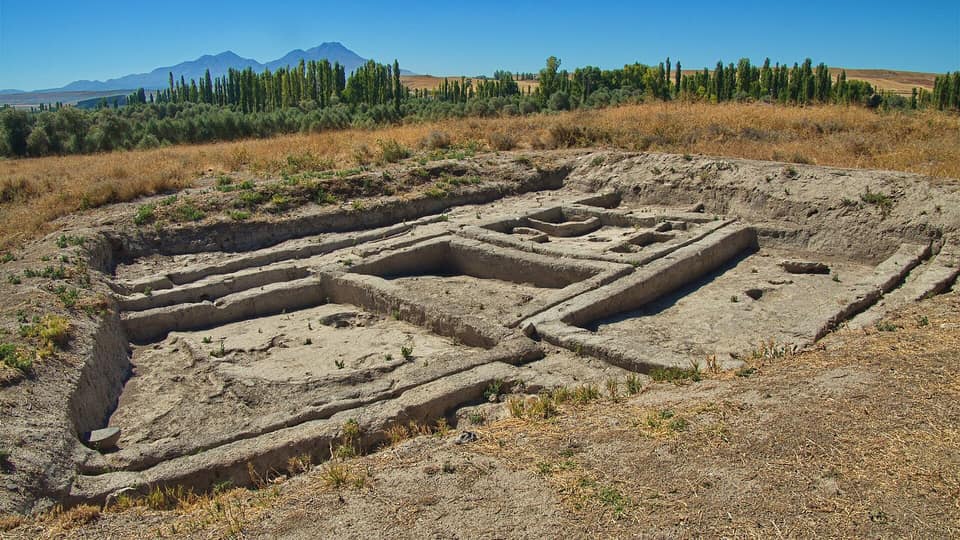
Obsidian, known as volcanic glass and a product of the region's volcanic geology, was the main raw material for the tools and weapons of the Aşıklı people. Everyday tasks such as hunting, butchering, and working hides and leather were all carried out with tools made of this sharp stone. In terms of architectural history, the mound holds the oldest example of the contiguous, rectangular mudbrick architecture typical of Anatolia. House walls were built of sun-dried mudbrick blocks, and the flat-roofed houses were entered by wooden ladders through an opening left in the roof. Among the finds from the mound is the skull of a young woman bearing traces of surgical intervention. This skull and the other finds from the mound are now displayed at the Aksaray Museum in the city centre.
Excavation and research history
Excavations at the mound began in 1989, the year Aksaray became a province, under the direction of Ufuk Esin, then head of the Department of Prehistoric Archaeology at Istanbul University. Today the Aşıklı Höyük Excavation and Research Project is carried out by an international team led by scholars from Istanbul University and Mimar Sinan University. Interdisciplinary research identifies the Aşıklı community as the forerunner of the farming societies of present-day Central Anatolia. The mound opened to visitors in 2009 and is listed on the Ministry of Culture and Tourism's museums and archaeological sites pages.
What to see and how to visit
At the entrance, visitors are greeted by full-scale replicas of a group of excavated houses, rebuilt using the methods of experimental archaeology. The reconstructions include two semi-subterranean houses dated to the 9th millennium BC. Single or two-roomed rectangular mudbrick buildings of the 8th millennium BC, arranged around a street, have also been rebuilt. Inside the houses, finds and reconstructions reflecting the prehistoric way of life are on display. Shrubs and trees such as hackberry, wild almond and wild plum have been planted in this area as well. Every year the researchers sow wild wheat in an experimental field here and harvest it with obsidian tools. After the open-air section, the second stop is the excavation area, where the original remains can be seen under a protective roof.
If you start with the reconstructed houses and then move on to the real walls under the roof, it becomes easy to compare a rebuilt house with the traces left in the ground. Do not leave the marked path in the excavation area and do not touch the mudbrick remains. Looking from the top of the mound towards the banks of the Melendiz helps you understand why the village was founded beside this water. Musular Höyük, west of the Melendiz in the same village of Kızılkaya, is known as one of the oldest settlements of the period after Aşıklı. It has been established that Musular was first settled about 8,000 years ago.
Getting there and visiting
Public transport runs from the centre of Aksaray to Kızılkaya village at certain times of the day. From the village centre, the mound is reached in a walk of about five minutes. Before you go, check the official page on muze.gov.tr for opening hours, closing days and admission conditions. Since the original finds are in the Aksaray Museum in the city centre, pairing the mound with the museum on the same day completes the story. The Melendiz stream flowing past the mound is the same river that carved the Ihlara Valley, so Aşıklı makes a good start to a day of nature and history that leads on to the valley.
Comments
Loading...
Location - Aşıklı Höyük
Venue Info
AddressKızılkaya Köyü, Gülağaç, Aksaray
VenueGülağaç, Aksaray
TypeHistorical & Cultural Sites