

Transportation & City ToursCable Cars & Viewpoints
Amisos Tepesi (Baruthane Tümülüsleri)
11
No ratings yet
Sign in to like and rate
Amisos Hill (Baruthane Tumuli)
About Venue
Amisos Hill is an archaeological site rising northwest of the city that carries Amisos, the ancient name of Samsun. According to the Kültür Portalı, the ancient city of Amisos covers Toraman Hill northwest of the city centre and its slopes, and it was founded on a height commanding its surroundings. Written sources report that the city was founded in the 6th century BC by Milesians who had established a colony at Sinop. The Kültür Portalı describes the founding and growth of the city in four stages. In the first stage the Milesians used Amisos, a small settlement, as the starting point of the trade route linking the Black Sea with inner Anatolia. Then Cappadocians settled here, Phocaeans also arrived with the permission of the Cappadocian leader, and the city grew. In 437 BC, with the settlement of Athenians coming from Sinop, the name of the city was changed to Peiraieus.
The Upper City, built on the ridges of Toraman Hill, is thought to have covered an area of about 44 hectares. The harbour lay to the east of the hill, and behind the harbour there was a Lower City with commercial warehouses and sailors' quarters. The eastern, western and southern slopes of the city were used as cemeteries. Amisos grew strong through the trade networks that developed in the Hellenistic period and enjoyed its most brilliant era under Mithridates VI, king of Pontus. The city also continued to exist in the Roman and Byzantine periods.
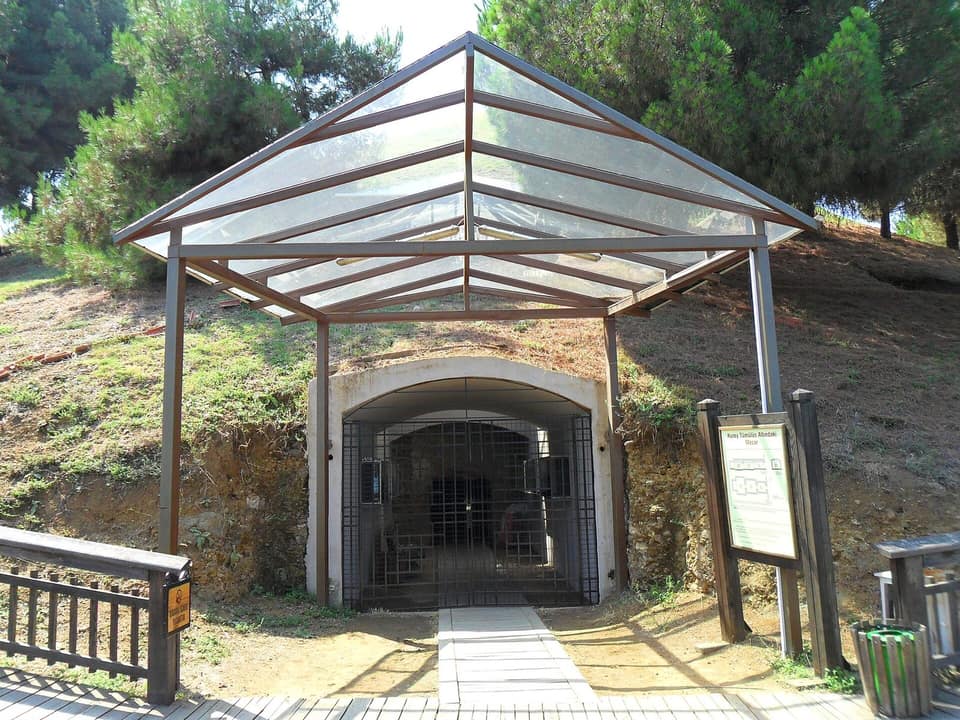
The most visible remains on the site are two large artificial mounds known as the Baruthane Tumuli. Rescue excavations begun in 2004 uncovered tombs beneath these mounds. At the end of scientific excavations carried out jointly by Samsun Museum and Istanbul University, two separate tombs were opened to visitors. According to the Samsun guide of the Middle Black Sea Development Agency, the excavations took place in 2004, 2005 and 2006, with Prof. Dr. Sümer Atasoy as scientific adviser. It is understood that the tumuli were built in the Hellenistic period, when the Mithridatic dynasty reigned.
The southern tumulus is about 15 metres high and 40 metres wide, and beneath it lies a two room tomb carved into a conglomerate layer. The walls, ceiling and floor of the burial chambers are covered with cream coloured plaster. Lines were incised on the walls of the front room to give the look of stone masonry, and these lines were filled with navy blue paint. Above and beside the door to the back room there are niches painted yellow, and in the back room stands a funerary bed with a decorated front. The agency's guide notes that this tomb may be the only painted and plastered example found on the Black Sea coast. Pottery fragments, jugs, perfume bottles, bone ornaments and bronze nails were found during the excavations. The northern tumulus is about 8 metres high and covers a tomb of three rooms arranged one behind the other. The rooms of this tomb are unplastered and their walls are decorated with false half columns.
The city's famous treasure, however, did not come from the tumuli; according to the Kültür Portalı it was found in 1995 in a separate rescue excavation in the Cedit neighbourhood of İlkadım. These finds, made up of gold jewellery, are now displayed in a special section of Samsun Museum.
Today the hill is visited like an archaeological park, with wooden walkways and landscaped areas. The page of the Provincial Directorate of Culture and Tourism states that the tumuli and tombs were closed to visitors because of the danger of collapse, so check the current status of access to the burial chambers before you go. Even if the tombs are closed, you can see the covered entrance of the northern tumulus and the shape of the mounds from outside. According to the Kültür Portalı, the hill can be reached from Batıpark by cable car or by car. Find out the current operating information and fares of the cable car from the official announcements of the operating institution. According to the directorate, the area reached by the cable car also has a municipal souvenir centre and restaurants. The Kültür Portalı states that the site is 6 kilometres from the bus station and 28 kilometres from the airport. The hill offers a wide view over the city centre and the coast; the late afternoon, when the light softens, is a good time for photographs. Going on to Samsun Museum after your visit is a good order for thinking about the tomb architecture on the hill together with the finds from Amisos.
Comments
Loading...
Location - Amisos Tepesi (Baruthane Tümülüsleri)
Venue Info
Venueİlkadım, Samsun
TypeTransportation & City Tours