

Historical & Cultural SitesArchaeological Sites
Altıntepe Ören Yeri
7
No ratings yet
Sign in to like and rate
Altıntepe Archaeological Site
About Venue
Altıntepe is an Urartian fortress built on a volcanic hill rising 60 metres above the plain on the northeastern edge of the Erzincan plain. The Culture Portal and the Governorship of Erzincan write that the hill lies 15 kilometres from the city centre, 100 metres north of the highway between Erzincan and Erzurum. Both official sources present Altıntepe as one of the best-preserved Urartian cities to have survived to the present day. The article by the excavation director Mehmet Karaosmanoğlu and Halim Korucu notes that among the volcanic cones surrounding the plain, Altıntepe is the most striking for its setting.
The first scientific excavations on the hill were carried out between 1959 and 1968 by Prof. Dr. Tahsin Özgüç. The Urartian buildings and small finds uncovered in these excavations were regarded as the only examples of the culture they represent and made an important contribution to Anatolian archaeology. Left unprotected after the first excavations, the fortress was looted by treasure hunters. Since 2003 a team led by Prof. Dr. Mehmet Karaosmanoğlu has continued excavation and restoration work on behalf of Atatürk University and the Ministry of Culture and Tourism.
The history of the hill is older than the Urartians. In soundings opened during the second phase of excavations, fragments of Bronze Age pottery of the glossy black burnished Karaz type were found. The Urartian buildings fall into two phases; according to Özgüç, the first level dates to the second half of the 8th century BC and the second level to the second half of the 7th century BC. Because the fortress was built on the trade route linking east and west and was hard to defend, it was enclosed by a double wall. The inner wall surrounds the buildings on the levelled upper part of the hill and has a single-passage gate on the east.
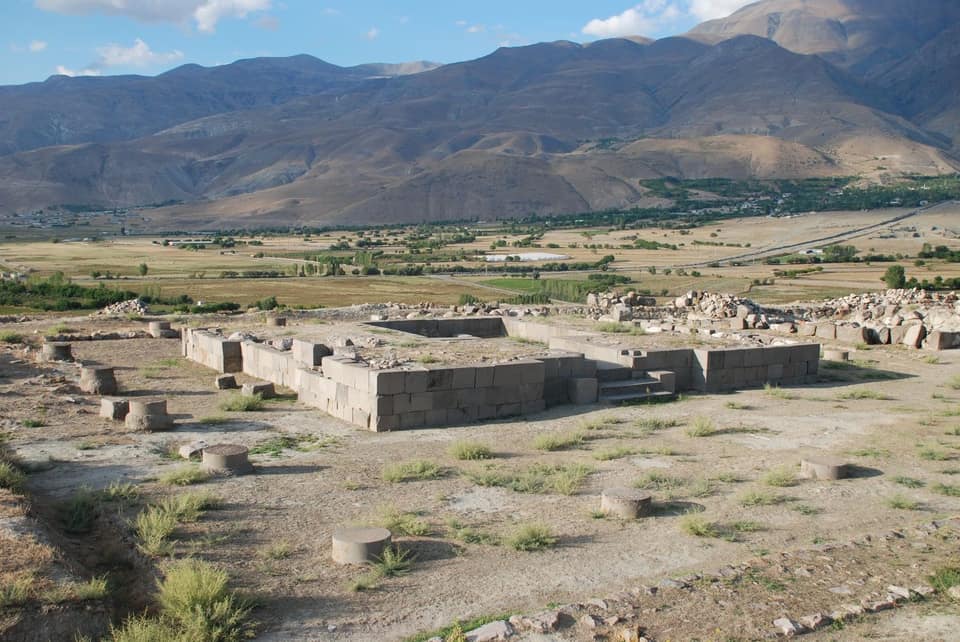
The most important building on the hill is the group that the Culture Portal calls the temple-palace complex. According to the article, the square main building at the core of this complex measures 13.80 by 13.80 metres on the outside and is among the best-preserved and most carefully built examples of Urartian architecture. The first three courses of its thick walls are of fine cut stone, the rest of mud brick, and the building is thought to have been tower-like, about 14 metres high, equal to the length of one side. The main building stands in the middle of a courtyard measuring 27.20 by 30 metres and lined on the inside with porticoes. Wooden posts resting on 20 carefully worked stone bases carried the roof of the porticoes. The mud-brick walls were decorated with coloured paintings.
South of the main building lies the columned reception hall of the Urartian period, the apadana. In its first phase the hall measured 15 by 37 metres and its roof was carried by six wooden posts. The hall was later enlarged and was uncovered in Özgüç's excavations measuring 44 by 25.30 metres, its roof carried by posts standing on 18 stone bases. Karaosmanoğlu and Korucu describe this building as the largest apadana of the Urartian period in Anatolia. The interior of the hall and its gate rooms was adorned with coloured wall paintings made on dry plaster.
The excavations also brought to light details of daily life in the fortress. Next to the rooms where the governor lived, a bathroom with a stone basin was found, together with a sewage system running beneath the buildings, which was evidently planned before the fortress was built. In the storehouse outside the inner wall, 60 storage jars buried up to their shoulders were arranged in six rows of ten. Some of the jars bear incised hieroglyphs and relief crescent motifs. Three underground chamber tombs of built stone were made on the terrace on the southern slope of the hill; the bronze cauldrons, a gold bowl, ivory figurines and horse harness found there are now displayed at the Museum of Anatolian Civilizations in Ankara. The Governorship of Erzincan also records that the names of kings appear on bronze objects inscribed in cuneiform.
The hill continued to be used after the Urartians. On a natural terrace on the eastern slope, the second phase of excavations that began in 2003 uncovered a basilica-plan building of the Byzantine period with interior dimensions of 19.60 by 11.30 metres. A study published in the Journal of Mosaic Research dates the building to the middle of the 6th century, the reign of Justinian I. The coloured mosaics covering its floor, with geometric, plant and animal figures, are considered unique in the region.
Start your visit on the upper plateau of the hill and first read the stone foundations of the square main building together with the column bases in the courtyard. Then move on to the rows of bases of the large hall to the south; the layout of the bases tells you on its own how large the hall was. From the hilltop the Erzincan plain and the surrounding mountains open up in a wide panorama. There is almost no shade on the site; bring a hat and water, and do not climb onto the remains. Check the current visiting conditions of the archaeological site with the provincial directorate of culture and tourism.
Comments
Loading...
Location - Altıntepe Ören Yeri
Venue Info
AddressPiri Sami, 24150 Üzümlü/Erzincan
VenueÜzümlü, Erzincan
TypeHistorical & Cultural Sites