

Historical & Cultural SitesArchaeological Sites
Alinda Antik Kenti
38
No ratings yet
Sign in to like and rate
Alinda Ancient City
About Venue
Alinda is a Carian city built on two rocky hills just above the centre of Karpuzlu district in Aydın. From among the ruins you look down on the Karpuzlu plain, and it is immediately clear that the site was chosen both for defence and for control of the plain. According to the ministry's site description, the city's history reaches back to the second millennium BC, but most of the remains visible today date from the fourth century BC. The name Iyalanda found in Hittite sources is thought to correspond to Alinda, and the Aydın book of the South Aegean Development Agency also lists it among the Hittite-period cities of the region. According to Wikipedia, the city was one of those paying tribute to the Delian League in the fifth century BC.
Alinda's best known moment in history concerns Queen Ada, sister of the Carian satrap Mausolus. According to the account based on Strabo, Ada was driven out of Halicarnassus by her brother Pixodarus around 340 BC, withdrew to Alinda and made it her seat. When Alexander the Great arrived in Caria in 334 BC, Ada went out to meet him and offered to hand over the city and to support him against the relatives who had seized the throne. After conquering western Anatolia, Alexander left Ada in office and gave her the government of the whole of Caria. The ministry text notes that this development led the city to adopt Greek culture rapidly. For a time the city was known as Alexandria by the Latmos, but it had returned to its old name by 81 BC at the latest. Alinda remained an important trading city that minted its own coins from the third century BC to the third century AD.
The city was enclosed by a wall built of local granite and reinforced in places with two-storey towers. The first large building visitors reach is the agora building, and it is the most impressive structure still standing at Alinda today. Running east to west, it has three storeys, with the top floor level with the agora square to the north and the lowest floor opening onto a narrow terrace to the south. The lower floor is divided in two by a wall running its full length, and cross walls cutting that wall divide it into shops arranged as paired rooms. Standing in front of the tall walls and looking through the window openings, it becomes easy to picture daily life in a busy Hellenistic market place.
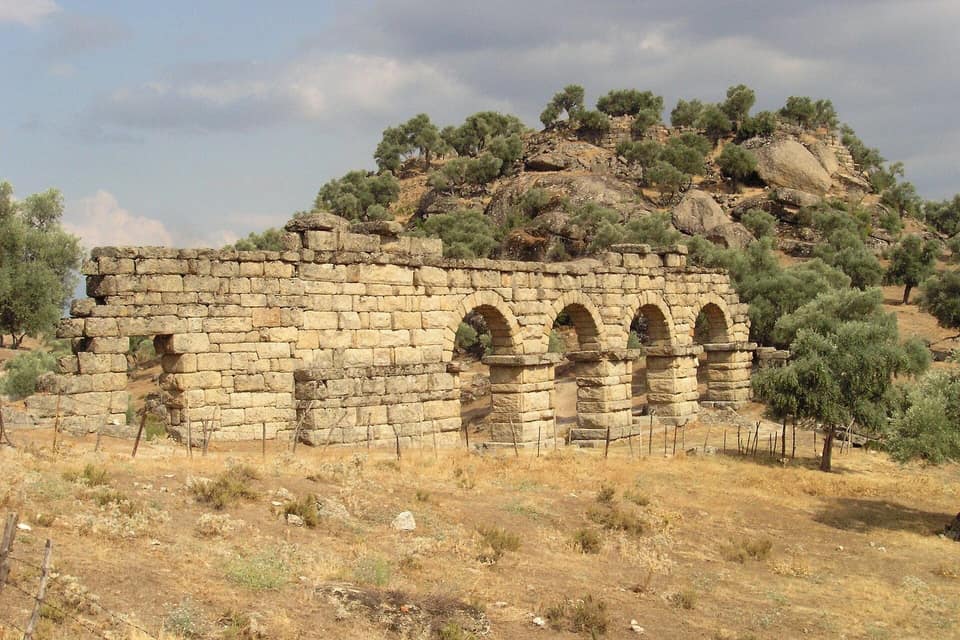
The theatre on the south-western slope of the lower acropolis rests on a natural incline, and its seating, which faces south-east, survives close to its original height. Its stage building has collapsed completely, but the theatre shows Hellenistic features and continued in use in the Roman period with later additions. Wikipedia gives its capacity as about five thousand, and when you climb the rows and sit down the whole plain opens out in front of you. At the western end of the upper acropolis stands the aqueduct with round arches, rising on four piers as far as it survives. Above the arches you can make out the water channel, and where it meets the city wall the remains of a roughly square collecting basin. Rising among olive trees in front of the rocky hill, the aqueduct offers the finest photograph on the site.
On the acropolis there are two temple foundations whose plans alone can still be traced. The surroundings of the city are covered with tombs that spread as far as the far slope of the hill beyond the aqueduct. Many of them are of the so-called Carian type, made by cutting a cavity into a large rock and covering it with a separate lid stone. The sarcophagi you will come across between the houses of Karpuzlu show that the city's cemetery was concentrated on the southern slope. The ministry description stresses that because the district was built over the ancient fabric, most Roman structures have been lost, yet Alinda remains one of the best preserved cities in the region.
Most of the site has not been restored, and the paths between the ruins are stony and steep in places, so you should wear shoes with a firm sole. Allow a few unhurried hours for a walk from the agora to the theatre and on up to the upper acropolis and the aqueduct. There is little shade on the hills in summer, so it is more comfortable to go up early in the morning or late in the afternoon. According to the Culture Portal, Alinda is reached by a road of about 26 kilometres that leaves the Aydın to Muğla highway at its thirtieth kilometre. The same source notes that you can also come by metropolitan municipality buses and Karpuzlu minibuses from central Efeler. Visiting hours vary by period, so check the current information on the ministry's museum website before you go.
Comments
Loading...
Location - Alinda Antik Kenti
Venue Info
AddressOrta Mahallesi, Alinda Caddesi, Karpuzlu / Aydın
VenueKarpuzlu, Aydın
TypeHistorical & Cultural Sites