

Historical & Cultural SitesArchaeological Sites
Aleksandreia Troas Ören Yeri
10
No ratings yet
Sign in to like and rate
Alexandria Troas Archaeological Site
About Venue
Alexandria Troas is a large Hellenistic and Roman city in the Kestanbolluk area within the borders of Dalyan village, in the Ezine district of Çanakkale. The ruins spread over a wide plateau near the Aegean coast, covered with olive groves and scrub. The city is regarded as one of the largest ancient cities of Anatolia and was for many years the main harbour of the Troad region.
The founding of the city goes back to the period after Alexander the Great. According to the Ministry of Culture and Tourism, the city was founded in 310 BC by Antigonus Monophthalmus, one of Alexander's generals, under the name Antigoneia. After Alexander's death Lysimachus changed the city's name and gave it the name Alexandria Troas, meaning the city of Alexander in the Troad. According to the provincial directorate's Ezine page, when the city was founded the people of the surrounding cities of Gargara, Hamaxitus, Neandreia, Kolonai, Larisa, Kebren and Skepsis were settled here. Life at Neandreia on the summit of Mount Çığrı also came to an end with this migration.
The city was laid out according to a plan drawn in advance and covers an area of about 390 hectares. This area was surrounded by city walls about eight kilometres long. It was a planned settlement with temples, baths, a stadium, a fountain, a stone-paved street, a theatre, an aqueduct and a harbour. The Culture Portal writes that the city lived its most brilliant years in the Roman period and that its population reached up to a hundred thousand people.
In the Roman period the city revived. According to the provincial directorate, Augustus had a colony founded here for retired Roman soldiers and supported the city's transformation into a Roman metropolis. According to the account based on Suetonius, the biographer of Caesar, the city's position between Europe and Asia even led to the idea of making it the capital. A similar idea later came up under Emperor Constantine, but Constantinople was eventually chosen as the capital.
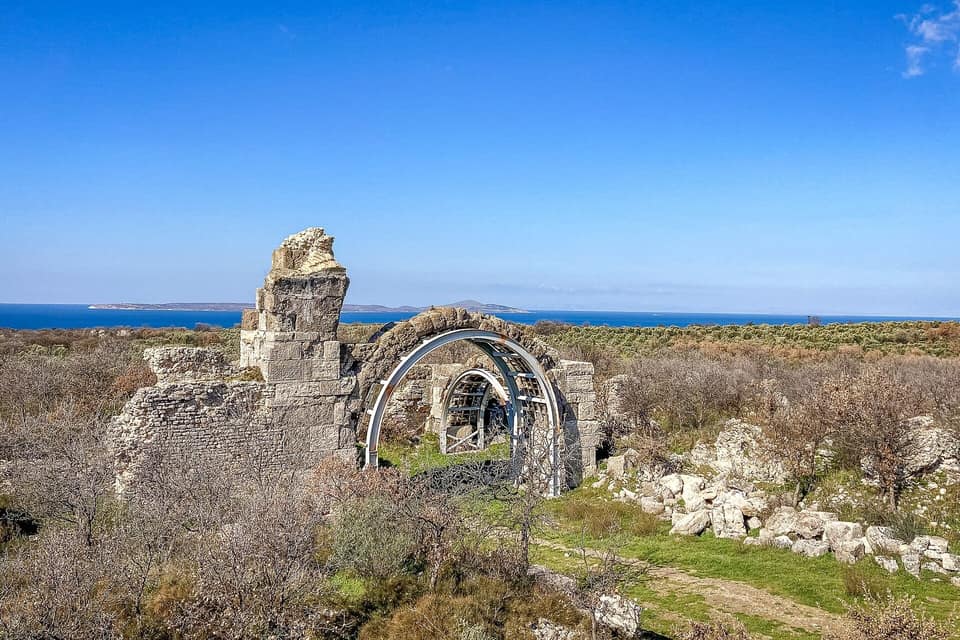
Another golden age of the city was the 2nd century AD. Herodes Atticus of Athens, one of the richest men of the ancient world, had a great aqueduct built from Mount Ida (Kaz Dağı) to the city. The great bath, the symbol of the city, was built together with this aqueduct in AD 135. With dimensions of about 123 by 84 metres it is one of the largest Roman baths in Anatolia, and the provincial directorate writes that its facade is about a hundred metres long. Most of the building stood until 1809 and collapsed in an earthquake that year. The huge arches seen today belong to the parts that survived from that time. The Gymnasium of Herodes Atticus, adjoining the bath on the west, is known as one of the largest gymnasiums in Anatolia.
Near the bath is the nymphaeum, or monumental fountain, considered one of the most beautiful buildings of the city. To the east of the city lies a great water gate with a round inner courtyard and a tower on each side. Built at the beginning of the 3rd century BC, this gate was used until the city was abandoned. The inner courtyard of the gate is twenty metres in diameter, and it is striking that the lower parts of its walls are carved into the bedrock.
At the highest point of the city a large theatre was built as early as the Hellenistic period. From the site of the theatre a wide view opens towards Neandreia on Mount Çığrı to the east, Lesbos to the south, Bozcaada to the west and the Dardanelles to the north. The function of the rectangular building to the north-west of the theatre has not been determined to this day; medieval and early modern travellers described it as the Palace of Maidens, a pirates' refuge or a palace. To the west of the city centre there is a temple where excavations continue. The rebuilding of this temple, whose foundations reused cut stones from the Hellenistic period, is thought to date to the time of Augustus. Many relief-decorated and coloured marble architectural pieces and a head of a statue of Dionysus have been found in the temple area.
The ancient harbour is now closed off from the sea and offers a calm view at sunset. The provincial directorate writes that the harbour is thought to have replaced the silted-up harbour of Ilion and that Roman soldiers passed through here on their eastern campaigns. The excavations are now carried out under the direction of Prof. Dr. Erhan Öztepe of Ankara University.
Because the site is spread over a wide area, beginning the visit with the bath, the symbol of the city, and the adjoining gymnasium makes it easier to grasp the scale of the city. The paths between the ruins are scrubby and stony, so wear sturdy shoes and carry water in summer. Do not go too close to the protective structures in the excavation areas or to the base of the standing arches. According to the Culture Portal, it is possible to get there by village minibuses via Ezine, but a car is more convenient for moving between the sites. Since visiting conditions can change, check the Ministry's museum page before you go.
Comments
Loading...
Location - Aleksandreia Troas Ören Yeri
Venue Info
AddressDalyan köyü, Kestanbolluk mevkii, Ezine / Çanakkale
VenueEzine, Çanakkale
TypeHistorical & Cultural Sites