

Historical & Cultural SitesArchaeological Sites
Alacahöyük
8
No ratings yet
Sign in to like and rate
About Venue
Alacahöyük is a mound in the town of Alacahöyük, in the Alaca district of Çorum, settled layer upon layer for thousands of years. According to the sources of the Ministry of Culture and Tourism, it was one of the important centres of culture and art of the Hittites. The site lies 49 kilometres from Çorum and only 8 kilometres from the Çorum-Ankara highway. According to the travel guide of the provincial directorate it is 39 kilometres by road from Hattusa and 60 kilometres from Sapinuwa.
From discovery to a national excavation
The mound was first introduced to the scholarly world in 1835 by the British researcher William Hamilton. Then, in 1861, 1881 and 1893, G. Perrot, W. Ramsay and E. Chantre carried out studies here during their journeys through Anatolia. In 1907 Makridi Bey, at the suggestion of Halil Ethem Bey, director of the Istanbul Archaeological Museum, carried out work at the Sphinx Gate that lasted about fifteen days. The first truly systematic excavations on the mound, however, began in the Republican period, in 1935, on behalf of the Turkish Historical Society by order of Atatürk. This excavation is considered one of the first national excavations of Türkiye, and the provincial directorate presents it as the first official excavation of the Republic. The work was started by Remzi Oğuz Arık, and Hamit Zübeyr Koşay and Mahmut Akok continued the excavation until 1983. The excavations, interrupted in 1983, were resumed in 1996 by Prof. Dr. Aykut Çınaroğlu. After a three-year break the work has continued since 2021 under the direction of Prof. Dr. Tayfun Yıldırım.
Four layers of civilisation
Four main layers of civilisation were uncovered in the excavations. The fourth layer, at the bottom, reflects the first settlement founded on virgin soil, that is, the Late Chalcolithic Age. The third layer is the Early Bronze Age, dated to between 2500 and 2000 BC, and the finds that made the mound famous come from this layer. The second layer belongs to the Hittite period, and large buildings, block houses, streets, large and small water channels and the city wall were uncovered in it. The first layer at the top represents the Phrygian, Hellenistic, Roman, Byzantine and Seljuk-Ottoman periods.
The Sphinx Gate
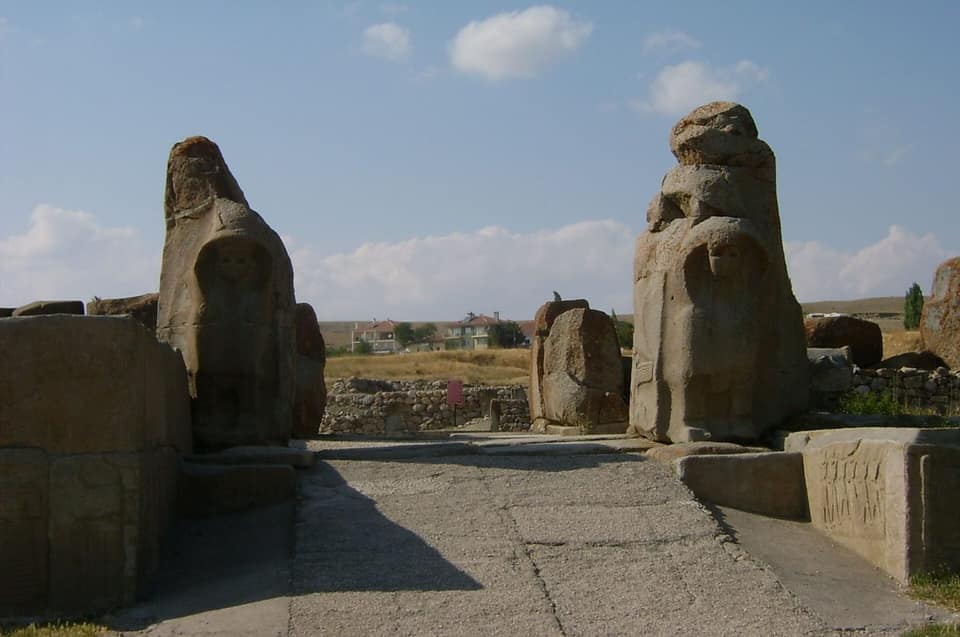
The first structure to greet the visitor is the Sphinx Gate, built of andesite blocks on a limestone foundation. The gate is 10 metres wide, and the jamb blocks on either side are carved in the form of sphinxes. The inner and outer faces of the two towers carrying the sphinxes are decorated with relief orthostats, in other words upright stone slabs. A bull figure stands out among the reliefs on the western tower. Some of the works found on the mound are displayed in the Alacahöyük Museum, and some among the most valuable collections of the Museum of Anatolian Civilizations in Ankara.
The Early Bronze Age tombs
The most important finds of the mound are 13 tombs dated to the Early Bronze Age and thought to belong to princes and princesses. The rectangular tombs, with sides lined with stone, were covered with wooden beams, and the heads and legs of cattle were placed on top of them. The tombs yielded ornaments, sun discs, statues of deer and bulls, and weapons such as daggers, swords and axes. These rich works, made of gold, silver, electrum, copper, bronze and precious stones, show that the tombs belonged to a dynasty. The vessels made with hammering, casting and inlay techniques and the fine decoration of the gold jewellery are the product of a long craft tradition. These tombs have contributed greatly to the understanding of the native Hattian civilisation, which was a source of Hittite culture.
The Alacahöyük Museum
The first local museum at Alacahöyük opened in 1940, moved to its building inside the site in 1982 and was rearranged in 2011. The halls bear the names of the excavation directors, and in the Hamit Zübeyr Koşay hall the place of the excavations in Turkish archaeology is explained with wall panels. Works from the Chalcolithic, Early Bronze Age and Hittite periods are displayed in the Remzi Oğuz Arık hall, and Hittite and Phrygian works in the Mahmut Akok hall. The showcase on the history of the excavation holds tools used in the dig and part of the scientific publications on Alacahöyük.
Visiting
Because the museum is inside the site, going into the halls first and then out onto the open ground makes it easier to recognise the layers and the tomb area in the field. There is little shade on the open ground, so choose the morning hours in summer. Check the official museum website of the Ministry of Culture and Tourism for up-to-date information on opening hours and entry conditions. The Hittite Way walking trails, marked in 2011 in the Alacahöyük, Hattusa and Sapinuwa triangle, also pass through this area. Made up of eleven short and six long trails with a total length of 380 kilometres, this network offers an option to those who want to link the excavation sites on foot.
Comments
Loading...
Location - Alacahöyük
Venue Info
AddressAlacahöyük beldesi, Alaca / Çorum
VenueAlaca, Çorum
TypeHistorical & Cultural Sites