

Historical & Cultural SitesArchaeological Sites
Afrodisias Antik Kenti ve Müzesi
38
No ratings yet
Sign in to like and rate
Afrodisias Ancient City and Museum
About Venue
Aphrodisias is an ancient city in the Geyre quarter of Karacasu district in Aydın, set in the fertile valley cut by the Dandalaz stream, a tributary of the Büyük Menderes. The city stands on a plateau about 600 metres above sea level, with the slopes of Babadağ rising to the north. According to the Culture Portal, traces of settlement here go back to the middle of the fifth millennium BC, and the Acropolis and Pekmez mounds within the site bear witness to that deep past. A small village in the sixth century BC, the settlement gained the status of a city state in the second century BC, during the intense urbanisation of the Menderes valley, and was laid out anew on a grid plan. The city takes its name from the sanctuary of Aphrodite that stood at the centre of its identity.
Having built close ties with Rome in the first century BC, Aphrodisias came under the protection of Octavian, and in 39 BC the Roman Senate granted it tax exemption and autonomy. These privileges opened the way to the golden age in which most of the monumental marble buildings you see today were raised. The city's real wealth lay in the white and blue-grey marble quarries opened on the foothills of Babadağ, two or three kilometres to the north-east. Having the quarries so close to the city turned Aphrodisias into a sculpture centre that was famous across the Mediterranean world from the first century BC to the fifth century AD. Works signed by sculptors from Aphrodisias have been found in many cities of the empire, Rome above all.
According to the excavation project run with Oxford University, the city was a medium-sized settlement of about 72 hectares, yet its monuments carried the grandeur of a metropolis. At the end of the third century Aphrodisias became the capital of the newly created Roman province of Caria, and it kept its classical fabric until the widespread urban collapse of the seventh century. The excavation team stresses that its distance from the main roads is what allowed the city and its sculpture to survive so well. Together with the ancient marble quarries to the north-east, Aphrodisias was inscribed on the UNESCO World Heritage List in 2017.
European travellers had known the ruins since the eighteenth century, and in 1705 William Sherard became the first to record the inscriptions built into the city walls. The first excavations were carried out in 1904 and 1905 by a French team under Paul Gaudin and Gustave Mendel, and the finds of 1905 were brought to the Istanbul Archaeological Museum on the initiative of Osman Hamdi Bey. Systematic and continuous excavations began in 1961 for New York University under Kenan Erim, who led the work until his death in 1990. According to an often-told story, the photographer Ara Güler went to Karacasu in 1958 to photograph the opening of a dam, noticed the ancient stones in the walls of the village houses and drew international attention to the city with his pictures. Turkish Wikipedia, however, notes that the city was known long before, and that Güler's contribution was to bring the ruins back into the spotlight.
It makes sense to start at the museum by the entrance, because Aphrodisias is one of the rare places where the museum and the site are intertwined. According to the ministry brochure, the finds were first stored in a caravan inn in the old village of Geyre, and the present museum building opened to visitors on 21 July 1979. The halls display imperial and portrait statues made by the sculpture school, the Zoilos Frieze, the statue of Melpomene, the muse of tragedy, and the group of Achilles and Penthesilea. A first century AD marble copy of the Diskophoros, the bronze statue by Polykleitos, and a horse carved from a single block of blue marble are other highlights of the collection. Do not miss the corner with the unfinished statues, because there you can best see the stages through which the stone was shaped. Since 2008 the high relief panels of the Sebasteion complex have been displayed in the museum's annex.
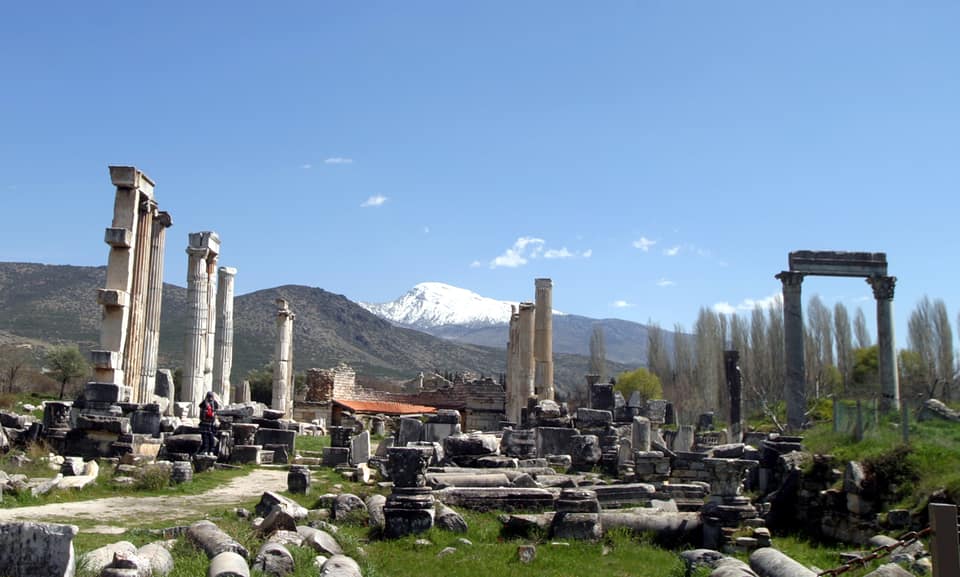
When you walk from the museum into the site, the first major stop is the Tetrapylon at the end of the main north-south street. Dated to around AD 200, this monumental gateway was built in the Corinthian order with four columns on each of its four sides, and it was re-erected in 1991 using about 85 percent of its original blocks. Just east of the Tetrapylon lies the simple tomb, made of local white marble, of Kenan Erim, who devoted his life to the city. The standing Ionic columns of the Temple of Aphrodite, the oldest marble building in the city, form the focal point of the site. The stadium to the north measures about 270 by 60 metres, and with thirty rows of seats along both sides and both ends it is estimated to have held about 30,000 spectators. Regarded as the best preserved ancient stadium in the Aegean, its eastern end was turned into an arena for shows in the late fifth century.
The Baths of Hadrian were built by the city council to commemorate the emperor's visit, and their cold, warm and hot rooms make the layout of a Roman bath easy to read. Built around AD 200 on the edge of the north agora, the council house was, according to the ministry brochure, a multi-purpose hall used both for council meetings and for concerts. The long pool in the middle of the South Agora was part of a city park framed by marble porticoes and planted with beds of palm trees. The ministry page also lists the white marble theatre, which seated about seven thousand people, among the sights worth seeing.
Allow at least half a day to see the whole site with the museum, because the buildings are spread over a wide plain. The paths are mostly level earth, so comfortable shoes are enough, but there is little shade in the open areas at midday in summer. Spring, when the summit of Babadağ is still covered in snow, is the best season for framing the mountain behind the columns. Nazilli and Karacasu are about 40 kilometres apart, and municipal buses run between the two districts. Opening hours and admission conditions change with the seasons, so check the current information on the ministry's museum website before you go. The ministry page also suggests a look at the few surviving houses of the old village of Geyre, which was emptied during the excavations, and at the pottery workshops of Karacasu.
Comments
Loading...
Location - Afrodisias Antik Kenti ve Müzesi
Venue Info
AddressGeyre Mahallesi, Kenan Erim Caddesi No:4, Karacasu / Aydın
VenueKaracasu, Aydın
TypeHistorical & Cultural Sites