

Tuzu Bizim Tarafa Uzat / Anima / Çiçek Adası
Pass the Salt to Us
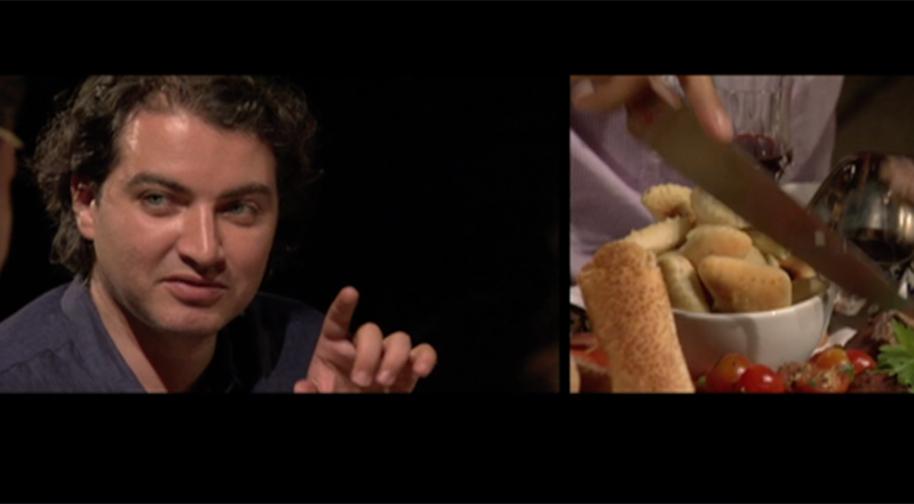
This film, produced collaboratively by Palestinian-Danish artist Larissa Sansour and Lebanese-American artist Youmna Chlala, explores the complex relationship between Palestine and Lebanon through dialogues around a dining table. Set in a virtual and imaginary space, the film captures an intimate moment away from the hierarchy of the Western gaze, addressing the closeness between cultures in the region or the fabricated ideas cultures have about each other with a humorous tone. One of the main motifs in Sansour's works, which she presented at the 11th Istanbul Biennial in 2009 with the video installation "Drinking Soup" in Bethlehem, is "food." In this film, it becomes a means of bringing together two neighbors separated by political borders, making the impossible real.
Pass the Salt to Us / Trespass the Salt
Directors: Larissa Sansour, Youmna Chlala
2012, Lebanon, Palestine, United Kingdom
11 min
Arabic, English, French | Turkish subtitles
Anima
The three-part documentary Anima, which won the Best Film Award in the National Documentary Competition at the Istanbul Film Festival in 2021, examines people's relationships with animals in different regions of Turkey. It questions how local cultures and belief systems affect the perception of nature. Director Yusuf Emre Yalçın's observations point to sociological phenomena that extend to gender roles and hierarchical order. The documentary takes the audience through live animal markets, sacrificial rituals, camel wrestling, and beauty animal contests, pursuing the question of where the distinction between the sacred and the sacrificial comes from. The director's dreams and childhood memories accompany this journey.
Anima
Director: Yusuf Emre Yalçın
2021, Turkey
39 min
Turkish | English subtitles
Best Film Award, 2021 Istanbul Film Festival National Documentary Competition
Flower Island
A tomato is planted in a field, harvested, and sold in a supermarket, then perhaps it rots and is thrown away. But everything does not end here: Flower Island follows the tomato to its real "end"; it observes its journey among animals, waste, women, and children. In this journey, the difference between tomatoes, pigs, and humans becomes clear. Do you have twelve minutes to watch a narrative that is not fictional at all? To embark on a global tour of the cycles of domination established by the power of capital, you just need to follow the orbit of a Brazilian tomato.
The 1989 film Flower Island is a social critique film addressing poverty in Brazil. Directed by the famous filmmaker Jorge Furtado, the film is a continuation of the Cinema da Boca do Lixo movement, named after the Boca De Lixo neighborhood in São Paulo. Considered one of the best Brazilian short films of all time and one of the most successful examples of the short film format, Flower Island presents a narrative technique that can still be called innovative today, bringing together seemingly unrelated motifs such as nuclear bombs, the Jewish Holocaust, capital increase, perfume production, tomato harvesting, and waste, revealing the landscape of inequality and environmental destruction.
Flower Island / Ilha das Flores
Director: Jorge Furtado
1989, Brazil, 12 min
Portuguese | Turkish subtitles
Best Short Film, 1990 Berlin Film Festival
Audience Award, Press Award, 1991 Clermont-Ferrand Short Film Festival
Best Short Film Award, 1990 Brazil Silver Daisy Awards