
📚 BooksPaid
Mercimek, Mantar, Mikroalg: Yarının Proteini | Protein 101 Seminerleri
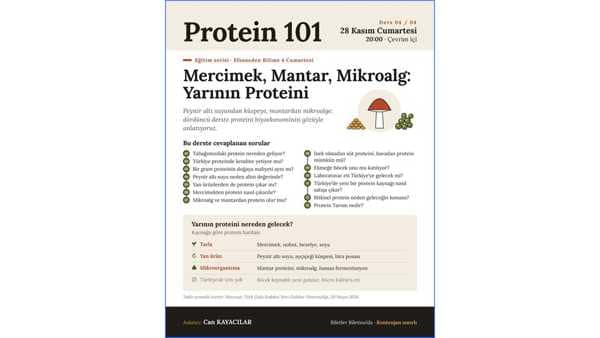
While producing one kilogram of cheese, 5 to 9 kilograms of whey are generated, depending on the type of cheese. This liquid, once considered a byproduct, is now one of the most sought-after raw materials in the protein industry. The protein of tomorrow is also full of similar surprises: in the residue of an oil mill, in a mushroom culture, in a microalgae pond, or even in bacteria that produce protein from carbon dioxide and hydrogen. Is insect flour being added to bread? Will lab-grown meat reach our tables? In this seminar, we discuss protein from the perspective of the bioeconomy, from the field to the bioreactor. Here are some of the questions you will find answers to: Where does the protein on our plates come from? Is Turkey self-sufficient in protein? Is the environmental cost of one gram of protein the same? Why is whey so valuable? Can protein be extracted from byproducts? How is protein extracted from lentils? Can protein be obtained from microalgae and mushrooms? Is it possible to have milk protein without cows, or protein from the air? Is insect flour being added to bread? Will lab-grown meat come to Turkey? How can a new source of protein be launched in Turkey? Why is plant-based protein the topic of the future? What is protein farming? What does science say? Environmental cost: According to a food footprint analysis, one of the most comprehensive studies in the field, based on data from approximately 38,000 farms in 119 countries, the greenhouse gas, land, and water cost of one gram of protein varies significantly depending on the source. Legumes are among those with the lowest impact. There are also significant differences between different producers of the same product. Whey: While producing one kilogram of cheese, 5 to 9 kilograms of whey are generated, depending on the type of cheese. Approximately one-fifth of the proteins in milk remain in this liquid. Byproducts and leaves: Approximately one-third of sunflower meal and about one-fifth of the dry weight of beer dregs are protein. The photosynthetic enzyme ribulose-1,5-bisphosphate carboxylase/oxygenase (RuBisCO) in leaves is the most abundant protein in the world. Microalgae and mushrooms: The dry weight of microalgae such as spirulina is 55–70% protein. Mycoprotein, produced by fermenting mushroom filaments, has been sold in the UK since 1985. Fermentation: In precision fermentation, a gene from a milk protein is given to microorganisms, and this protein is produced in tanks. Some bacteria can also produce protein by obtaining their energy from hydrogen and their carbon from carbon dioxide. Regulations in Turkey: The Turkish Food Codex Regulation on Novel Foods, which came into effect on May 20, 2026, stipulates the following: – Novel foods derived from insects are not approved. – The application process for meat produced by animal cell culture is closed. – Products that were not previously widely consumed in Turkey can be put on the market after undergoing an application and risk assessment. Protein from lentils: Lentil flour is dissolved in a slightly alkaline solution, and then the protein precipitates when the environment is acidified (isoelectric precipitation). The industrial production of isolates is also based on the same principle. As you leave the seminar, you will be able to read about the journey of a protein to your plate and its associated costs. You will be able to evaluate news and claims related to new protein sources from a scientific and regulatory perspective. Who is it for? For anyone who wants to expand their knowledge, especially those working in the food, agriculture, and nutrition sectors, entrepreneurs, students, and those curious about the future of food. How do I participate? The seminar series is online. The participation link will be sent to the email address you provided when purchasing your ticket before the seminar. Each seminar is 60 minutes long: approximately 45 minutes of presentation and 15 minutes for Q&A. Four seminars make up the "Protein 101" series. Each one is a complete module; you can participate in whichever ones you choose: October 31: Rebuilding Yourself Every Day November 7: How Much Protein is Enough in the Age of "Proteinmaxxing"? November 21: Can Peas Build Muscle? November 28: Lentils, Mushrooms, Microalgae: The Protein of Tomorrow. Participants who attend all four seminars will receive a certificate of completion signed by Can Kayacılar. Who is giving the seminars? Can Kayacılar is a biologist, neuroscientist, and industrial scientist. He was the winner of Teknogirişim 2012 in Turkey and founded Turkey's first nanobiotechnology company. He develops biorefinery technologies that extract valuable components from agricultural byproducts using supercritical carbon dioxide, as well as plant-based protein formulations. One of his recent projects is a water-soluble formulation containing 35 grams of plant-based peptides per 100 milliliters. He introduced the concept of the "Pulp Economy" and the idea of "Protein Farming" and spoke on the main stage at WorldFood Istanbul 2025. His bioeconomy articles reach over 88,000 followers on LinkedIn, and Favikon ranked him among Turkey's top 20 LinkedIn content creators in 2025 and 2026. Important Note: This seminar is for general informational purposes only and does not constitute personal dietary or medical advice. Consult with your doctor or a registered dietitian for any decisions related to your health.
Date & Time
28 November 2026, Saturday
20:00 – 21:00
Ticketed Event