⚽ SportsPaid
EGE’NİN SAKLI KENTLERİ: NYSA VE MAGNESİA DOĞA YÜRÜYÜŞLERİ
Meeting Point: Şirinevler Neighborhood, Meriç Street No: 27/1, Bahçelievler, Istanbul.
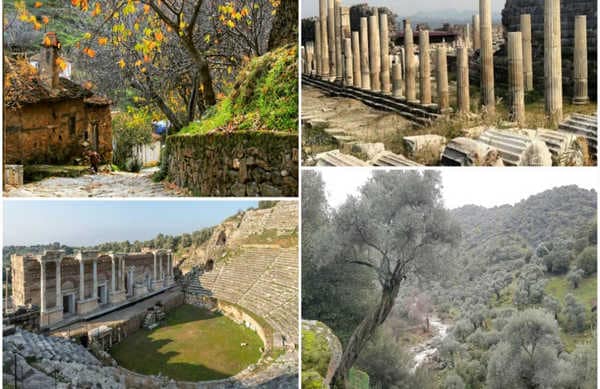
AEGEAN REGION'S HIDDEN CITIES: NYSA AND MAGNESIA NATURE WALKS December 12-13, Saturday-Sunday Hiking Leader: GİRAY ŞENAY - 05556239977 We will begin our journey on Friday evening, December 11th, at 9:00 PM from Bakırköy. Event plan and hikes: DAY 1: KAVAKLI – ANCIENT CITY OF NYSA – SALAVATLI (12 KM, MODERATE), AYDIN ARCHAEOLOGY MUSEUM DAY 2: ÇAKIRBEYLİ – SARIDERE HIKING TRAIL (5 KM, EASY), ANCIENT CITY OF MAGNESIA, RETURN TO ISTANBUL Note: The event organizer may make changes to the event plan and content based on weather conditions, trail and road conditions, the schedule throughout the day, and participant performance. DAY 1: SATURDAY, DECEMBER 12 KAVAKLI – ANCIENT CITY OF NYSA – SALAVATLI (12 KM, MODERATE), AYDIN ARCHAEOLOGY MUSEUM We will arrive in the center of Aydın early in the morning and have breakfast and do some shopping at a suitable location. Afterwards, we will proceed to the village of Kavaklı. Here, we will first visit the museum dedicated to Yörük Ali Efe, a hero of the Turkish War of Independence. Our hike, which continues through olive groves, will end in the village of Salavatlı after we see the ruins of the Ancient City of Nysa, the Akharaka Bathhouse, and the Pluto Kore Temple. After enjoying tea and relaxing at the village cafe, we will visit the Aydın Archaeology Museum, which exhibits artifacts from many ancient cities in the Aydın region and its surroundings. We learn about the founding of the Ancient City of Nysa from the writings of the famous traveler and geographer from Amasya, Strabo (63 BC – 19 AD), and the historian Stephanos, who lived during the reign of Augustus. In his work "Geography," Strabo describes it as a "twin city, divided by a strait formed by floodwaters, and extending largely along the foothills of Mount Mesogis (Aydın/Cevizli Mountain)." The region, formerly known as Caria, was established during the Hellenistic period in the first half of the 3rd century BC by Antiochus I Soter, son of Seleucus. In mythology, Zeus ordered Hermes to entrust the infant Dionysus to the nymphs of Mount Nysa for his upbringing. The inhabitants of Nysa incorporated scenes from the life of Dionysus, the god of Nysa, into the friezes of the stage building of the theater they constructed. The ancient city of Nysa offers visitors striking examples of Roman architecture and engineering, with its structures harmoniously integrated into the valley, particularly its stadium, tunnel, and three bridges. The Aydın Archaeology Museum, opened in 1959, is considered one of the most important archaeological museums in Turkey. The museum building was constructed in the 19th century by İsmail Hakkı Bey, the governor of Aydın. It was renovated in 1992 with a modern museum building. The museum covers an area of 3,000 square meters and houses a rich archaeological collection. Among the museum's most important artifacts are sculptures, ceramics, coins, and sarcophagi dating back to the Ancient Greek period. In addition, the collection also includes artifacts from the Hellenistic, Roman, and Byzantine periods. These artifacts were discovered during excavations in Aydın and its surrounding areas, and they demonstrate the importance of this region in ancient times. In the garden, stone artifacts from various periods are displayed, originating from ancient cities within the Aydın province, including Tralleis, Magnesia, Alinda, Alabanda, Nysa, Amyzon, Piginda, Harpasa, Myus, Pygela, Orthosia, and Mastaura. These artifacts consist of sculptures, sarcophagi, columns and column capitals, altars, tomb stelae, Islamic tombstones, milestones, inscribed and relief stelae, and various architectural fragments. One of the most remarkable artifacts in the museum is the "Aphrodisias Aphrodite" sculpture, which has become a symbol of Aydın. This sculpture dates back to the Hellenistic period and was found in the famous ancient city of Aphrodisias. Other important artifacts include the "Aydın Sarcophagus" and the "Labraunda Zeus Statue." These are just a few examples of the rich and diverse collection on display in the museum. **DAY 2: DECEMBER 13TH, SUNDAY - ÇAKIRBEYLİ - SARIDERE HIKING ROUTE (5 KM, EASY), MAGNESIA ANCIENT CITY** After checking out of the rooms and having breakfast, we will travel by vehicle to the village of Çakırbeyli. We will embark on a 5 km hike through olive groves along the Sarıdere river. At the Çakırbeyli Village Market, where local producers offer their products to visitors, we will enjoy tasting local products and shopping. Afterwards, we will visit the ancient city of Magnesia and begin our journey back to Istanbul. According to legend, Magnesia was founded by the Magnetes who came from Thessaly. The location of the first Magnesia, founded by the Magnetes after receiving a prophecy and guidance from Apollo, is unknown. It is known that in the 4th century BC, the Athenian Thibron relocated and rebuilt the city due to epidemics caused by the Menderes River constantly changing its course and flooding, as well as the threat from the Persians. The current city is the second Magnesia, rebuilt in this location. Until it voluntarily joined Alexander the Great (334 BC), it was under Persian rule, and later under the Hellenistic kingdoms established by his commanders, first the Seleucid Kingdom (240 BC) and then the Kingdom of Pergamon (189 BC). These were the city's most glorious years. The city held an important commercial and strategic position within the triangle formed by Priene, Ephesus, and Tralleis. In 133 BC, with the Kingdom of Pergamon coming under the protection of the Roman Empire, Magnesia also became one of the Roman cities in Anatolia, known as the province of Asia. After Pergamon fell under Roman control, the ancient city of Magnesia fully integrated into the ranks of Roman cities, and its architectural structure changed from that point onwards. Known for its surrounding walls, which stretched for a mile and a half, Magnesia was the city with the second largest architectural structure after the ancient city of Ephesus. Today, only fragments of the walls remain. In Magnesia, there was a temple dedicated to Dindymene, the mother of the gods. Strabo later noted that the temple no longer existed and that the city had been moved to a different location. The initial excavations at the archaeological site were conducted between 1891 and 1893 by a German archaeological team led by Carl Humann, who is also known for discovering the Pergamon Altar of Zeus. These excavations, which lasted for 21 months, partially uncovered the theater, the Temple of Artemis, the agora, the Temple of Zeus, and the prytaneion. Artifacts unearthed from the archaeological site are currently on display in Istanbul and Aydın, as well as in Berlin and Paris. Replicas of the pronaos (entrance hall) of the Temple of Zeus and a section of the Temple of Artemis can be seen at the Pergamon Museum in Berlin.
Date & Time
12 December 2026, Saturday
09:00 – 19:00
Location - YUDOSK
Ticketed Event