

Ünye Castle and Its Rock Tombs, the Ancient Black Sea Face of Ordu
One of the things that sets Ünye apart from its neighbours on the Black Sea coast is the steep mass of rock rising behind the town.

Sign in to like and rate
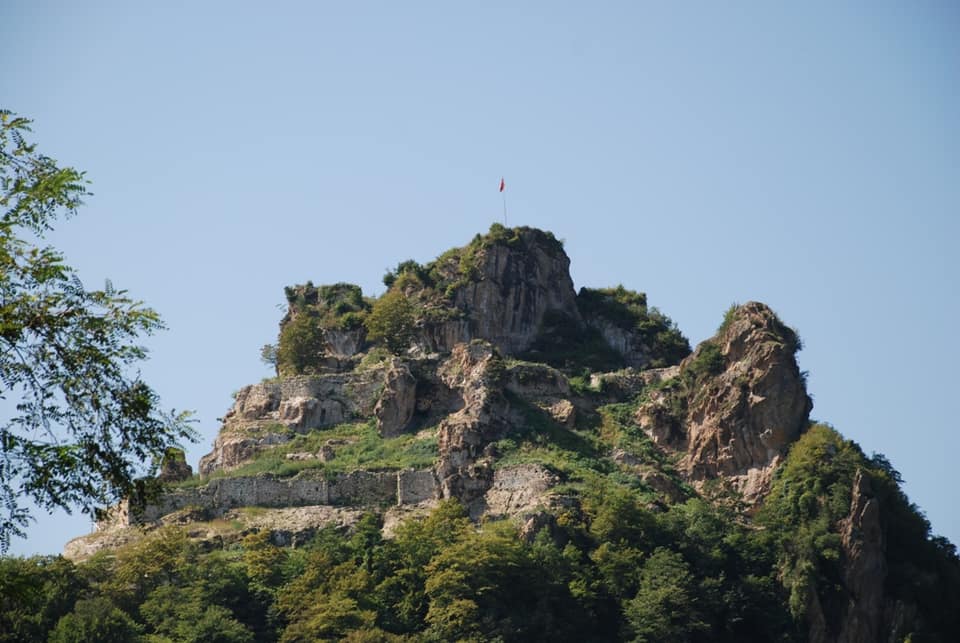
One of the things that sets Ünye apart from its neighbours on the Black Sea coast is the steep mass of rock rising behind the town. The castle sitting on top of it carries one of the oldest layers of Ordu's story into the present. This article takes you to the castle, to the rock tomb carved high on its face, to the tunnels, and to the district's other rock tomb, and explains what to look at and how to plan the visit.
The castle on the rock
The castle stands beside the Ünye-Niksar highway, south-east of the district centre. The Culture Portal places it about five kilometres from the centre, while the access section of the same page says seven kilometres. Because the sources give the distance slightly differently, it is best to confirm current directions on official pages before you set out. The Ordu Provincial Directorate of Culture and Tourism describes the castle as about 2,500 years old. Its walls and curtain walls are built on sheer slopes, and anyone looking from the coast picks out the silhouette of the rock and its ramparts at once. The same official source adds that, because the site rises so far above its surroundings, it was used as a fortified position in the 11th and 12th centuries. So this rock was a strategic point in the Middle Ages as well as in antiquity. Since the castle rests on a single block of rock, structure and nature cannot be separated here, and asking which part was shaped by hands and which by the rock itself is one of the pleasures of the visit.
Pontic traces and a conflict between sources
The founding of the castle is tied to the Kingdom of Pontus. Here the sources do not fully agree, and that should be said openly. The Culture Portal and the provincial directorate's guide state that the five-metre-high gate was probably built in the time of Mithridates II. The Ünye Municipality city guide also attributes the rock tomb to Mithridates II. The directorate's 2023 opening announcement, however, says the castle was built by the Pontic king Mithridates VI. Whichever Mithridates is correct, the common point is that the castle was an effective centre used by the Pontic kings. This article therefore uses a cautious wording: the castle is attributed to the Pontic king Mithridates. The municipality guide also reports that the Roman commander Pompey, who defeated Mithridates, destroyed the Pontic castles of the region and blocked the tunnels with large pieces of rock. That account shows the site was part of a regional war history rather than a small local fort.
Gate, walls and water structures
The municipality guide says the castle has four-phase walls, tunnels, water cisterns and many rock tombs. Walls built in four phases suggest that the castle grew layer by layer rather than in one period. The entrance is on the south-east side, and the first thing a visitor meets is the five-metre-high gate. As you walk, notice the stonework of the gate, how it sits on the rock, and how the walls rise in sequence above it. Inside the castle there are also the remains of a bath, pools, water channels and a fountain. Living on top of such a rock required collecting and storing water, and the cisterns and channels confirm this. The Culture Portal also records that near the summit there are two tunnels and a cistern. The bath remains hint that the castle was not only a military point but carried traces of a settled way of life. Some remains stand while others survive only as foundation traces; if you plan to photograph them, afternoon side light shows the texture of the stone better.
The king's rock tomb high above
The most striking detail of the castle is the tomb cut into the rock face. The Culture Portal records that on the entrance side, about ten metres above the ground, there is a tetrastyle rock tomb three metres wide and two metres high. At each of the three corners of the tomb's triangular pediment there is a relief eagle, and the one at the right end is well preserved. The municipality guide says the tomb, carved into the bedrock to the left of the gate, follows the style of Paphlagonian rock tombs. Hacer Kumandaş Yanmaz's 2018 article, published on DergiPark, examines this link academically. The article identifies three rock tombs in Ünye, two at the castle and one at Tozkoparan in Cevizdere. According to the author, many features of the Ünye tombs resemble examples in the Paphlagonia region. The eagle motif on the castle tomb belongs to the same line as the protective figures also seen on the Kalekapı Rock Tomb in Kastamonu. The article stresses that the tombs did not simply transfer a foreign culture and that local features also played a part in shaping them. Because the tomb is high above the ground, you will look up from below rather than from close range. Seeing the eagles from a distance is enough, so do not try to get closer.
Tunnels and restoration
Another well-known face of the castle is its tunnels. The Culture Portal says two tunnels descend to the north-west at an incline of about 45 degrees near the summit. The directorate's December 2023 announcement describes the restoration carried out by the Governorate's Investment Monitoring and Coordination Directorate and the Ünye Municipality. According to the announcement, the walls were repaired, two tunnels opened, the surroundings landscaped, a walking platform completed and a rail system prepared for descending into the tunnel. The news headings on the Ünye Municipality's official site show that the restoration was completed and the castle opened to visitors in June, with strong interest. The Communications Directorate's regional press page also reports the opening on 2 June. The directorate's general castle page still carries an old closure note from 2022; that note is outdated and belongs to the restoration period. Even so, opening hours, entry arrangements, fees and how the tunnel section operates are details that can change. Before you go, check the current situation on the official pages of the Ünye Municipality and the Ordu Provincial Directorate of Culture and Tourism.
Tozkoparan Rock Tomb
Ünye's third rock tomb lies outside the castle, in Gürpınar village in the Cevizdere locality. The Culture Portal says the Tozkoparan Rock Tomb is five kilometres from the district centre, that its entrance is a large round arch, and that a deep descent leads into two rooms one inside the other. The official page is short, so we take the detail from the academic article. According to the article, the relief bull's head at Tozkoparan, together with the eagle motif at the castle, is an example of a tradition of protective figures. The author also notes the similarity of Tozkoparan to tombs where door pivot sockets suggest closed entrances. The castle tomb is carved high on the rock face, while Tozkoparan has an entrance that descends deep. Comparing the two lets you see two different solutions in the same district. The sources do not detail visiting conditions for Tozkoparan, so ask local institutions about access before going.
Ottoman period traces
The castle does not belong only to the Pontic age. According to the municipality guide, soldiers were stationed at the castle in the Ottoman period. A historic fountain stands on the castle road. The guide says it is not known when or by whom the fountain was built, but its inscription states that it was repaired in 1823 in the name of Ümmü Gülsüm. This sentence should be read carefully, because the inscription gives a repair date, not a construction date. Still, the fountain is a small but concrete trace showing that life around the castle continued in the early 19th century. Looking at the fountain while walking up the castle road fits the ancient and the Ottoman layers into a single walk.
How to visit
The castle is reached from the district centre by the asphalt road toward Niksar; official pages note that access is by asphalt road. Choose early morning or late afternoon, and wear comfortable shoes that grip, as the ground is rocky. The walking platform and viewpoints face the Black Sea, so keep your camera ready. After the castle you can return to the district centre and stroll Ünye's historic streets. Do not enter areas that are closed or under excavation, and do not climb the rocks. For gate hours, entry arrangements and access to the tunnel section, always consult the Ünye Municipality and the Ordu Provincial Directorate of Culture and Tourism.
Sources
- Kültür Portalı, Ünye Kalesi, https://www.kulturportali.gov.tr/turkiye/ordu/gezilecekyer/unye-kalesi
- Ordu İl Kültür ve Turizm Müdürlüğü, Ünye Kalesi Turizme Açılıyor, https://ordu.ktb.gov.tr/TR-362019/unye-kalesi-turizme-aciliyor-25122023.html
- Ordu İl Kültür ve Turizm Müdürlüğü, Ünye Kalesi (Ünye/Ordu), https://ordu.ktb.gov.tr/TR-130747/unye-kalesi-unyeordu.html
- Ünye Belediyesi, Şehir Rehberi, Ünye Kalesi, https://www.unye.bel.tr/sehir-rehberi/unye-kalesi/
- Ünye Belediyesi, Kale haberleri, https://www.unye.bel.tr/?s=kale
- İletişim Başkanlığı, Ünye Kalesi ziyaretçi haberi, https://www.iletisim.gov.tr/turkce/yerel_basin/detay/unye-kalesini-2-ayda-115-bin-kisi-ziyaret-etti-ordu
- Kumandaş Yanmaz, Ordu İli Ünye İlçesi Kaya Mezarları, DergiPark, https://dergipark.org.tr/tr/pub/asead/article/494179
- Kültür Portalı, Tozkoparan Kaya Mezarı, https://www.kulturportali.gov.tr/turkiye/ordu/gezilecekyer/tozkoparan-kaya-mezari
Comments
Be the first to comment