

Tünel, the World's Second Underground Railway, and the Story of Istanbul's Trams
A short line that climbs from Karaköy to Beyoğlu in a minute and a half has been doing the same job for more than 150 years.

Sign in to like and rate
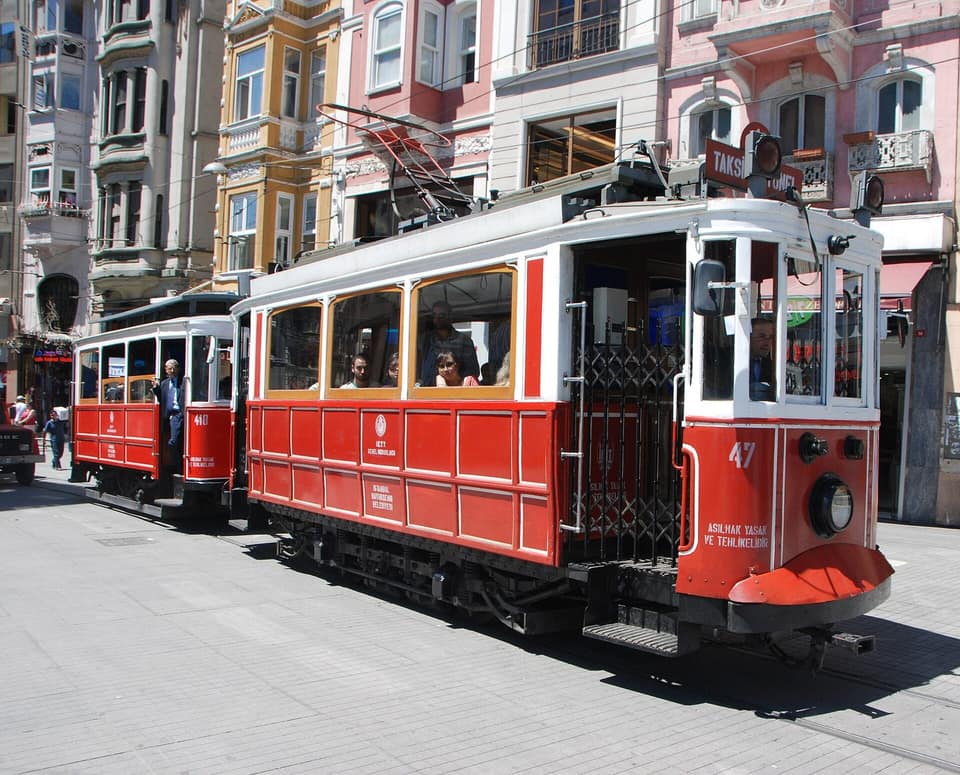
A short line that climbs from Karaköy to Beyoğlu in a minute and a half has been doing the same job for more than 150 years. Tünel is described as the world's second-oldest underground urban railway after the London Underground, opened in 1863, and it is Turkey's first underground rail transit system. Four years before it opened, horse-drawn trams had already taken to Istanbul's streets. These two vehicles mark the beginning of the history of İETT, the authority that runs the city's buses today.
This article tells how Tünel was built, how the horse tram gave way to the electric tram, why trams withdrew from the city, and how they came back on İstiklal Avenue and on the Kadıköy-Moda line. At the end there are a few practical tips for riding Tünel and the nostalgic tram today.
The Problem of the Yüksekkaldırım Slope
In the second half of the nineteenth century Galata, with its banks and trading houses, was the financial heart of the city, while Pera just above it was the centre of embassies and social life. According to Wikipedia, traffic between the two ran up the Yüksekkaldırım slope, with a steep gradient of about 24 per cent, used by an average of 40,000 people a day. The slope was tiring for pedestrians and a serious obstacle for moving goods.
Anyone walking up from Galata today still feels that gradient in their legs. The idea of Tünel was born exactly here: to overcome the height difference between the two districts with a cable-hauled train running underground.
An Engineer on Holiday
According to İETT's chronology, the French engineer Eugène-Henri Gavand came to Istanbul as a tourist in 1867. Seeing the crowds climbing up and down the slope, Gavand presented Grand Vizier Ali Paşa with a plan for an underground railway from Galata to Pera in February 1868. In 1869 he applied to the Ministry of Public Works, and following a decree of Sultan Abdülaziz he received the concession to build Tünel on 10 June 1869. In November of the same year the construction agreement and specifications were signed by the Minister of Public Works, Davut Paşa, and Gavand.
The real challenge was finding the money. In 1870 Gavand managed to set up a French joint-stock company in Paris together with two banks, but could not raise enough capital. In 1871 he was given permission to found a British company, known in Turkish as the Payitaht Demiryolu Şirketi, the Capital Railway Company. The British company's formation was completed in April 1872, and in August of that year it issued bonds in London and Istanbul.
Four Shafts Underground
Excavation began from shafts sunk from the surface. According to İETT's chronology, the first shaft was opened in autumn 1871 in Hendek Sokağı near the Galata Tower, and a second followed in December. On 20 March 1872 the two shafts met underground, and a small ceremony was held at the site, decorated with Turkish, French and British flags. A third shaft was opened in Kamondo Sokağı in August 1872 and a fourth in Billur Sokağı in September 1873. In November 1872 excavation began both at the starting point on the Beyoğlu side and from the Galata end.
The man behind the project did not see its conclusion. In October 1874 the Tünel company pushed Gavand aside and took sole control. In November 1874 construction was completed and trial runs began. According to Wikipedia, goods and animals were carried in the carriages on the first trial runs to overcome the public's possible fear of underground travel and to prove the system was safe.
17 January 1875
Tünel opened on 17 January 1875, the first day of Eid al-Adha, at a ceremony attended by many Turkish and foreign guests. İETT's record notes a small but touching detail: Gavand, the builder of Tünel, was not at the ceremony. The first fare was 10 para. The line opened to the public the next day and carried 75,000 passengers in its first fourteen days. In February 1875 Gavand was awarded the Order of the Ottoman Nobility, third class, and company staff who had worked on the project were also decorated.
The first Tünel was very different from today's. According to Wikipedia, the carriages were wooden, lit by gas lamps, and the system was driven by two steam engines of 150 horsepower. Breaks in the hauling belt caused two accidents in the two years after the opening: in the first, no one was hurt because the driver applied the brake in time; in the second, in September 1876, eight people were injured.
A year later, in 1876, Gavand published a book in Paris, "Tunnel de Constantinople", telling the story of the construction and his negotiations with the Ottoman government. İETT had the book translated into Turkish in 2011, bringing it back to readers.
A Short but Steep Line
In its dimensions Tünel is closer to a funicular than to a metro line. According to English Wikipedia, the line is about 573 metres long, and the upper station stands 61.55 metres above the lower one. Each car can carry 170 passengers, and the trip takes about a minute and a half. The lower station is in Karaköy, the upper one in Beyoğlu, on Tünel Square. The line is called "the world's second-oldest metro" because it is the oldest underground urban railway after the London Underground, which opened on 10 January 1863.
The story of its concessions and owners is a long one. According to İETT's chronology, the British company's concession was extended by 75 years in 1904; in 1911 the operation was transferred to an Ottoman joint-stock company, and the same year the Tünel, tram and electricity companies were brought together in a consortium that formed part of the Belgian-based SOFINA group. Also in 1911, Tünel's Beyoğlu station was renewed and construction of the Metrohan building began above it. Only the ground floor of this steel-framed building, with its marble floors and staircases, followed Gavand's design; it was completed in 1914, and a seventh floor was added in 1928. For many years the headquarters of the tram company, Metrohan today also hosts talks and events organised by İETT.
The line had its hard times too. According to İETT's chronology, services were first restricted and eventually stopped altogether because the hauling cable had worn out; a new cable reached Haydarpaşa on 24 June 1945 and, once it had been quickly fitted, services resumed. It took some time, however, for operations to return fully to normal.
Tünel's great transformation began in 1968. The line closed on 25 November 1968 for renovation and electrification, and the Karaköy station and its buildings were rebuilt. The electric Tünel was officially opened on 2 November 1971 and began carrying passengers again on 9 November 1971. According to English Wikipedia, the wooden carriages were replaced by two electric steel cars running on pneumatic tyres. In 2007 the line was taken in for renovation again; the stations were renewed, entrances and exits were made accessible to passengers with disabilities, and Tünel reopened in its new form on 10 December 2007. The wooden carriages used from 1875 to 1968 were faithfully restored by İETT craftsmen for display in 2008. Tünel's 150th anniversary was celebrated in 2025.
Trams Pulled by Horses
While Tünel was being built, rails were also being laid in Istanbul's streets. According to İETT's chronology, an agreement to establish trams in the city was signed in 1869, and in the same year the first trial runs were made with a tram pulled by two large horses brought from Hungary and Austria. In February 1870 Konstantin Karapano Efendi founded the Istanbul Tram Company with a capital of 400,000 lira; after 1881 it was known as the Dersaadet Tram Company.
The first horse tram entered service between Azapkapı and Beşiktaş on 31 July 1871, at a ceremony held in Tophane and attended by statesmen and foreign ambassadors. İETT regards this date as its own founding date and celebrated its 150th anniversary in 2021. New lines followed quickly:
- the 3,730-metre Eminönü-Aksaray line in November 1871,
- the Beşiktaş-Ortaköy line in February 1872,
- the 3,600-metre Aksaray-Yedikule line in August 1872,
- the 2,600-metre Aksaray-Topkapı line in January 1873.
In the early years the tram had no fixed stops; it halted wherever a passenger wished. According to İETT's record, stops were introduced in 1880 because this slowed the service. In 1883 tram tracks were also laid in Galata, Tepebaşı and on what is now İstiklal Avenue.
The Men Who Shouted Varda
The most colourful employee of the horse tram was the vardacı. According to İETT, these men ran ahead of the horses with a horn, the nefir, warning pedestrians with the cry "varda", meaning "look out". The post was abolished in 1899 to save money. Trams also had curtains separating women from men; according to İETT's chronology this practice ended in December 1923. The museum İETT opened in 1994 at the Karaköy entrance of Tünel displayed a summer horse-tram car and a horse-tram stop.
A war cut the horse tram's life short. When the Balkan War broke out in October 1912, all 430 of the tram company's horses were bought for 30,000 lira, and Istanbul was left without trams for about a year. When the trams returned, it would be electricity rather than horses that pulled them.
The Age of the Electric Tram
Before electrification, the bridge and the power station had to be ready. Trams could not cross the old wooden Galata Bridge; the ban was lifted on 27 April 1912 when the new steel bridge opened. In 1913, 36 motor tramcars, 17 built by Franco-Belge and 19 by MAN, were brought in and unloaded at the Kabataş and Dolmabahçe piers. The same year the Silahtarağa power station, described in İETT's chronology as Turkey's first electricity plant, was established.
According to İETT's record, the first electric tram ran over the Galata Bridge on 25 January 1914, and the day's takings were donated to the Ottoman Navy Society. A sentence from the speech given that day by Bedri Bey, acting mayor of the city, captures the mood of the time: "The horses changed on the slopes, the vardacıs blowing their horns, the crack of the drivers' whips are now passing into history." On 11 February 1914 the first current flowed from Silahtarağa to the tram network, and on 20 February 1914 regular services began on the Karaköy-Ortaköy line. İETT celebrates the anniversary of the electric tram every year on 11 February.
When the First World War began, transport in Istanbul stopped for eight months. In 1916 season-ticket booklets for the trams went on sale. Permission to run trams on the Asian side had been granted in March 1914; the side's first and best-known line, Üsküdar-Kısıklı, opened on 8 June 1928. For the tenth anniversary of the Republic in 1933, Istanbul's entire fleet, 320 trams and 4 buses, took to the streets.
In 1936 more modern trams appeared on the streets. İETT's record describes them in detail: they were painted pale yellow, did not allow passengers to ride hanging on the outside, carried side destination boards, were divided in the middle to separate the classes, and kept their doors shut while moving, with the doors and steps opening automatically at stops. These trams ran mainly on the Şişli-Tünel, Şişli-Beyazıt and Harbiye-Fatih lines.
The Years of Farewell
In 1939 the tram, Tünel and electricity undertakings were nationalised and, under Law No. 3645, took the name Istanbul Electricity, Tram and Tunnel Administration, İETT. According to İETT, the red and white of its logo were taken from the Turkish flag. Buses had been in the city since 1930 and gradually began to take the tram's place.
English Wikipedia sums up the reasons trams were withdrawn in three points: the cars were uncomfortable, they were slow because they got stuck in traffic caused by cars, and the tracks were outdated, noisy and ran down the middle of the street. On 27 May 1961 the first trolleybus line opened between Topkapı and Eminönü. According to İETT's chronology, the trams of the European side said farewell to the city on 12 August 1961 in a parade of cars decorated with bay leaves, following tram No. 128; English Wikipedia gives June of the same year as the date of the last run. Confidence in the tram lasted a little longer: in 1954 İETT's workshops built a copy of the air-braked, automatic-door electric trams using local materials and labour. The Üsküdar-Kadıköy Public Tram Company, which ran the Asian side's trams, was transferred to İETT with all its facilities on 16 March 1955. The electric trams of the Asian side made their final trip on 14 November 1966; according to English Wikipedia, that last run was on Line 12 between Kadıköy and Üsküdar.
Having started as a tram company, İETT went on to become the centre of the city's land transport. According to its short history, the gasworks were transferred to İETT in 1945, the trolleybus entered service in 1961, the management and supervision of private public buses passed to İETT in 1985, the AKBİL electronic ticket came into use in 1995, and the Metrobüs entered the city's life in 2007. In 2008 İETT's old tram depot at Bağlarbaşı was turned into a cultural centre, and in 2015 AKBİL gave way entirely to the İstanbulkart.
The retired trams lived on for a while in a museum. In 1967 an İETT Tram Museum with 15 to 20 cars opened at Kuşdili in Kadıköy; it closed in 1981 and the cars were sent to İETT's camp at Avcılar.
The Red Tram Returns to İstiklal
The tram's return to the city came with the pedestrianisation of İstiklal Avenue. According to İETT, the avenue was closed to traffic and turned into a pedestrian zone in 1990, and on 29 December 1990 the nostalgic tram went back into service on the Tünel-Taksim line. According to English Wikipedia, the line is about 1.6 kilometres long and runs via the Tünel, Ağa Camii, Galatasaray, Odakule and Taksim stops.
The vehicles are not replicas but genuine first-generation Istanbul tramcars restored in the 1980s. According to English Wikipedia, as of 2008 the motor cars included No. 47, built in 1913, and No. 223, built in 1928, while trailers 411 and 418 had been built in Germany in 1914 and 1919. According to İETT, car No. 223 was once again faithfully restored in July 2025.
The line's recent history has its own small milestones. Services were suspended for a year because of infrastructure works on İstiklal Avenue, and the tram returned to its passengers on 30 December 2017. In May 2012 period-style uniforms echoing the 1930s were designed for the nostalgic tram's drivers and Tünel's operators. In November 2020 the nostalgic tram stop at Tünel was named after the young engineer Halit Ayar. And in April 2024 the first battery-electric tram, with the same interior and exterior design as the nostalgic tram, began running on İstiklal Avenue.
A Loop from Kadıköy to Moda
The Asian side got its tram back in 2003. According to Metro İstanbul, the T3 Kadıköy-Moda Tram Line entered service on 1 November 2003. The line is 2.6 kilometres long, has 11 stations and runs as a one-way loop: it starts at Kadıköy Square, turns from Altıyol into Bahariye Caddesi, reaches Moda and returns to Kadıköy along Moda Caddesi. A full circuit takes about 20 minutes.
The line partly follows the route of the old No. 20 tram line and is therefore also called a nostalgic tram. According to Metro İstanbul, it is served by second-hand Tatra GT6 trams bought from the German city of Jena, and the cars are maintained in a workshop near the Kadıköy-İDO station. By then the city's modern tram had long been back: the first section of today's T1 line opened between Yusufpaşa and Beyazıt on 13 June 1992.
Riding Tünel and the Nostalgic Tram
Tünel and the nostalgic tram are two short rides that complement each other and are best enjoyed together. Here are a few suggestions.
- Start in Karaköy. Tünel's Karaköy station is close to the Karaköy ferry pier and the T1 tram stop. Climbing the slope underground in a minute and a half is the best way to understand why Yüksekkaldırım was such a problem. Exhibitions are sometimes held at Karaköy station too; İETT once staged a photography exhibition there called "Journey through the Time Tunnel" on Tünel's anniversary.
- When you come out of Beyoğlu station onto Tünel Square, look up at the Metrohan building; its ground floor still follows Gavand's design.
- Board the nostalgic tram at the stop on the square and ride to Taksim, then walk back down İstiklal Avenue. When the cars are crowded, waiting for the next one makes for a more pleasant ride.
- If you cross to Kadıköy by ferry, take the T3 loop. One full circuit is enough to see Bahariye Caddesi and Moda from the window; you can also get off in Moda and walk down to the shore.
- The İstanbulkart is valid on both lines. Since timetables and fares can change, check the official İETT and Metro İstanbul websites for current information.
As you ride, remember that there is a 150-year story beneath the rails: a tunnel that began with a tourist's observation, men shouting "varda", trams that could not cross the bridge, and red cars that returned to the same avenue years later.
Sources
- İETT, Short History, https://iett.istanbul/icerik/kisa-tarihce
- İETT, Chronological History, https://iett.istanbul/icerik/kronolojik-tarihce
- Metro İstanbul, T3 Kadıköy-Moda Tram Line, https://www.metro.istanbul/Hatlarimiz/HatDetay?hat=T3
- Metro İstanbul, History, https://www.metro.istanbul/Home/Tarihce
- Turkish Wikipedia, Tünel (Istanbul), https://tr.wikipedia.org/wiki/Tünel_(İstanbul)
- Wikipedia, Tünel, https://en.wikipedia.org/wiki/Tünel
- Wikipedia, Istanbul nostalgic tramways, https://en.wikipedia.org/wiki/Istanbul_nostalgic_tramways
- Wikipedia, Trams in Istanbul (1871-1966), https://en.wikipedia.org/wiki/Trams_in_Istanbul_(1871-1966)
Comments
Be the first to comment