

Trabzon's Hillside Gardens, the Calendar of Hazelnut and Tea
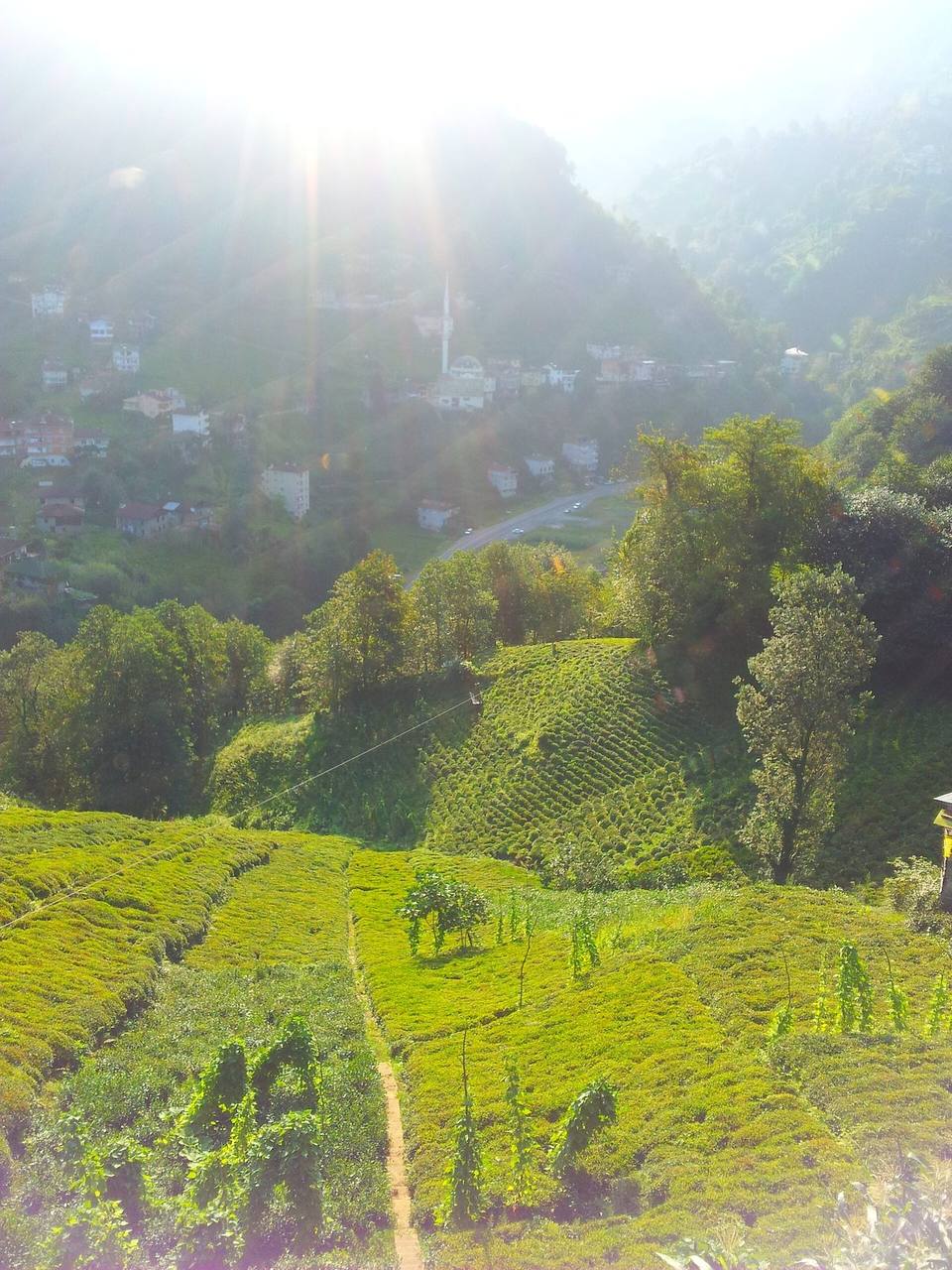
Order within the green Anyone visiting Trabzon in summer sees that almost every slope climbing up from the coast is green. Much of this green, however, is not forest but garden.
 Radar TürkiyeNovember 24, 2026
Sign in to like and rate
Order within the green
Anyone visiting Trabzon in summer sees that almost every slope climbing up from the coast is green. Much of this green, however, is not forest but garden. According to the Provincial Directorate of Agriculture and Forestry, about 23 per cent of the province's total area of 466,200 hectares is farmland, 22 per cent is meadow and pasture, and 39 per cent is forest and scrub. Of the farmland, 76.2 per cent is fruit land; hazelnuts are grown on 60 per cent of all farmland and tea on 15 per cent. According to the Directorate, 8.7 per cent of Turkey's hazelnut area and 6.7 per cent of its production are in Trabzon. In other words, when people speak of farming in Trabzon, the two plants that come to mind are hazelnut and tea. Knowing how these two plants are spread across the slopes, their calendar through the year and the garden culture around them makes it easier to read the landscape you see as you travel around the city and its villages.
Hazelnut, the shrub-tree of the coast
A study by Serkan Doğanay of Atatürk University, published in the Eastern Geographical Review, examines hazelnut farming in Trabzon together with its natural conditions. According to the study, the hazelnut is a small tree that can grow up to 6 or 7 metres. It starts bearing fruit 5 to 6 years after a garden is established and reaches its highest yield in 8 to 10 years. The trees can bear fruit for 80 to 100 years, but the yield of those over 50 declines. Along the Black Sea, hazelnuts are grown economically up to 60 kilometres inland and up to a height of 750 metres, while the densest belt lies between 0 and 500 metres.
The hazelnut likes a humid and mild climate. The study states that places where the average annual temperature is 13 to 16 degrees and rainfall is over 700 millimetres, evenly spread across the seasons, are suitable for hazelnuts. In Trabzon rainfall is spread over all four seasons, and there is no real dry season to speak of. What the hazelnut fears most are spring frosts; according to the study, these frosts can cut yields by 50 to 80 per cent. The foehn winds that blow on the eastern Black Sea coast between November and April lead to early budding, and the late frosts that follow then hit the crop. Long-lasting fogs in spring also harm pollination.
These conditions also draw the map of the hazelnut gardens. According to the study, hazelnuts are concentrated especially in the districts with a coastline. The reason why there are many hazelnut gardens in Maçka, an inland district, is that the moderating influence of the sea reaches inland along the Değirmendere valley. In the east, in Of and Sürmene, tea farming has limited the spread of the hazelnut. On the way from the coast to Maçka, you can see for yourself how the hazelnut groves on the valley floor thin out as you climb and give way first to forest.
The kelif, the threshing floor and August
The website of the Hazelnut Research Institute features a memoir describing the hazelnut season in Çeşmeler village in Maçka between 1955 and 1970. According to this account, the season began in June and July with the mowing of grass in the hazelnut groves and the clearing of the ground under the trees. When the nuts began to fill, bears, which are very fond of hazelnuts, came to the gardens at night. To prevent this, garden owners lit fires at the entrances on the forest side, hung lanterns, and kept watch in huts called "kelif", built high up on four posts set in the ground. In the kelifs, folk songs were sung to the kemençe and the shepherd's flute, and people talked late into the night.
According to the memoir, the picking season opened from mid-August, starting with the places close to the sea. The whole family and day labourers picked the nuts clump by clump, in a line, using small baskets, trays or a cloth tied around the waist. The harvested nuts were carried to the threshing floor in baskets on people's backs or on horses and mules and spread out in the sun. Within a few days the green husks turned yellow and the nuts came out of them. The empty husks were stored to be burned in the hearth in winter, and the sacked hazelnuts were sold in September, before the schools opened. The account adds that traditional methods have largely continued in the Maçka villages, where gardens are small, while machines are used in the large gardens. Doğanay's study also draws attention to the importance of drying after the harvest; heavy rain during this period and poor drying lower the quality of the crop.
Tea, the slopes in the east
When you move to the east of Trabzon, the texture of the gardens changes. The hazelnut clumps give way to dense, pruned rows of tea. According to ÇAYKUR's tea farming lecture notes, tea production in Turkey takes place along a coastal strip of about 180 kilometres stretching from the Sarp border gate to the Araklı stream, and in a narrow belt 10 to 35 kilometres inland from the coast. Araklı is the western end of this belt. The Provincial Directorate of Culture and Tourism also writes that tea farming in Trabzon takes place mainly in the eastern districts.
Tea arrived in the region fairly recently. According to ÇAYKUR, Law No. 407 of 1924 laid the legal groundwork for growing tea in Rize and Borçka. From 1937 onwards, tonnes of seed were brought from Batumi to start planting gardens, and the first crop was harvested in 1938. Tea Law No. 3788 of 1940 supported tea farming, and the tea areas expanded quickly. The first tea factory opened in Rize in 1947. The Provincial Directorate of Culture and Tourism states that tea farming began in the region in the 1930s, that the plant bears a crop five years after planting, and that it is harvested three times a year.
Today Trabzon ranks second in tea farming after Rize. According to ÇAYKUR's 2025 data, 19.28 per cent of Turkey's tea gardens are in Trabzon; in the province 50,319 growers cultivate tea on about 152,852 decares. The area per grower is about 3 decares. This figure shows that tea farming in the region is carried out mostly by small family holdings.
The calendar of three flushes
The rhythm of tea through the year is different from that of the hazelnut. According to ÇAYKUR's notes, while tea can be picked all year round in tropical countries, at higher latitudes such as Turkey production is possible for only six months a year, and three flush periods form each year. On the eastern Black Sea, depending on the weather, the picking of tea shoots begins at the end of April or in the first half of May. When a shoot that has reached picking maturity is plucked, the dormant bud in the leaf axil below it wakes up and a new shoot begins. The flat, dense surface you see in the gardens is the result of this continuous picking and pruning.
This calendar also shapes life on the slopes. From late spring, picking starts in the tea gardens, and towards the end of summer the hazelnut gardens turn into threshing floors. The fresh green of the tea slopes in the east in May and June, and the activity in the hazelnut groves near the coast in August, are the most striking sights.
The other fruits of the garden
The hazelnut and tea gardens do not stand alone. The Provincial Directorate of Agriculture and Forestry lists walnut, kiwi, table olives, blueberry, persimmon and strawberry among the province's other important fruits. Apples, pears, mandarins and oranges, on the other hand, are not grown in dedicated orchards but as single trees inside the hazelnut and tea gardens or along their edges. Doğanay's study also notes that there are fruit trees and alders in the hazelnut gardens. In the geography account of the Provincial Directorate of Culture and Tourism, the persimmon also appears among the plants of the maquis belt that reaches from the coast up to 300 metres. Standing out with their orange fruit in autumn, these trees are the seasonal ornament of the hillside gardens.
How to see the hillside gardens
Most hazelnut and tea gardens are private property and a family's livelihood. Do not enter the gardens without permission, do not pick fruit from the trees, and do not walk over hazelnuts spread out on a threshing floor. The best way to see the landscape is to stop at a suitable level spot while passing along village and highland roads and look at the slopes. The Değirmendere valley stretching from the coast to Maçka is good for following the hazelnut belt, and the roads running inland from Of and Sürmene for following the tea belt. In the picking season, vehicles carrying loads and people walking become more frequent on the village roads, so drive carefully.
When walking on the slopes, remember that they are steep and that the soil becomes slippery after rain. Travellers who want to take part in picking tea or hazelnuts should do so only at the invitation and under the guidance of the garden owner. Trabzon's green slopes are a landscape for a visitor and the calendar of the year for a villager; seeing both together is one of the ways of looking at the city more closely.
Sources
- Trabzon Provincial Directorate of Agriculture and Forestry, Bitkisel Üretim, https://trabzon.tarimorman.gov.tr/Menu/53/Bitkisel-Uretim
- Trabzon Provincial Directorate of Agriculture and Forestry, Arazi Durumu, https://trabzon.tarimorman.gov.tr/Menu/32/Arazi-Durumu
- Trabzon Provincial Directorate of Culture and Tourism, Tarım Ürünleri, https://trabzon.ktb.gov.tr/TR-365459/tarim-urunleri.html
- ÇAYKUR, Çay Tarımı Ders Notları (Tea Farming Lecture Notes) 2025, https://www.caykur.gov.tr/uploads/8.tarim_kisim_mudurlugu_ders_notlari.pdf
- Hazelnut Research Institute, Yetiştirici Gözünde Fındığın Değeri, https://arastirma.tarimorman.gov.tr/findik/Sayfalar/Detay.aspx?SayfaId=28
- Doğanay, S., Trabzon İlinde Fındık Tarımı (Hazelnut Agriculture in Trabzon), Eastern Geographical Review 13, https://dergipark.org.tr/en/download/article-file/26660
Comments
Be the first to comment