

The Story of Kültürpark and the İzmir International Fair
In the very centre of İzmir, between Alsancak and Basmane, lies a green island of 420,000 square metres.

Sign in to like and rate
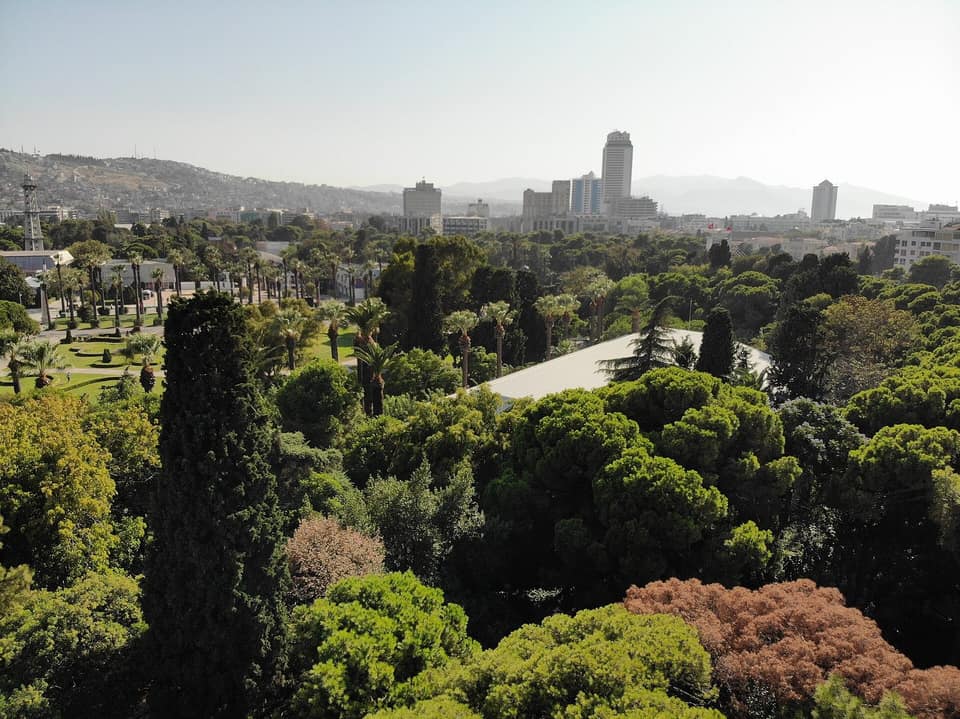
In the very centre of İzmir, between Alsancak and Basmane, lies a green island of 420,000 square metres. For ninety years Kültürpark has been both the garden where the city breathes and a fairground that opens its gates to the world every September. This article tells the story of how the park rose from the site of a fire, where the İzmir International Fair came from, which buildings and museums stand inside the park, and how to explore it today.
From a burnt district to the idea of a park
The land on which Kültürpark was built was the site of neighbourhoods reduced to ash in the İzmir Fire of 1922. For more than a decade after the fire the area remained a wasteland of rubble and empty plots, a neglected void in the middle of the city. The idea came from Moscow. According to the history published by İZFAŞ, the journalist Suad Yurdkoru was impressed by Gorky Park during a trip to Moscow in 1933 and shared his impressions with the mayor, Dr. Behçet Uz. As Wikipedia relates, the report Yurtkoru prepared was approved by the municipal council on 14 May 1934; Uz travelled to Moscow in 1935 and had two architects draw up a draft project. Clearing of the rubble began in the second half of 1934, the foundation was laid on 1 January 1936, and the park opened on 1 September 1936 together with the fair inaugurated by Prime Minister İsmet İnönü. The original 360,000 square metres were extended southwards by a further 60,000 square metres in 1939. Kültürpark was conceived as a people's university: sports grounds, exhibition halls, an open-air theatre, a zoo and a library were to be gathered within the same walls.
From the 9 September exhibitions to an international fair
The roots of the fair are older than the park. Alongside the İzmir Economic Congress that convened on 17 February 1923, an exhibition of domestic goods was held on the Second Kordon; İZFAŞ counts this exhibition as the fair's first step. The first regular exhibition opened on 4 September 1927 at the İzmir School of Arts under the name 9 September Exhibition and was visited by more than 80,000 people. A second followed in 1928; the event then continued as the 9 September Fair in 1933, the İzmir International 9 September Fair in 1934 and again, under a slightly different Turkish name, in 1935. The 1935 fair drew 311,000 visitors, and that year it became obvious that the site was too small. In 1936 the fair moved into its new park; the opening ceremony in front of the Lozan Gate was attended by 48 foreign organisations from Egypt, Greece and the Soviet Union, 32 provincial pavilions and 45 domestic organisations. Held that year under the name Arsıulusal İzmir Fuarı, it was the sixth fair by today's count. In 1943 the number of visitors passed one million. During the war years the 1942 fair could not open at all and the fairs of 1944 to 1946 remained national events; from 1947 onwards it continued without interruption as an international fair. In the late 1940s the fair joined UFI, the global association of trade fair organisers, and it remains that body's oldest member from Türkiye.
The Parachute Tower, the music halls and fair evenings
The great novelty of the 1937 fair was the Parachute Tower. Behçet Uz had seen the tower in Gorky Park and proposed a similar one to the Turkish Aeronautical Association; construction of the 48-metre reinforced-concrete tower began in 1935 and it opened with the fair on 20 August 1937. According to Wikipedia it was the world's first reinforced-concrete parachute tower; it has three terraces, a lift in the middle and a spiral staircase of 245 steps winding around it. Open to visitors during fair seasons, the tower was closed after being damaged in the Aegean Sea earthquake of 2020, and restoration work began in 2026. In 1938 the zoo, the Vakıflar Pavilion, the Clock Tower and the Ada and Göl music halls, the gazinos, opened. From the 1950s onwards the fair gazinos were regarded as the summit of entertainment in Türkiye; the Göl Gazinosu and the Manolya Garden, named by Zeki Müren himself, were the most famous of these stages. The names of singers such as Safiye Ayla, Zeki Müren, Sezen Aksu and Tanju Okan became inseparable from the İzmir Fair. During the Cold War the fair turned into a stage on which the United States and the Soviet Union competed with their pavilions, and the space race was followed before the eyes of İzmir. Until 1978 the fair ran for a full month, from 20 August to 20 September; its length was cut to twenty days in 1979 and 1986 and to ten days in 2004.
Buildings and museums inside the park
Over the years Kültürpark has also housed the city's museums. The İzmir Archaeological Museum stood inside the park from 1951 to 1984 and the İzmir Museum of Painting and Sculpture from 1952 to 1973. In 2004 the İzmir Museum of History and Art opened within the park; when its collections were moved to the İzmir Culture and Art Factory in 2025, an art gallery opened in the museum building and the İlber Ortaylı Library was opened the same year. The old fire station on the 9 Eylül Square side of the park is today the Ahmet Piriştina City Archive and Museum. Built between 1930 and 1932 to a design by the architect Mesut Özok, the building served as the fire brigade headquarters for seventy years, from 1932 until the end of 2001; its restoration began on 8 February 2002 and the archive and museum opened on 10 January 2004. In the institution's own words it is the first city archive and museum in Türkiye; its newspaper collection, council minutes, Ottoman court registers and photograph albums are open to researchers. In 1990 the former Fuar Mehtap Garden was roofed over and turned into the 750-seat İsmet İnönü Art Centre. The park also contains the Atatürk Open-Air Theatre, İzmir Sanat, the Youth Theatre, fourteen covered exhibition halls and four conference halls. The zoo closed in 2008 when the İzmir Natural Life Park opened at Sasalı, and the amusement park that had opened in 1973 was closed in 2025. In 2023 it was decided to rebuild the Ada and Göl gazinos of 1938 faithfully to the originals; the Göl Gazinosu reopened in 2025 as a social facility and the İzmir Cuisine Museum, and the Ada Gazinosu is planned to open in 2026.
Where the fair stands today
When trade fairs around the world shifted from general fairs to specialised ones, İzmir joined the trend from the 1980s onwards. İZFAŞ, founded on 7 February 1990 under the leadership of the İzmir Metropolitan Municipality together with the chambers, exchanges and exporters' associations, has organised the fairs ever since. Until Fuar İzmir opened at Gaziemir in 2015, every fair in the city was held at Kültürpark; today the specialised fairs take place at Gaziemir, while the İzmir International Fair and the İzmir Book Fair remain at Kültürpark. The fair now lasts ten days in the first half of September; the 95th İzmir International Fair was held on 5-13 September 2026 under the slogan The Fair in the Heart of the City. In recent years each fair has had a theme, a partner country and a guest province of honour; in 2024 the theme was technology, the special guest was Cuba and the guest province was İstanbul. During the fair, concerts, plays, film screenings, talks and street performances fill the park in the evenings; since opening hours and the programme change on fair days, check the latest information on the official İZFAŞ website.
How to explore the park
The park has five gates: Lozan, Montrö, 9 Eylül, Cumhuriyet and 26 Ağustos. The classic entrance is the Lozan Gate; the opening ceremony of 1936 was held in front of it, and on fair evenings the crowds still pour in here. Those arriving from Basmane station use the 9 Eylül Gate, those coming from Alsancak the Montrö Gate. Inside the park there is a 1,850-metre tartan running and walking track, a swimming pool, tennis courts and an indoor sports hall; in the early morning the track belongs to the runners. The trees are the park's real treasure. In more than 200,000 square metres of green space, 117 plant species from 44 families and 7,709 trees have been counted, catalogued and insured; according to İZFAŞ, most of the first trees planted were brought from abroad. The park received the Green Flag Award in 2025. Our suggestion is to walk in this order: enter through the Lozan Gate and follow the main axis, pause by the pool of the Göl Gazinosu, pass beneath the Parachute Tower and continue to the Atatürk Open-Air Theatre, then set aside an hour for the City Archive on the 9 Eylül Square side, where the photographs of İzmir before the fire and the old newspapers are kept. Although there is an underground car park for 594 vehicles beneath the park, public transport is easier; Basmane railway station and the metro station are a few minutes' walk from the 9 Eylül Gate.
Practical notes
Outside the fair season the park can be entered freely throughout the day, and the most pleasant hours are early morning and late afternoon. The blossoming trees in spring, the coolness around the Göl Gazinosu in summer and the silence after the fair in autumn are three different faces of the park. The Parachute Tower is closed during restoration; content yourself with looking at it from a distance and taking photographs. The opening hours and closing days of the City Archive and Museum, the İsmet İnönü Art Centre and the galleries are announced on the institutions' official websites; check there before you go. On fair days, come early for the evening concerts, try the Montrö or 26 Ağustos gates instead of the Lozan Gate, and prefer walking to cycling inside the park; in the crowd the finest view is the illuminated silhouette of the Parachute Tower.
Sources
- Vikipedi, Kültürpark, https://tr.wikipedia.org/wiki/K%C3%BClt%C3%BCrpark
- Vikipedi, İzmir Enternasyonal Fuarı, https://tr.wikipedia.org/wiki/%C4%B0zmir_Enternasyonal_Fuar%C4%B1
- Vikipedi, İzmir Paraşüt Kulesi, https://tr.wikipedia.org/wiki/%C4%B0zmir_Para%C5%9F%C3%BCt_Kulesi
- Wikipedia, İzmir International Fair, https://en.wikipedia.org/wiki/%C4%B0zmir_International_Fair
- İZFAŞ, History, https://www.izfas.com.tr/kurumsal-tarihcemiz
- İZFAŞ, Our Fairgrounds, Kültürpark, https://www.izfas.com.tr/fuar-alanlarimiz-kulturpark-tr
- İzmir International Fair official website, https://ief.izfas.com.tr/
- Ahmet Piriştina City Archive and Museum, Founding Story, https://www.apikam.org.tr/tr/Hakkimizda/1/29?tab=64
Comments
Be the first to comment