

The Fountains of Erzurum, Stone Stops for the Waters of Palandöken
Water from the mountain The historic fountains of Erzurum are small but telling structures that show how the city solved its drinking water problem over the centuries.
 Radar TürkiyeNovember 24, 2026
Sign in to like and rate
Water from the mountain
The historic fountains of Erzurum are small but telling structures that show how the city solved its drinking water problem over the centuries. According to a study by Haldun Özkan, an art historian at Atatürk University, the city's water in the Ottoman period fell into two groups: ground waters that rose within the city and mountain waters brought down from the slopes. The mountain waters were collected from springs, sources and outlets on the northern slopes of the Palandöken Mountains and carried into the city through pipes of fired clay. To ease the water shortage that came with population growth, more than a hundred springs on these slopes were brought into the city through pipes laid along 23 separate water channels and distributed through fountains to neighbourhoods, baths and courtyards.
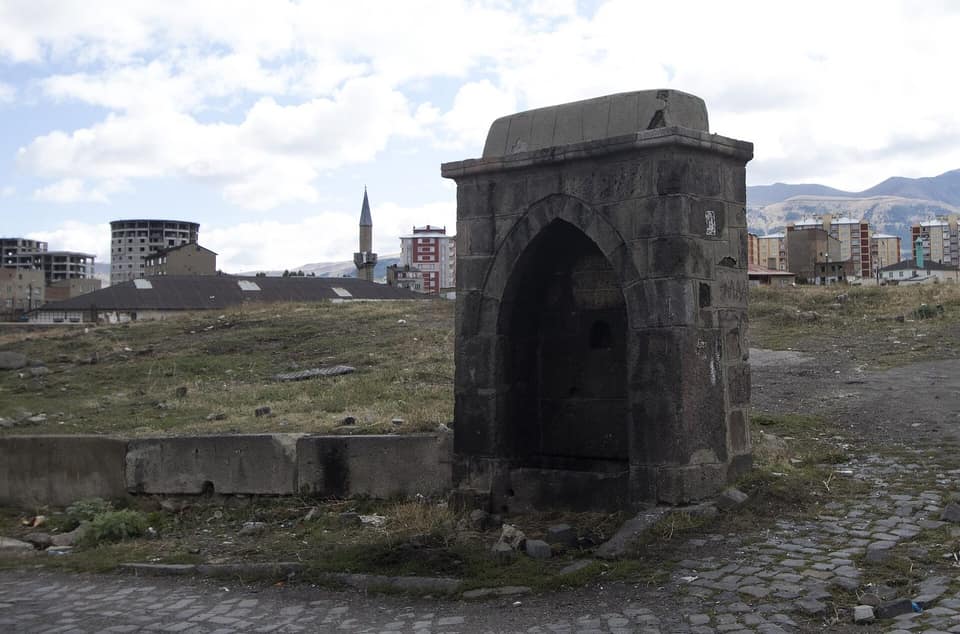
In this system the fountain was the last stop on the water's journey. Since it was not possible to bring water to every house, a neighbourhood met its needs from fountains at certain points. For this reason fountains gained an important place in community life and became one of the meeting points of the neighbourhood. If you walk down a street in Erzurum today and see a pointed arched stone niche leaning against a wall, you are most likely standing in front of a piece of this old water network.
Erzurum's fountains in numbers
Özkan's article, published in 2018, states that there are 179 fountains in the city centre of Erzurum and that 37 of them carry inscriptions. All of the inscribed fountains date from the Ottoman period, and most were built between the 17th and 19th centuries. By century the distribution is as follows: one fountain from the 16th century, nine from the 17th, ten from the 18th, eleven from the 19th and six from the 20th. Of the inscriptions, 35 are written in thuluth script and two in taliq; 26 are on marble and 11 on stone. Of the 37 inscriptions, 30 record construction and seven record repairs, and in 13 of them the date is given through the abjad numerical system.
The inscriptions also introduce the person who commissioned each fountain. The name of the patron is written on 31 inscriptions and the profession on 17; among them are governors, viziers, muftis and aghas. In this way each fountain carries into the street the name of someone who played a part in the administration or trade of the city. According to Özkan, the fountains were built as charitable foundation works.
A plain stone architecture
Erzurum's fountains were built for durability rather than display. According to Özkan, all of them are of cut stone, and most stand against the wall of a building or a garden. A typical Erzurum fountain consists of a rectangular stone block with a pointed arched niche in the middle, a spout inside the niche and an inscription above the arch. Some are topped with a moulded eave, while others have a stone cap known as a fountain saddle. Most fountains are undecorated; ornament appears on only seven examples.
A survey launched by Erzurum Technical University in 2025 also notes that these structures are generally built of cut stone and that some were damaged or had to be moved as the city grew and new building took place. In the study, carried out together with the Erzurum Regional Laboratory for Restoration and Conservation of the Ministry of Culture and Tourism, eight historic fountains were measured, their materials were analysed with portable instruments and their vibration behaviour was examined. That even such small masonry structures are studied by engineers today shows the value this heritage holds for the city.
The earliest examples
The earliest known fountain in the city is on the facade of the Çifte Minareli Medrese. Özkan dates this facade fountain to the end of the 13th or the beginning of the 14th century. No longer running today, it consists of a pointed arched niche set in a rectangular frame and is regarded as one of the fine examples of Anatolian Seljuk facade fountains. Looking carefully at the facade as you visit the madrasa lets you catch this detail.
The oldest Ottoman fountain to survive with its inscription is the Şabahane, also called the Şafiiler Fountains, at the start of Taşmağazalar Street. This row of six adjoining fountains faces east and is crowned by a band of muqarnas ornament. According to the Persian inscription above the third fountain from the left, the structure was commissioned in 1556, in the reign of Suleiman the Magnificent, by a man named Yakup. The guide of the Erzurum Provincial Directorate of Culture and Tourism also highlights the Şabahane fountains among the Ottoman water structures of the city.
The fountain at the castle gate
If you visit Erzurum Castle, look at the Castle Fountain beside the entrance gate. It was built against the castle wall in the classic style of Erzurum fountains and has a pointed arched niche. According to its inscription it was commissioned in 1681 by Ali Ağa, the agha of the castle, and repaired in 1905. Özkan notes that the first, five line inscription is no longer in place, while the second inscription, recording the repair, is carved directly into the stone of the fountain.
A foundation deed written in stone
The most interesting of Erzurum's fountains is the Hacı Mehmed Ağa Fountain on Gürcü Kapı Street. On the pediment of this wide, rectangular, pointed arched fountain is a ten line summary of a foundation deed, written in thuluth script on marble. According to a study by Hüseyin Yurttaş and Zerrin Köşklü, the inscription measures about 0.80 by 0.71 metres, and the researchers write that they have seen no other example of its kind. Özkan also stresses that this is the only Erzurum fountain bearing a summary of a foundation deed.
The inscription mentions a total of 60 fountains and five water channels that Hacı Mehmed Ağa repaired or built anew outside the city walls and in Hasankale. It also lists the 142 shops and inn rooms he had built outside the Tabriz and Georgian gates as their source of income. The foundation was established in 1723. The inscription further makes the people of the surrounding area responsible for looking after the fountains whenever they need repair. Writing a fountain's own maintenance arrangement on its face shows that water was seen as a lasting public service in the city.
A four sided fountain and a fountain that moved
The Dörtgüllü Fountain on Saray Bosna Street, in the Murat Paşa neighbourhood, is the only four sided fountain to survive in Erzurum. Each face has a pointed arched niche and a spout, which recalls the square fountains of Istanbul. According to its inscription the fountain was commissioned by İbrahim Paşa, who served as governor of Erzurum at various times. There is a ten year difference between the date of 1745 written in numerals and the date derived from the abjad calculation. The inscription on the southern face records that the fountain was repaired in 1855.
The Yazıcızade Fountain, built by the same pasha and dated 1750 by its inscription, is both a square fountain and a sunken fountain set below ground level. According to Özkan it was moved in 1998 and placed on the western side of the newly opened Saray Bosna Street. The Dabakhane Fountain, mentioned in the guide of the Provincial Directorate of Culture and Tourism, also lies today about four metres below the level of the road. It was built in the 18th century in an area crowded with leather workshops, to meet the water needs of the craftsmen.
Akpınar and its abundant water
The Akpınar Fountain, southwest of the square in the Mahallebaşı quarter, takes its name from the abundance and clarity of its water. Özkan writes that the fountain still keeps the rich flow it had on its first day. According to its inscription the ruined fountain was repaired in 1745 by İsmail Ağa; its original date of construction and its founder are unknown. The guide of the Provincial Directorate of Culture and Tourism also states that the fountain has one of the richest water sources in Erzurum and that water flows from eight spouts.
Another example you can see nearby is the Akif Ağa Fountain at the northwest corner of the Ulu Camii. According to Özkan the fountain was placed at this spot in 2002, and the date on its inscription is read as 1883, although one of the numerals cannot be made out clearly. The fountain in the courtyard of the Taşhan was also brought there later, and its inscription gives the years 1797 to 1798.
Tips for visiting the fountains
Most of the fountains are gathered in the city centre, in an area that can be explored on foot. A walk that starts at the castle with the Castle Fountain, continues to the facade fountain of the Çifte Minareli Medrese, and then goes down to the Akif Ağa Fountain at the corner of the Ulu Camii and the courtyard of the Taşhan, brings together examples from different centuries in a single outing. The Şabahane fountains stand at the start of Taşmağazalar Street, while the Hacı Mehmed Ağa Fountain is on Gürcü Kapı Street.
Morning and late afternoon, when the light falls from the side, are better for reading the inscriptions; the letters are easier to make out with the help of shadows. Some fountains stand against the wall of a house or a garden, so take your photographs from the street and do not enter courtyards without permission. In winter the area around the spouts may freeze, so watch your footing as you approach the basin. The fountains of Erzurum are small structures standing in the shadow of the great monuments, yet they are the ones that tell most closely how the city related to its mountain, its water and its neighbourhoods.
Sources
- Özkan, H., Kitabeli Erzurum Çeşmeleri, Turkish World Journal of Language and Literature 45, 2018, https://dergipark.org.tr/tr/download/article-file/627382
- Yurttaş, H. and Köşklü, Z., Erzurum İli Vakfiyelerinde Taş Özetler, Turkish World Journal of Language and Literature 44, 2017, https://dergipark.org.tr/tr/download/article-file/503276
- Erzurum Provincial Directorate of Culture and Tourism, Erzurum Travel Guide, https://erzurum.ktb.gov.tr/Eklenti/149998,turizm-rehberi---enpdf.pdf
- Erzurum Technical University, Tarihi Erzurum Çeşmeleri İnceleme Çalışması, 2025, https://erzurum.edu.tr/Content/menu_dosyalar/59edd124-0855-4ea6-986a-167c62b6bc82.pdf
Comments
Be the first to comment