

The Eskişehir Stone, the Story of Meerschaum from Mine to Pipe
When you stop in front of a display case in Eskişehir and look at a grape harvest scene carved into a milk-white stone, you are in fact looking at a material that comes out at this quality nowhere else in the world.

Sign in to like and rate
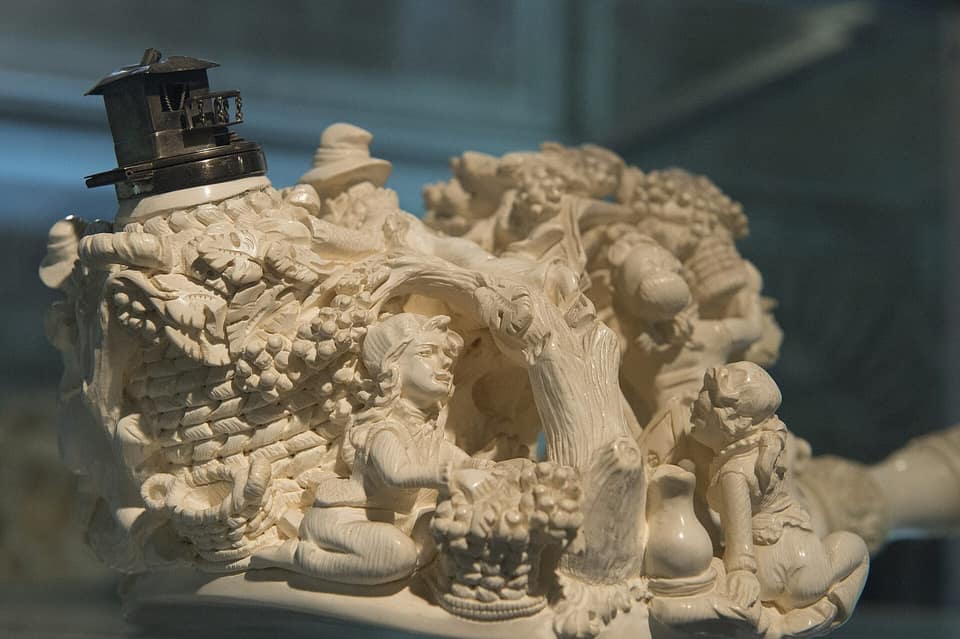
When you stop in front of a display case in Eskişehir and look at a grape harvest scene carved into a milk-white stone, you are in fact looking at a material that comes out at this quality nowhere else in the world. The Provincial Directorate of Culture and Tourism describes meerschaum as the symbol of the city and writes that Eskişehir is the only region in the world where white meerschaum is mined. Known locally as the Eskişehir stone, this soft, light and white material has been brought up from deep underground on rope ladders for centuries and turned into pipes, jewellery and figurines under the craftsmen's knives. This article follows the stone's path from the shaft to the museum case and explains where you can see it in Eskişehir today.
Many names, one stone
Meerschaum has more than one name. The Directorate's page describing the Meerschaum Museum lists, alongside the name Eskişehir stone, the names sea foam, Meerschaum and sepiolite. English Wikipedia explains where these names come from. Meerschaum means sea foam in German, and the name comes from the lightness of the mineral; because it is porous and light, it can float on water. According to the same article, Abraham Gottlob Werner referred to the stone by this name in 1788, while Ernst Friedrich Glocker gave it the name sepiolite in 1847. That name derives from the Greek word for cuttlebone, because the stone's porous texture was compared to that bone.
Chemically, meerschaum is a hydrated magnesium silicate. The Turkish Wikipedia article defines it as a rock formed when rocks containing magnesium and silicon are transformed deep underground by the action of hot waters. The same source lists the qualities that make the stone precious to craftsmen. Meerschaum is soft and easy to work, it softens even more when wet, and it hardens again when it dries. Because it is found wet underground, it is in its best state for carving the moment it is extracted, and as it dries it becomes lighter and gains strength.
Fathom by fathom underground
Even today, extracting the stone relies largely on manual labour. According to the page of the Provincial Directorate of Culture and Tourism on underground resources, meerschaum is mined in eight villages thirty-five kilometres from the city centre. Depth is measured in the fathom, an old unit of measure. The shafts descend vertically from five fathoms down to as many as thirty-three, and the finest stones come from below twenty fathoms. The Directorate writes that miners go down the shafts on ladders made of rope and that the stone is brought up with difficulty from deep down, through plenty of water.
Turkish Wikipedia describes the same process in a little more detail. First vertical shafts are dug from the surface; when the layer holding the stone is reached, horizontal tunnels are opened along it, and the meerschaum, scattered in nodules, is searched for in these tunnels. At some sites the layers lie below the groundwater level, so the water must be drained first. The article stresses that the work relies largely on human strength and on experience, even intuition, gained over the years. The sources give different figures for depth. The Meerschaum Museum page speaks of depths of up to a hundred and fifty metres, while Wikipedia mentions deeper layers; rather than giving an exact number, it is more accurate to say that it varies from pit to pit.
English Wikipedia, drawing on the 1911 Encyclopaedia Britannica, also describes the scene of the older period. The main workings were the Sepetçi and Kemikçi pits, located to the southeast of the city. The same source records that thousands of shafts leading down to horizontal galleries were said to exist in the area.
The mole's stone
There is a legend told in Eskişehir about how meerschaum was found, and both the Culture Portal and the Provincial Directorate of Culture and Tourism relate it at length. According to the legend, the first to find the stone was a mole. A young man walking from the Karatepe area to a nearby village sits down to rest and sees a mole playing with a white stone in front of a hole. When he picks up the stone and begins to carve it with his knife, the stone lets out a cry, first turns into a young girl, then crumbles and rolls back into the hole. The young man starts digging after it, and the villagers searching for him finally find him at the bottom of a deep shaft. The Culture Portal writes that those who work meerschaum attach great meaning to this legend and regard the mole that brought the stone up from the depths as the forerunner of their craft.
From Vienna to Eskişehir
The stone's opening to the world is a long story. The Provincial Directorate of Culture and Tourism writes that meerschaum is said to have been introduced to the Austrians by the Janissaries during the siege of Vienna. English Wikipedia dates the first record of meerschaum pipe making to around 1723; because its porous structure draws in moisture and tar, the material quickly became a prized pipe stone. The same article notes that carved Turkish meerschaum products were traditionally made in centres such as Vienna.
Nineteenth-century travellers had already noticed how important the stone was for Eskişehir. The Eskişehir entry of the TDV Encyclopedia of Islam relates that the French traveller Charles Texier named meerschaum working as the city's most important industry. For a long time, however, most of the raw stone was sent abroad and worked in Europe. According to Turkish Wikipedia, local carving developed from the 1940s onwards, increased greatly in the 1970s, and the export of raw meerschaum was banned. The sources disagree on the year of the ban. The Turkish article gives 1980, while the English article dates the ban from the 1970s. Both sources agree on the outcome; the working of the stone passed into the hands of Eskişehir's craftsmen.
At the craftsman's bench
Turkish Wikipedia explains that the craftsman's work begins with the damp stone that comes out of the shaft. As long as the stone does not lose its moisture, it is easy to work. During long sessions, stone that dries out and hardens is softened again by dipping it in water. Each task has its own knives, and the number of these tools, most often prepared by the craftsmen themselves, sometimes approaches fifty. The model best suited to the stone's natural shape is chosen so that it can be used with the least waste; in the article's words, the most important source for the model is observation and the craftsman's imagination.
Once the carving is finished, the piece is dried for a long time with indirect heat and sanded very finely. It is then polished by dipping it in heated beeswax and rubbing it until it shines. At this stage the stone takes on a semi-translucent cream colour and acquires its ivory-like appearance. The same source also notes that local carving, which began in the early twentieth century with women turning beads from pieces of stone on hand lathes, developed in many directions from the early years of the Republic. Today meerschaum is used not only for pipes but also for jewellery, ornaments and figurines.
At the Meerschaum Museum
You can see the finest examples of this craft at the Meerschaum Museum in Odunpazarı. The Culture Portal writes that the museum was opened in 2008 by the Odunpazarı Municipality in the Kurşunlu Complex. The Provincial Directorate of Culture and Tourism explains how the collection was formed. Works shown at the international meerschaum festivals, handicraft competitions and exhibitions organised by the Eskişehir Governorship since 1998 were bought by the Special Provincial Administration, and this was the museum's first step. Today the museum holds around four hundred works by sixty artists. According to the Directorate, the museum is housed in the former madrasa section of the complex built between 1517 and 1525 and is known as the first meerschaum museum opened in the world.
Move slowly along the cases. To see how the same stone was turned from a rough nodule into a scene as fine as lace, look at the backs of the carvings and their delicate parts. For the museum's visiting days and hours, check the current information on its official website.
Meerschaum in the workshops and houses
When you leave the museum, walk a few streets down to Atlıhan. According to the Provincial Directorate of Culture and Tourism, the inn was built in the 1850s by Takattin Bey for market traders, travellers and villagers, fell into ruin over time and was rebuilt in 2006 with care for its original architecture. In the rooms of the two-storey inn, which covers an area of seven hundred and sixty-eight square metres, there are today units where meerschaum is produced and sold. Watching the craftsmen at work through a half-open door here is the easiest way to understand how the pieces you saw in the museum come into being.
The houses of Odunpazarı also hide a detail connected with meerschaum. The Directorate mentions a work called Gül Asa, kept in the Hafız Ahmet Efendi Mansion in the neighbourhood. The piece came from the hands of the great meerschaum master Hafız Ahmet Efendi, and according to the Directorate one example is displayed today at the Anıtkabir Museum.
Taking a piece of stone home
The Culture Portal writes that pipes, jewellery and ornaments made of meerschaum are among the finest gifts to take home from Eskişehir and lists the places where you can find them. Atlıhan in Odunpazarı, the handicrafts centre in the Kurşunlu Complex, Çukur Çarşı in the city centre and the Esnaf Sarayı on İki Eylül Caddesi are the main ones. Meerschaum is fragile; wrap the piece you buy well and do not leave it wet. Turkish Wikipedia reminds us that the stone, which softens with moisture, hardens again when dry, and that it yellows as it is used as a pipe.
The finest thing about the meerschaum story is that all of it stands side by side within a few hundred metres. When you look at the works in the museum in the morning and stop by a craftsman's bench in the inn in the afternoon, you will have seen from start to finish how a damp nodule brought up from a shaft becomes the symbol of the city.
Sources
- Eskişehir Provincial Directorate of Culture and Tourism, Meerschaum, https://eskisehir.ktb.gov.tr/TR-158759/luletasi.html
- Eskişehir Provincial Directorate of Culture and Tourism, Meerschaum Museum, https://eskisehir.ktb.gov.tr/TR-339668/luletasi-muzesi-odunpazari.html
- Eskişehir Provincial Directorate of Culture and Tourism, Kurşunlu Mosque and Complex, https://eskisehir.ktb.gov.tr/TR-336893/kursunlu-camii-ve-kulliyesi-odunpazari.html
- Eskişehir Provincial Directorate of Culture and Tourism, Atlıhan Handicrafts Bazaar, https://eskisehir.ktb.gov.tr/TR-347094/atlihan-el-sanatlari-carsisi-odunpazari.html
- Eskişehir Provincial Directorate of Culture and Tourism, Odunpazarı Houses, https://eskisehir.ktb.gov.tr/TR-336894/odunpazari-evleri.html
- Türkiye Culture Portal, Meerschaum Museum, https://www.kulturportali.gov.tr/turkiye/eskisehir/gezilecekyer/luletasi-muzesi
- Türkiye Culture Portal, Meerschaum, https://www.kulturportali.gov.tr/turkiye/eskisehir/nealinir/luletasi
- TDV Encyclopedia of Islam, Eskişehir, https://islamansiklopedisi.org.tr/eskisehir
- Wikipedia, Lüle taşı, https://tr.wikipedia.org/wiki/L%C3%BCle_ta%C5%9F%C4%B1
- Wikipedia, Sepiolite, https://en.wikipedia.org/wiki/Sepiolite
Comments
Be the first to comment