

The Dovecotes of Cappadocia, Field Manure Carved into Rock
Walking through the valleys of Cappadocia, you are bound to notice rows of small holes cut into the slopes, some of them framed with painted red and white bands.

Sign in to like and rate
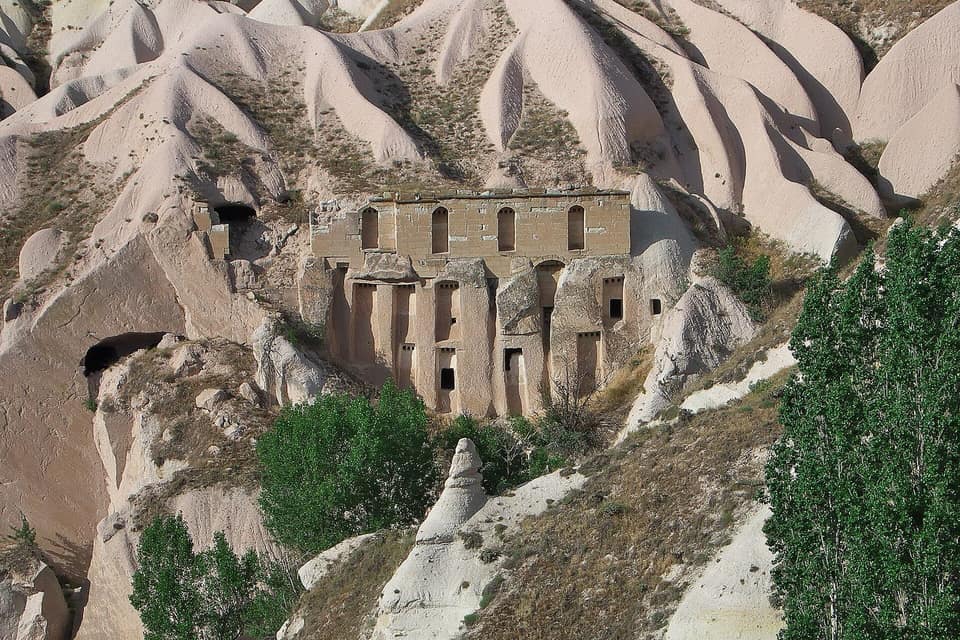
Walking through the valleys of Cappadocia, you are bound to notice rows of small holes cut into the slopes, some of them framed with painted red and white bands. These are not the windows of houses but the doors of pigeons. Describing the region's valleys, the Nevşehir Governorship stresses that people carved dovecotes as well as dwellings into the rock faces of these natural corridors, while farming the valley floors. The dovecote is the structure in this landscape most directly tied to farming. In this article we explain why these rock-cut bird houses were made, how they took shape, what the decorations on their facades tell us, and where you can best see them today.
Manure for the vineyard, a room in the rock
Dovecotes exist because of manure. An article on Cappadocia in TÜBİTAK's Bilim Çocuk magazine explains that these houses were built to collect pigeon droppings, which local farmers used to raise yields in their vineyards and gardens. Uçhisar Municipality likewise notes that pigeon manure, with its high nitrogen and phosphorus content, was especially valuable in vine growing. The pigeon chapter of an Ankara University livestock textbook writes that pigeon manure is high in dry and organic matter and more valuable than many other animal manures. The same source says these structures are called "güvercinlik" in Cappadocia, "burç" in Kayseri and "boranhane" in Diyarbakır, and that they have survived to the present day. Tuff, formed from volcanic ash and easy to carve, offered a perfect setting for this need. A farmer would carve a room into a slope near his fields, cut nesting niches into its walls and draw the birds there; the manure that built up was collected at intervals and carried to the vineyard.
How a dovecote is carved
According to the Bilim Çocuk article, dovecotes are small rooms in the soft rock, no larger than five to ten square metres. Small hollows are cut into the walls for the birds to roost and lay their eggs. In some places the structures were reinforced with wood or zinc. A 2019 study by Savaş Maraşlı of Nevşehir Hacı Bektaş Veli University emphasises that the region's rock-cut dovecotes have no distinct plan type. There are multi-storey examples as well as single-storey ones. Some were carved into a block of rock on a sloping hillside, others into free-standing fairy chimneys. Maraşlı notes that dovecotes are a building type not very common in Anatolia but concentrated in Cappadocia, and that they belong with the region's rock-cut farm buildings alongside linseed-oil presses, food stores, beehives, depots and stables.
Their location was not random either. The English Wikipedia article "Dovecote" writes that Cappadocian dovecotes were mostly built near water sources and high above the valley, with their entrances, called "mouths", usually facing the east or south side of the valley. The aim was to protect the structure from the cold and let sunlight in. Uçhisar Municipality points out that the nests were carved into steep cliffs at heights that predators such as foxes and martens could not reach. That is why those small holes high on the slopes look so inaccessible.
Red bands and flowered facades
What sets dovecotes apart from ordinary hollows is the painted decoration on their facades. According to Maraşlı's study, the decorations are painted in red, black, blue or green on a white ground and fall into four groups, geometric, floral, figural and object motifs. The Bilim Çocuk article explains that the paints were obtained from trees, flowers, wild herbs and soil containing iron oxide. Uçhisar Municipality also notes that the motifs around the entrances were made with red ochre or root dyes from local plants, and that the red paint helped the pigeons spot their nests from afar and find their way back.
Maraşlı goes a step further here. If the decorations around the openings had only been meant to attract pigeons, a plain coat of paint would have been enough; nobody would have bothered with more laborious figural and floral compositions. In the researcher's view, local artists created a space where, while attracting the birds, they could also show their inner world, their social surroundings and their way of life through motifs that reflected the fashion of the time. Among the common motifs are carnations in a vase and cypress trees lined up side by side. The depiction of objects such as the hookah fits nineteenth-century taste. So when you look at the facade of a dovecote, you are also looking at a picture a villager painted on his own wall.
Distant relatives
Taking manure from pigeons was not an invention of Cappadocia alone. According to the English Wikipedia article "Dovecote", the oldest known dovecotes are the fortress-like towers of Upper Egypt and the domed towers of Iran, and in these regions too the droppings were used by farmers as fertiliser. The same article notes that pigeon droppings were also useful for tanning leather and making gunpowder. Around Isfahan in Iran, a European traveller in the seventeenth century counted close to three thousand dovecote towers, and today more than three hundred historic towers have been identified across the province. These towers were built to supply manure to Isfahan's market gardens and were painted with red bands so that the pigeons could easily recognise them. The likeness to the red bands of Cappadocia is striking. The difference lies in the material. There separate towers were raised for the pigeons, while here the room was carved straight into the rock. The Ankara University course chapter also notes that the rock dove is accepted as the ancestor of the domestic pigeon; the rocky slopes of Cappadocia offer this bird a setting reminiscent of its natural home.
How old is the tradition
The sources do not agree on the age of the dovecotes, so caution is needed. Uçhisar Municipality and Göreme Municipality trace pigeon keeping in the region back to the ninth century. The decorated facades you see on the slopes today, however, are much more recent according to research. Maraşlı writes that the dates, style and composition of the decorations point to the eighteenth century and later. Bilim Çocuk likewise estimates that the region's pigeon houses were built between the eighteenth and twentieth centuries. The English Wikipedia, citing a study, reports that the oldest examples in the region date from the eighteenth century but are few, and that most were built in the nineteenth and early twentieth centuries. In short, pigeon keeping may have old roots, but the painted facades in front of you are largely the work of the last three centuries.
A walk through Pigeon Valley
The easiest way to see dovecotes is to walk the valley named after them. According to Uçhisar Municipality, Pigeon Valley, Güvercinlik Vadisi in Turkish, runs for about four kilometres from the foot of Uçhisar Castle to Göreme. The municipality says the walk is of medium difficulty and takes on average between an hour and a half and two hours. As Uçhisar lies higher than Göreme, starting the walk in Uçhisar means going downhill, which is more comfortable. Along the valley you will see oleaster, apricot, plum and apple trees, and wildflowers in spring. The Vasıl stream, which can dry up depending on the season, runs through the valley. Göreme Municipality also notes that there is a waterfall in the valley that drops from a height of fifteen metres. The route passes through short tunnels carved into the rock and abandoned cave dwellings. The Turkish Wikipedia writes that the valley can be viewed from Uçhisar Castle and lies on the flight path of hot-air balloons; early in the morning the balloons become part of the view as well.
Where else to see them
Dovecotes are not unique to this valley. The Bilim Çocuk article writes that they can be seen in the valleys around Uçhisar, in the Kılıçlar and Güllüdere valleys near Göreme, in the Üzengi valley at Ürgüp, in the Balkan Deresi and Kızılçukur valleys around Ortahisar, at Çat near Nevşehir and in the Soğanlı valleys within the borders of Kayseri. Göreme Municipality notes that many dovecotes can be seen along the roughly four-kilometre trail in Güllüdere Valley. Meskendir Valley is also a good choice for birdwatchers. The municipality writes that species such as the nightingale, the rock nuthatch, the black-headed bunting, the blackbird, the hoopoe and the pigeon can be observed there, that the rock dovecotes typical of Cappadocia can be photographed in the valley, and that it is also rich in butterflies in June.
Practical tips
- You will see the colours on the facades best in the first light of morning or in the late afternoon; Uçhisar Municipality also recommends these hours for photography.
- The valley floor can at times be dusty, slippery and uneven; wear walking shoes that support the ankle and have a good grip.
- Avoid the midday heat in summer and carry plenty of water.
- Dovecotes mostly sit on steep slopes; do not leave the path to get closer, binoculars or a zoom lens are enough.
- Do not write on the rocks, do not damage the vegetation, and take your rubbish out of the valley.
- You can combine the Pigeon Valley walk with a visit to Uçhisar Castle; the valley starts at the foot of the castle.
Sources
- Uçhisar Municipality, Güvercinlik Vadisi, https://www.uchisar.bel.tr/guvercinlik-vadisi/
- Göreme Municipality, Valleys, https://www.goreme.bel.tr/tr/vadiler-1758438144
- Nevşehir Governorship, Cappadocia Valleys, https://nevsehir.gov.tr/kapadokya-vadileri
- Savaş Maraşlı, Facade decorations of rock-cut dovecotes in Nevşehir (Nevşehir Hacı Bektaş Veli University open archive, 2019), https://acikerisim.nevsehir.edu.tr/handle/20.500.11787/4255
- TÜBİTAK Bilim Çocuk, Kapadokya, https://bilimcocuk.tubitak.gov.tr/wp-content/uploads/sites/157/2025/09/4bb73738-81f7-41e0-b103-feb9d6d30115.pdf
- Ankara University, Pigeon Breeding course chapter, https://oys.ankara.edu.tr/pluginfile.php/435833/mod_resource/content/1/11.%20B%C3%96L%C3%9CM.pdf
- Wikipedia, Dovecote, https://en.wikipedia.org/wiki/Dovecote
- Turkish Wikipedia, Güvercinlik Vadisi, https://tr.wikipedia.org/wiki/G%C3%BCvercinlik_Vadisi
Comments
Be the first to comment