

The Cuisine of Kayseri, from Mantı to Pastırma
The shortest way to get to know Kayseri is through its table. The city stands on a plain at the foot of Erciyes, where old caravan routes once crossed, and its cuisine carries the mark of both facts.

Sign in to like and rate
The shortest way to get to know Kayseri is through its table. The city stands on a plain at the foot of Erciyes, where old caravan routes once crossed, and its cuisine carries the mark of both facts. The dry wind blowing off the mountain is good for curing meat, and the spices brought by the roads give that meat its flavour. This article reads the cuisine of Kayseri through official records. Our guides are the list of dishes published by the Kayseri Provincial Directorate of Culture and Tourism and the geographical indication registration documents of the Turkish Patent and Trademark Office. We look first at the tiny squares of mantı, then at how pastırma and sucuk are dried, and after that at the pastries, oven dishes and desserts. At the end there are a few suggestions on how a visitor can approach this table.
A table full of registrations
The geographical indication database of the Turkish Patent and Trademark Office currently lists 34 registrations for Kayseri. Eight of them are designations of origin and twenty six are geographical indications. A designation of origin says that a product owes all of its qualities to the place where it was born. A geographical indication says that its reputation is tied to a place and that certain stages of production must take place there. Most of the food registrations bearing the name of Kayseri were filed by the Kayseri Chamber of Commerce, and in every document we read for this article the geographical boundary is the whole province of Kayseri. The oldest food registrations are pastırma and sucuk; both were registered in 2002. Mantı joined the list in 2009, and in recent years it has been followed by yağlama, katmer, nevzine, the fırın ağzı kebab and several other kinds of mantı. The registration documents are more than a list of names. Each one sets out which ingredients a dish is made with, in what order and in what quantities. The document also defines the board that will carry out inspections. Reading them is therefore rather like reading a very meticulous cookbook.
Forty mantı on one spoon
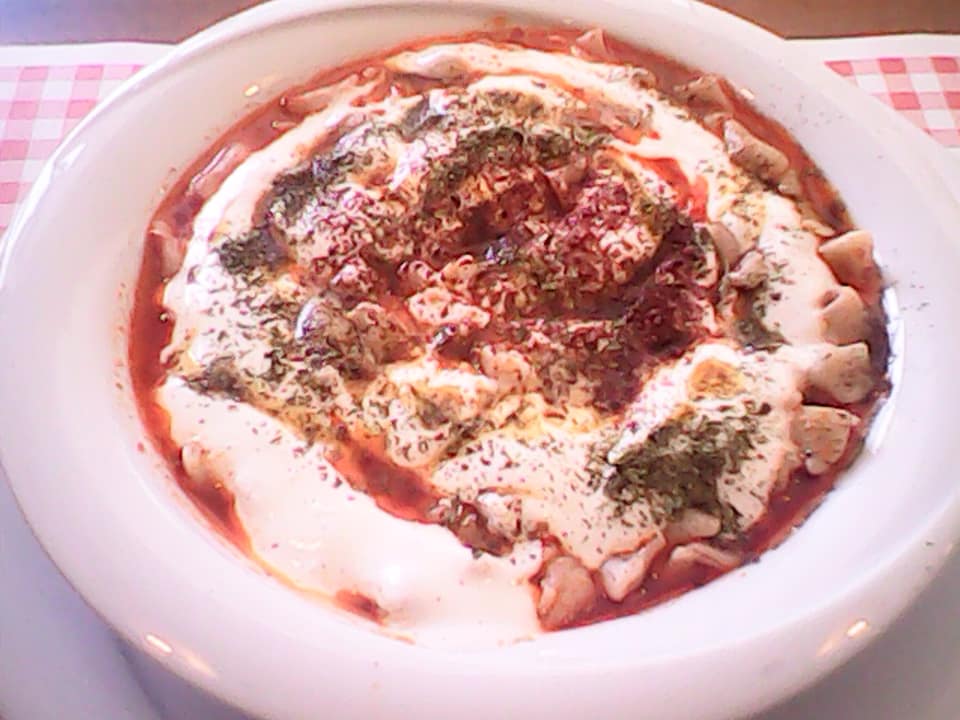
The measure of Kayseri mantı is how small it is. The registration document introduces it with a saying long repeated in the region: forty mantı on a single boxwood spoon. The dough is kneaded from flour, egg, water and salt, rested and then rolled out with a rolling pin to a thickness of about one millimetre. The thin sheets are stacked and cut into squares with sides of a little over fifteen millimetres. In the middle of each square goes a filling of raw minced beef, dry onion, basil, ground red pepper and black pepper. According to the document, one of the details that sets Kayseri mantı apart is the basil; it gives the filling its aroma. Another detail is the way it is closed. The corners of the dough are brought together with the fingertips but not laid exactly on top of one another, so the mantı does not sit like a sealed bundle but like a small pouch with its tip slightly open.
Over the boiled mantı goes a sauce made by sizzling tomato paste and ground red pepper in butter. Garlic yoghurt or plain yoghurt and sumac are added if you like, and the dish is served with some of its broth. The document also states that mantı sold in packets is dried in the oven and packed in a protective atmosphere. That rule lies behind the packets of dried mantı that visitors carry home from the city. Rolling the dough thin and cutting and closing it small requires, in the words of the registration, real skill; the document bases the link between the dish and Kayseri on exactly this labour.
The relatives of mantı
In Kayseri mantı is not a single dish but a family. Kayseri Yağ Mantısı is made with a yeasted dough. The dough is rolled thicker, cut into squares of six to eight centimetres, filled with raw mince and parsley and closed into a shape that resembles a flower. The pieces are fried on both sides in hot oil, and a tomato sauce made with olive oil and garlic yoghurt are poured over them. The document notes that only olive oil is used so that the sauce does not set as it cools. Kayseri Tepsi Mantısı, on the other hand, is cut into small squares and closed so that the middle stays open. The pieces are stood upright, row after row with no gaps, in a tray greased with butter, browned in the oven, and then a tomato sauce is drizzled over them and the tray is cooked a little longer on the stove. It is served in the same tray, with yoghurt placed in the centre.
The latest variety to join the list is Kayseri Purov Mantısı, also known locally as Pirov Mantısı. Its filling is not mince but cheese; the cheese is kneaded with onion and red pepper and placed in small pieces of dough closed into triangles. The mantı are first fried in a little oil and then cooked briefly with water in sautéed tomato paste. The registration document also explains one reason for all this variety. In the past, families who moved to their vineyard houses for the summer found it hard to go down into the city to buy bread. So all kinds of dishes were made from dough, and the different forms of mantı developed.
Pastırma summer
The story of Kayseri pastırma begins with the weather. According to the registration document, the city sees dry weather especially in autumn, and the wind blowing from Erciyes makes it possible to dry meat in the open air. In this season the difference between day and night temperatures is very large; locally this time of year is called pastırma summer. Even today pastırma is dried in sheltered open air sections of the production sites, and climate controlled rooms are used when the weather is not suitable.
The document describes production step by step. Large pieces are taken from the back, leg and shoulder of healthy male cattle. Slanting cuts are made in the meat with a knife; this is called şaklama. The cuts are packed with curing salt and the meat is left for a few days. It is then washed until the salt pockets are empty, drained on hangers and pressed into its flat shape. After drying in the open air the meat is pressed once more and then goes into the çemen vat. Çemen is made by adding sweet and hot red pepper, cumin and garlic to a mixture of fenugreek seed flour, vetch and wheat. According to the document, the dominant flavour of Kayseri pastırma is cumin. The excess çemen is scraped off, a thin layer is left and the pastırma is dried one last time. When sliced it looks red inside with white streaks of fat.
The registration document links the roots of pastırma to the location of the city. In Kayseri, where animal husbandry was widespread and which lay on the silk road, preserving meat with spices is a very old practice. The document also records that Kayseri pastırma is mentioned in many old written sources, above all the Seyahatname of Evliya Çelebi.
Finger sucuk
The sibling of pastırma is sucuk, and it benefits from the weather of the same season. Kayseri sucuk is made by kneading minced beef with suet, garlic and spices and stuffing it into natural casings. It is tied off with string into finger shaped pieces a little over ten centimetres long. According to the document its taste is distinctly hot, with garlic and cumin to the fore. When sliced, the white specks formed by the suet look like a mosaic. According to the document, the mosaic does not form if the kneading fails, and it is the masters who decide how long the kneading lasts. During pastırma summer the sucuk warms by day and matures in the cool night air, so it dries slowly and evenly. The registration also counts easy access to spices such as red pepper, cumin and black pepper centuries ago among the reasons for this flavour.
From şebit to yağlama
The list of dishes published by the Provincial Directorate of Culture and Tourism groups the pastries under a separate heading, and şebit yağlaması stands at the top of it. Şebit is a thin bread cooked on a sac griddle. Kayseri Yağlaması is made by spreading layers of minced meat filling between these breads. The filling is prepared by sautéing the mince with onion, peppers, tomato paste and tomatoes. The breads are stacked so that a layer of filling alternates with a layer of bread, and the top and bottom ones swap places so that all are equally soft. The yağlama is then cut into four pieces and served with garlic yoghurt or plain yoghurt. The registration document says that this dish, too, was born in the vineyard houses; in summer the need for bread was met with bazlama and şebit cooked on the griddle. The same list includes other pastries such as tandır böreği, kete, katmer and erişte.
The kebab cooked at the mouth of the oven
Kayseri Fırın Ağzı Kebabı is prepared in a copper tray. Tail fat is spread over the bottom of the tray, and lamb cubes and lamb chops mixed with thyme are laid on top. Over them go garlic cloves, rings of tomato and halved green peppers, and tail fat is placed on top once more. The tray is covered and goes into a stone oven. This is where the dish gets its name: the kebab cooks slowly for hours near the mouth of the oven, in its coolest spot. It is served with hot pide. Among the main dishes on the directorate's list there are also names such as pehli, sulu köfte, kağıtta pastırma, Kayseri güveci and karın dolması. In the soup section two registered soups stand out: kurşun aşı and börek aşı.
Nevzine and the desserts
Kayseri's best known dessert is nevzine. According to the registration document, a firm dough kneaded with flour, fat, walnuts, tahini and vinegar is pressed by hand into a tray, baked, and then a syrup made with grape molasses is drizzled over it. Because the dough is kneaded in the tray and pressed out by hand, locals do not say they make nevzine but that they press it. It keeps its structure even after the syrup is poured over it and crumbles in the mouth. The document recalls an old detail too. In the days when not every home had an oven, nevzine could only be pressed in neighbourhood bakeries, so it was the dessert of important occasions and important guests. Offering it at weddings, at the ceremony of asking for a bride's hand and to young mothers who had just given birth is also counted among old Kayseri traditions. The list also includes desserts such as gül baklavası, aside, pekmez helvası and dolaz, and drinks such as hoşaf, rose sherbet and gilaburu.
The products of the districts
Kayseri's geographical indications are not limited to the dishes of the city; the products of the districts are on the list too. Yamula aubergine, Tomarza pumpkin seeds, İncesu Karaevrek grapes, Özvatan flower honey and Pınarbaşı Uzunyayla Circassian cheese are registered as designations of origin. Gilaburu has received two separate registrations from two separate districts, Akkışla and Bünyan. Talas's Zincidere dried cream and its cheese with nigella seeds aged in clay pots, Develi's cıvıklı and gacer, and Erkilet's kedi bacağı are also among the geographical indications. These names are also a short list of what to look for at the market stalls when you come to Kayseri.
How to sit down at this table
The best time to taste Kayseri's cuisine is autumn, when pastırma and sucuk are hung out to dry. Yet mantı, yağlama and nevzine are on the table in every season of the year. There is a simple way to tell whether a product is really registered. According to the registration documents, the geographical indication logo appears on the product itself or on its packaging; for freshly cooked dishes it is displayed somewhere easily seen in the establishment. The first time you try mantı, notice the scent of basil before you mix the sauce into the yoghurt; that is the detail the registration particularly stresses. When buying pastırma, know that you can choose it with its çemen coating or scraped clean, and that it is sold whole or sliced. For those who want to try at home, the page of the Provincial Directorate of Culture and Tourism links to a regional cookbook prepared by the Kayseri Chamber of Commerce. For the dates of events and fairs it is best to check the directorate's current announcements.
Sources
- Kayseri Provincial Directorate of Culture and Tourism, Ne Yenir, https://kayseri.ktb.gov.tr/TR-55133/ne-yenir.html
- Kayseri Provincial Directorate of Culture and Tourism, Geographically Indicated Products, https://kayseri.ktb.gov.tr/TR-448920/cografi-isaretli-urunler.html
- Turkish Patent and Trademark Office, geographical indications of Kayseri, https://ci.turkpatent.gov.tr/cografi-isaretler/liste?il=38
- Turkish Patent and Trademark Office, Kayseri Mantısı registration document, https://ci.turkpatent.gov.tr/Files/GeographicalSigns/b2982161-08a3-4106-b698-00a6d5adf737.pdf
- Turkish Patent and Trademark Office, Kayseri Pastırması registration document, https://ci.turkpatent.gov.tr/Files/GeographicalSigns/65d342d4-0408-4f64-be6a-a120dd7ef24c.pdf
- Turkish Patent and Trademark Office, Kayseri Sucuğu registration document, https://ci.turkpatent.gov.tr/Files/GeographicalSigns/44f71030-9f19-45d5-87b5-14c98f4757ee.pdf
- Turkish Patent and Trademark Office, Kayseri Yağlaması registration document, https://ci.turkpatent.gov.tr/Files/GeographicalSigns/69811f58-54ee-4cbc-a40c-c9f9bb8bf607.pdf
- Turkish Patent and Trademark Office, Kayseri Fırın Ağzı Kebabı registration document, https://ci.turkpatent.gov.tr/Files/GeographicalSigns/4372a9d2-35ee-4a1a-9984-1540d1fb8a0e.pdf
- Turkish Patent and Trademark Office, Kayseri Nevzinesi registration document, https://ci.turkpatent.gov.tr/Files/GeographicalSigns/1145d076-9a8a-4ceb-9536-931a2f2c2def.pdf
- Turkish Patent and Trademark Office, Kayseri Yağ Mantısı registration document, https://ci.turkpatent.gov.tr/Files/GeographicalSigns/1bec0412-6c44-4023-ab13-97f5410eb01a.pdf
- Turkish Patent and Trademark Office, Kayseri Tepsi Mantısı registration document, https://ci.turkpatent.gov.tr/Files/GeographicalSigns/be48fea3-aa0f-4922-98a7-0205d61853e9.pdf
- Turkish Patent and Trademark Office, Kayseri Purov Mantısı registration document, https://ci.turkpatent.gov.tr/Files/GeographicalSigns/0c5a8213-e985-48e3-a94d-bb2ab080daaf.pdf
Comments
Be the first to comment