

The Bursa Table, Registered Flavours from Kebab to Candied Chestnuts
Where to begin at the Bursa table One of the easiest ways to get to know Bursa is to sit down at its table.
 Radar Türkiye24 Kasım 2026
Sign in to like and rate
Where to begin at the Bursa table
One of the easiest ways to get to know Bursa is to sit down at its table. The city's cuisine brings together the produce of a wide geography stretching from the foothills of Uludağ to the plains, and from the lakeshore to the Marmara coast. The Bursa Provincial Directorate of Culture and Tourism lists Bursa kebab, İnegöl köfte, Kemalpaşa dessert, hünkarbeğendi, pideli köfte, dik dik kebab and cevizli lokum among the dishes to taste in the city. In recent years some of these flavours have been registered with a geographical indication. A geographical indication is an official record that protects the name of a product and the way it is made in connection with a particular place.
The list of registered flavours
The geographical indications page of the Bursa Chamber of Commerce and Industry lists the products registered by the Turkish Patent and Trademark Office on the chamber's initiative. This list consists of Bursa candied chestnuts, Bursa grape must, Bursa milk halva, Bursa cantık, Bursa tahini pide, Bursa cevizli lokum and Bursa döner kebab. The chamber had announced that candied chestnuts were the first product to be registered among these applications. Looking at the list, you can see the two faces of Bursa cuisine. On one side there are pastries and desserts that come out of the oven, and on the other the tradition of kebab and köfte. Go Türkiye, the promotional portal of the Ministry of Culture and Tourism, adds other products with a geographical indication, such as İnegöl piyaz, İnegöl milky kadayıf, İnegöl çıbrıka and Zeyniler hinkal.
What a geographical indication says
According to the explanation of the Bursa Chamber of Commerce and Industry, geographical indications are registered either as a designation of origin or as a geographical sign. When announcing the European Union registration of candied chestnuts, the chamber stressed that this record documents the product's origin, its production method and its cultural ties to Bursa. The same statement noted that the registration will help protect the production conditions and strengthen the promotion of the product. In short, a registered product is not just a dish but a production tradition that a city protects under its own name.
Bursa kebab and pideli köfte
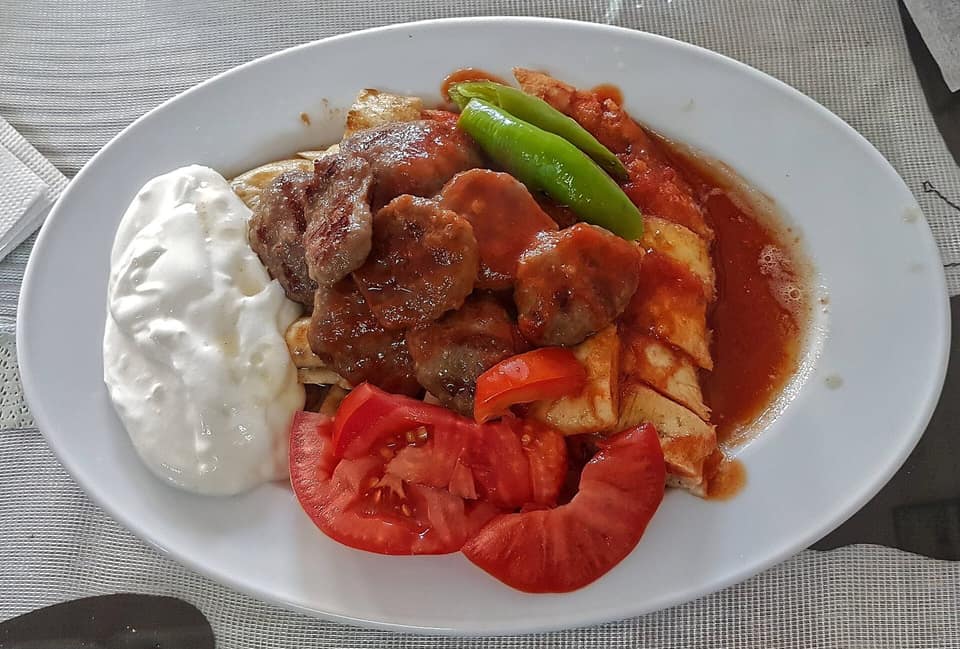
Bursa's best-known dish is the plate the provincial directorate calls Bursa kebab, also known as İskender kebab. According to the directorate's page, this kebab was first made around 1867, towards the end of the 19th century, by İskender Usta of Bursa. Döner meat cooked on a vertical spit is laid over finely cut pide, melted butter and tomato sauce are poured over it, and yoghurt is placed alongside. The directorate explains that the dish was first cooked in a kebab house in Bursa's Kayhan Bazaar and spread from there to the whole city and the country. Bursa döner kebab is also among the products registered with a geographical indication.
Pideli köfte is a close relative of the same tradition. According to the provincial directorate, grilled meatballs are placed on toasted pide, served with tomato sauce, and yoghurt is put on the side of the plate. Go Türkiye notes that the dish was born in the historic Kayhan Bazaar as an alternative to döner and that almost no spices are used. Its flavour comes largely from butter, pide, meatballs, yoghurt, tomato and peppers. Trying kebab and pideli köfte in the historic bazaar area, around the hans and the bedesten, means tasting the dish in the district where it was born.
İnegöl köfte and its companions
İnegöl köfte takes its name from the district of İnegöl to the east of Bursa. The Provincial Directorate of Culture and Tourism writes that these small grilled meatballs were brought into Turkish cuisine by immigrants from the Balkans and that they began to be sold under the name İnegöl köfte in the 1930s. Go Türkiye presents İnegöl piyaz, served beside the meatballs, as a product with a geographical indication. This piyaz is made with dried white beans, red onion, parsley, olive oil and vinegar. İnegöl çıbrıka, the seasoning of the meatballs and of many meat dishes, is also registered; this dried and ground herb is known by the scientific name Satureja hortensis. If you happen to go to İnegöl, try the milky kadayıf for dessert. According to Go Türkiye, shredded kadayıf pastry is arranged in a spiral and baked with butter and sunflower oil, then soaked in a light syrup made of milk, sugar and cream and topped with crushed walnuts.
Flavours of the oven
In Bursa, stone oven products stand out at breakfast and between meals. Go Türkiye explains that tahini pide is a breakfast tradition of about a hundred years. Tahini, grape molasses and sugar are spread on a leavened dough and the pide is baked in a stone oven. Cantık, on the other hand, is made by placing finely minced or diced meat inside a round dough with raised edges. Baked in a high-heat stone oven, cantık has a crispy crust and stays soft inside. Cevizli lokum, on the provincial directorate's list, is described as salty rolls filled with walnuts; although its name contains the word lokum, it is not a sweet but a salty pastry. Passing by the bakeries early in the morning is the best way to find these products warm.
Kemalpaşa dessert and milk halva
Kemalpaşa dessert takes its name from the district of Mustafakemalpaşa to the west of Bursa. According to the Provincial Directorate of Culture and Tourism, the dessert was first called cheese dessert, and it took its present name when it was first produced in this district and spread across the country. Sheep cheese, flour, semolina and eggs are kneaded into small biscuits three to four centimetres in diameter. These biscuits are baked, sold in bags and turned into the dessert by being placed in boiling sugar syrup. This is why Kemalpaşa dessert is also sold dry and comes to the table after being soaked in syrup.
Bursa milk halva is a dessert that dates from the Ottoman period. As Go Türkiye describes it, butter and flour are roasted, then milk and sugar are added, and it is baked in the oven until the top turns golden. It is traditionally served warm. On cold days, a small plate of milk halva after lunch lets you get to know one of the simplest and oldest flavours of the Bursa table.
Candied chestnuts
The flavour that has become Bursa's symbol is candied chestnuts. The Bursa Chamber of Commerce and Industry states that candied chestnuts have been produced in the city's Şekerciler Bazaar since the early 1900s and that Bursa has long been the production centre of this product. According to Go Türkiye, the chestnuts are gathered on Uludağ, and after their shells are removed they are wrapped in cheesecloth, boiled and cooked in a sugary syrup. The product was first registered with a geographical indication by the Turkish Patent and Trademark Office. The Ministry of Agriculture and Forestry announced in November 2025 that Bursa candied chestnuts had also received a geographical indication registration in the European Union, becoming the 42nd Turkish product to do so. According to the chamber, this is the city's fourth EU-registered product, after Bursa black fig, Gemlik olive and Bursa peach. Visiting the Şekerciler Bazaar to buy candied chestnuts is the most natural way to get to know the product at its historic place of production.
From field to table
Bursa's cuisine is not made up of cooked dishes alone. Go Türkiye lists Hasanağa artichoke, Karacabey onion, Keles cherry, Yenişehir pepper, Santa Maria pear, Bursa black fig, İznik müşküle grape and İnegöl cerrah bean among the city's registered agricultural products. The names of these products reflect the different soil and climate conditions of the province's various districts. Gedelek pickles, made with spring water in Gedelek village in Orhangazi, and hinkal, which carries the heritage of the Ahıska Turks in Zeyniler village in Yıldırım, are also among the local flavours listed by Go Türkiye. Bursa grape must, meanwhile, is an additive-free drink made by pressing dark grapes, boiling the juice briefly and cooling it. According to Go Türkiye, it is drunk cold and is traditionally served alongside döner.
Practical tips
If you want to build a day in Bursa around food, start the morning at a bakery with tahini pide or cantık. At midday try kebab or pideli köfte in the historic bazaar area and ask for cold grape must alongside. For dessert, Kemalpaşa dessert or milk halva is a good choice; you can buy candied chestnuts at the Şekerciler Bazaar for the journey home. If you have time to go to İnegöl, tasting the meatballs together with piyaz and milky kadayıf in the district where they were born is a different experience. According to the Bursa Chamber of Commerce and Industry, firms that want to use the geographical sign on their premises and packaging must first apply to the chamber. For this reason, checking the geographical indication emblem on the packaging is a good habit when you buy a registered product.
Sources
- Bursa Provincial Directorate of Culture and Tourism, What to Eat, https://bursa.ktb.gov.tr/EN-158275/what-to-eat.html
- Bursa Provincial Directorate of Culture and Tourism, Bursa Kebab, https://bursa.ktb.gov.tr/EN-207649/bursa-kebab.html
- Bursa Provincial Directorate of Culture and Tourism, İnegöl Köfte, https://bursa.ktb.gov.tr/EN-207653/inegol-kofte.html
- Bursa Provincial Directorate of Culture and Tourism, Kemalpaşa Dessert, https://bursa.ktb.gov.tr/EN-207656/kemalpasa-dessert.html
- Bursa Provincial Directorate of Culture and Tourism, Pideli Köfte, https://bursa.ktb.gov.tr/EN-207658/pideli-kofte.html
- Bursa Provincial Directorate of Culture and Tourism, Cevizli Lokum, https://bursa.ktb.gov.tr/EN-207660/cevizli-lokum.html
- Ministry of Culture and Tourism, Go Türkiye, Bursa Taste, https://goturkiye.com/bursa/taste
- Bursa Chamber of Commerce and Industry, Geographical Indications, https://www.btso.org.tr/bilgi-bankasi/bursa-ekonomisi/cografi-isaretler
- Bursa Chamber of Commerce and Industry, Bursa Candied Chestnuts Receive EU Geographical Indication Registration, https://www.btso.org.tr/en/guncel/haberler-ve-duyurular/haber-duyuru-detay/60336
- Ministry of Agriculture and Forestry, Bursa Candied Chestnuts and İpsala Rice Receive EU Geographical Indication Registration, https://www.tarimorman.gov.tr/Haber/6857/Bursa-Kestane-Sekeri-Ve-Ipsala-Pirinci-Abden-Cografi-Isaret-Tescili-Aldi
Comments
Be the first to comment