

The Ancient City of Anavarza, a Roman Metropolis Rising from the Cilician Plain
In the Middle of the Plain, a Rock and a City The rock mass that rises like an island from the flat fields of the Cilician plain is the first and most recognizable sign of Anavarza.

Sign in to like and rate
In the Middle of the Plain, a Rock and a City
The rock mass that rises like an island from the flat fields of the Cilician plain is the first and most recognizable sign of Anavarza. Texts of the Ministry of Culture and Tourism describe the hill in exactly this way, as a hill rising like an island in the middle of the plain. The ancient city lies 28 kilometres south of the centre of Kozan district, within the borders of today's Dilekkaya village. According to the Adana Provincial Directorate of Culture and Tourism, the city was founded on the slopes of the castle and covers an area of 1143 decares. In the sources the same place appears as Anavarza, Anazarbos and Caesarea ad Anabarsum; all three names describe the same city.
For visitors coming from Adana, the road runs through Kozan. The Culture Portal notes that the site can be reached by vehicles going from Kozan to Dilekkaya. The address of the site is given as Dilekkaya Neighbourhood, Kozan. This article was compiled from institutional texts so that you know what you are looking at before you enter the city, and it gives the figures as those texts give them. Set aside enough time to see the castle, the walls and the triumphal arch comfortably.
A Metropolis Growing in the Roman Age
The story of the city begins on the eastern edge of the Roman world. According to the Culture Portal, in the 1st century BC the Romans left the administration of this region to Tarkondimotos, whom they appointed as a vassal king. The same text says that after the city came under Roman rule in 17 BC it grew and developed, and rose to become one of the most important metropoleis of Anatolia. The General Directorate of Cultural Heritage and Museums writes that at the end of the 2nd century AD Anavarza was competing with Tarsus, the giant city of the ancient world, for the leadership of the Cilician League.
The 3rd century was the city's most splendid age. According to the General Directorate's text, in this century Anavarza obtained many military privileges, received the title of Metropolis, and until the middle of the century won the title of Neokoros three times. The Adana Provincial Directorate adds that the city once hosted festivals and Olympic games in Cilicia. In the Çukurova University news text, the excavation director says the city was known in history as the Unconquerable City and that its past is thought to be about two thousand years long. In later centuries the city came under Eastern Roman, Arab and Armenian rule, and in 1375 it was taken by the Mamluks. The General Directorate states that after this date there was no large-scale settlement here.
The Walls and the Ala Kapı Triumphal Arch
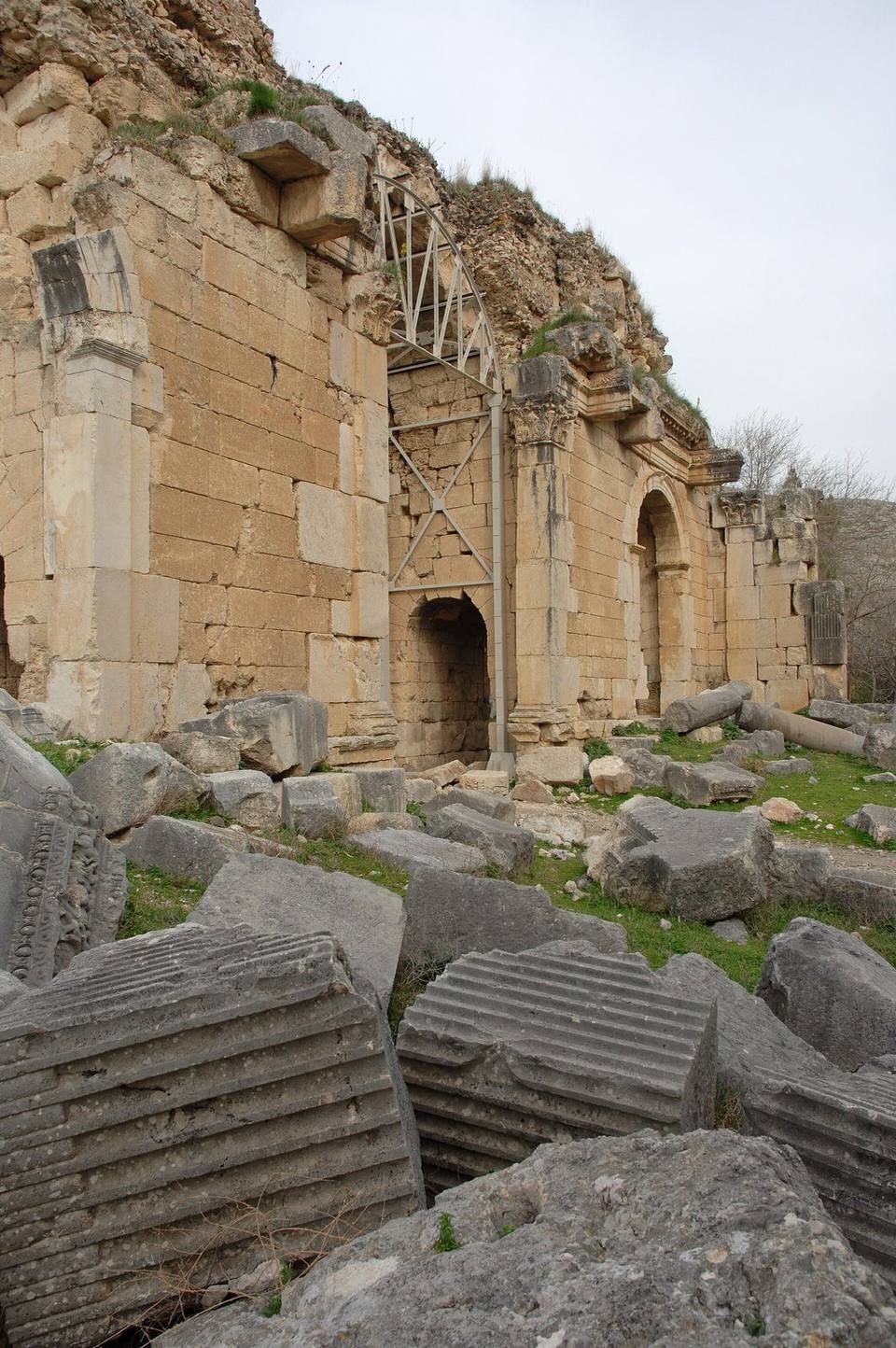
The most striking surviving part of the city is the triumphal arch at its southern entrance. According to the Adana Provincial Directorate, the walled city was entered through four large gates, and the only gate standing today is Ala Kapı, built as a triumphal arch. The General Directorate presents the structure as the only triumphal arch with three entrances in the Cilicia Region. The Provincial Directorate calls it the largest known triumphal arch of the region; this superlative is the institution's own assessment. The wall is described in the General Directorate's text as 1500 metres long with 20 towers.
The first excavation and restoration work on the arch began as cleaning and restoration under a 2013 permit of the General Directorate of Cultural Heritage and Museums. In the 2015 work, the excavation of the structure was completed, survey drawings were made and the damage to the structure was identified. About 500 block stones, most of them decorated, that had fallen from the arch in earthquakes were drawn and photographed one by one and moved to a stone park. The place of each block was determined, point cloud animations of the arch were prepared, and ground surveys were carried out with drilling down to 22.5 metres. In other words, the structure you see in front of you is the result of a serious process of documentation and conservation. Looking at the rows of blocks in the stone park beside it is the best way to understand how richly the arch was carved.
Colonnaded Street, Bath, Theatre and Stadium
Once you pass through the arch, the main axis of the city, the colonnaded street, begins. According to the Adana Provincial Directorate, most of this main street, which is 34 metres wide and 250 metres long, has been excavated and uncovered. Because the excavation continues, the length of the opened section may change over the years; it is sensible to ask about the current situation before your visit. The Culture Portal and the General Directorate list the important remains in the ancient city as follows: the colonnaded road, a bath, the remains of a church, a theatre, an amphitheatre, a stadium, water channels and rock tombs. West of the city there are also a necropolis and an ancient road.
What is interesting about this list is that it lets you read the daily life of the city. The bath tells of bathing and cleanliness culture, the theatre and amphitheatre of entertainment habits, and the stadium of festival and competition traditions. Water channels and rock tombs show the infrastructure and the burial culture of a crowded city. The General Directorate also counts among the important works a pool mosaic of the sea goddess Thetis, dated to the 3rd century AD. According to the Çukurova University news, excavations continued at the triumphal arch, the colonnaded street, the church, the bath and the amphitheatre, and in the 2020 season work was carried out in five separate areas with a team of about one hundred people. In that news text, Anavarza is described as the only ancient city in the Çukurova region supported to be worked on continuously for twelve months a year from 2020 onward.
The Castle Hill and Medieval Traces
On top of the rock in the middle of the plain stands the medieval castle. According to the same text, the castle shows inscriptions and repairs related to the period when the armies of Harun al-Rashid used it as a garrison. A cistern, many closed spaces, vaulted passages and tunnels, towers and niches are also among the elements listed for the castle. The Directorate describes the castle as a synthesis of the civilizations of the region.
Climbing to the castle also explains why the city was founded here. From the hill the plain opens in every direction, and the line of the walls and the direction of the colonnaded street are easier to read. The castle is a witness of the periods when the region changed hands after the decline of the ancient city. The General Directorate mentions Eastern Roman, Arab and Armenian rule, followed by the Mamluk conquest of 1375. For this reason repair traces from different centuries appear side by side on the castle hill. During the climb be careful of the stony ground, the steep slopes and the shadeless sections.
Anavarza in Science and Literature
Anavarza is known not only for its stones but also for the people it produced. The General Directorate and the Culture Portal write that the pharmacologist Dioscorides, who served in the Roman army in the time of Emperor Nero, was from Anavarza. According to the institutional texts, his five-volume work De Materia Medica was taught as one of the basic works in the medical faculties of all modern countries until the 18th century. The General Directorate finds this notable for the city's contribution to the history of world science. The Culture Portal also writes that the famous poet Oppianos was born and lived in this city, and that ancient sources show there were many linen weaving workshops in the city.
The same pages also open onto the city's very early traces. According to the Çukurova University news, the stone axe found in the 2020 excavations is dated to the Chalcolithic Period, and the headline of the news gives its age as about seven thousand years. The excavation director says it has been assessed that the axe was used in ceremonies. This find points to the fact that the surroundings of the castle hill had seen settlement long before the Roman age. The news also records that the excavation began in 2013 at the triumphal arch with a small team and reached a scientific team of about one hundred people in 2020.
How to Visit
Go to Anavarza via Kozan and take the vehicles that run to Dilekkaya. The Culture Portal describes the route this way. Opening hours and entry conditions can change; check the current information on muze.gov.tr. Because excavation continues, some areas may be closed or fenced. Do not go beyond fences and signs, do not step on the stones and do not climb on the blocks.
The site is open and shadeless; avoid the middle of the day in the summer heat of Çukurova. The cooler hours of spring and autumn are more suitable both for the castle climb and for photography. Take water, a hat and sturdy shoes. As a route, it makes sense to see first the triumphal arch, then the colonnaded street and last the castle hill, because when you come down from the hill the plan of the city will have settled in your mind.
The Culture Portal writes that the Ancient City of Anavarza was inscribed on the UNESCO World Heritage Tentative List in 2014. In the Çukurova University news, the excavation director expresses the expectation that the city may enter the Permanent List in the future. In the sources this article is based on, the city appears as a site on the Tentative List. In any case the site is a place where both excavation and conservation work are very much alive; your visit should be made with respect for that work.
Sources
- Adana İl Kültür ve Turizm Müdürlüğü, Anavarza Ören Yeri, https://adana.ktb.gov.tr/TR-228607/anavarza-oren-yeriancient-city-of-anavarza.html
- Kültür Portalı, Anavarza Ören Yeri, https://www.kulturportali.gov.tr/turkiye/adana/gezilecekyer/anavarza-kalesi
- Kültür Varlıkları ve Müzeler Genel Müdürlüğü, Anavarza Antik Kenti (Adana) 2014, https://kvmgm.ktb.gov.tr/TR-93760/anavarza-antik-kenti-adana-2014.html
- Çukurova Üniversitesi Haber Merkezi, Anavarza Antik Kenti'ndeki 2020 Yılı Kazı Çalışmaları Tamamlandı, https://habermerkezi.cu.edu.tr/haber-detay/2133
- Image, Dosseman, CC BY-SA 4.0, Wikimedia Commons, File:Anavarza Triumphal arch in Anazarbus 2750.jpg
Comments
Be the first to comment