

Sinan's Bridges on the Edirne Road, Büyükçekmece and Silivri
For centuries the overland road west from Istanbul to Edirne and the Balkans ran into the same problem.

Sign in to like and rate
For centuries the overland road west from Istanbul to Edirne and the Balkans ran into the same problem. Along the Marmara shore, lagoons opening onto the sea and marshes blocked the way; at Küçükçekmece and Büyükçekmece travellers had to cross the narrow strips of land where the lakes meet the sea, and at Silivri a stream plain prone to flooding. In the second half of the 16th century two great bridges associated with the name of Mimar Sinan were built at two of these crossings, and a road station inn was set up at the head of one of them. This article describes these structures in Büyükçekmece and Silivri together with the engineering decisions that keep them standing, and offers suggestions on how to visit them today.
The western gate of the Edirne road
This route is much older than the Ottomans. According to the TDV Encyclopedia of Islam, the Via Egnatia, which linked Istanbul to the west, crossed the passage at Büyükçekmece by a bridge called the Athyras Bridge, with a guard tower at each end. Bertrandon de la Broquière, who passed this way in 1433, writes that the bridge was in ruins. The story of the crossing at Küçükçekmece is similar: the TDV quotes Procopius to the effect that the bridge on the same road was set on a stone arch by Emperor Justinian in the 6th century.
Immediately after the conquest of Istanbul, Mehmed II had both bridges repaired; the TDV entry on Küçükçekmece states that the repair was carried out in the winter of 1455. But the road was carrying an ever heavier load. Armies heading to Rumelia, embassies, caravans and couriers all used the same crossings. In the last years of Süleyman the Magnificent, when it was seen that the old bridge at Büyükçekmece was in ruins and that travellers crossed it only with great difficulty, a decree was issued for a new bridge.
An old crossing at Küçükçekmece
The first bridge a traveller heading west meets is at Küçükçekmece. Known in Western sources as Ponte Piccolo, the "little bridge", by comparison with the Büyükçekmece Bridge, this structure is 210 metres long and 7.60 metres wide according to the TDV. In the Ottoman period it also served as a post of the palace guards where journeys to and from Rumelia were checked. Evliya Çelebi says that its construction began under Süleyman and was finished in the time of Selim II; however, Orhan Bozkurt, who studied Mimar Sinan's bridges, notes that this bridge does not appear in Sinan's lists of works and may belong to Acem Alisi, the chief architect before him. Because the bridge was widened and its slope levelled during the First World War, it has largely lost its original architectural features today. In other words, to see Sinan's signature you have to go a little further west.
Across the marsh at Büyükçekmece
The problem at Büyükçekmece was not to span a stream but to cross a wide, marshy stretch of land. As the TDV tells it, Sinan chose between two approaches. It was possible to build a short bridge over the marsh and connect its two ends to dry land with raised causeways; he preferred instead to build a much longer bridge running over the entire marsh. He also criticised the old Roman bridge: in the words the sources attribute to him, his predecessors had built it "fleeing the sea, off to the side, in the marsh", and that was why its foundations had failed. The new bridge was therefore laid further south, on a line closer to the sea with firmer ground.
The foundations were laid accordingly. The TDV relates that Sinan had cofferdam boxes the size of "a galleon" built for each pier, had piles two or three times a man's height driven into them, and had lead poured between the piles to bind them together. Büyükçekmece District Governorate writes that during construction the water of the lake was pumped out with large pumps. According to Selaniki Mustafa Efendi, the treasurer Hasan Çelebi and the accountant Hüsrev Bey were appointed as the commissioner and supervisor of the work.
When Süleyman the Magnificent died on the Szigetvar campaign, the bridge was completed under his son Selim II. The Arabic inscription on the bridge states that the work was begun by Süleyman's order and finished by Selim II in 975 (1567-68). The calligrapher, according to his signature, was Derviş Mehmed. The phrase "amel-i Yusuf b. Abdullah" read at the edge of the inscription is, according to the TDV, the only known signature of Mimar Sinan on any of his works; instead of his famous name, Sinan had only the name Yusuf written. Local sources also recount a saying attributed to Sinan in which he calls the bridge the masterpiece among his works.
Soon after its construction the bridge was damaged by a flood, and some of its arches were repaired, again by Sinan's own hand. Evliya Çelebi, who passed this way in 1651, describes the bridge as a marvel worth beholding, but gives the number of arches and the name of the inscription's calligrapher wrongly. Foreign travellers arriving from the west described the bridge with admiration in their travel accounts, and the Italian name Ponte Grande took hold. Most of the Ottoman armies' campaigns into Rumelia passed over this bridge; the retreats of the 1877 and 1912 wars also crossed it. Wikipedia writes that in 1915, while the Gallipoli campaign was under way, a British submarine put men ashore to blow up the bridge, and that these soldiers were captured by Ottoman patrols.
Four sections, twenty-eight arches
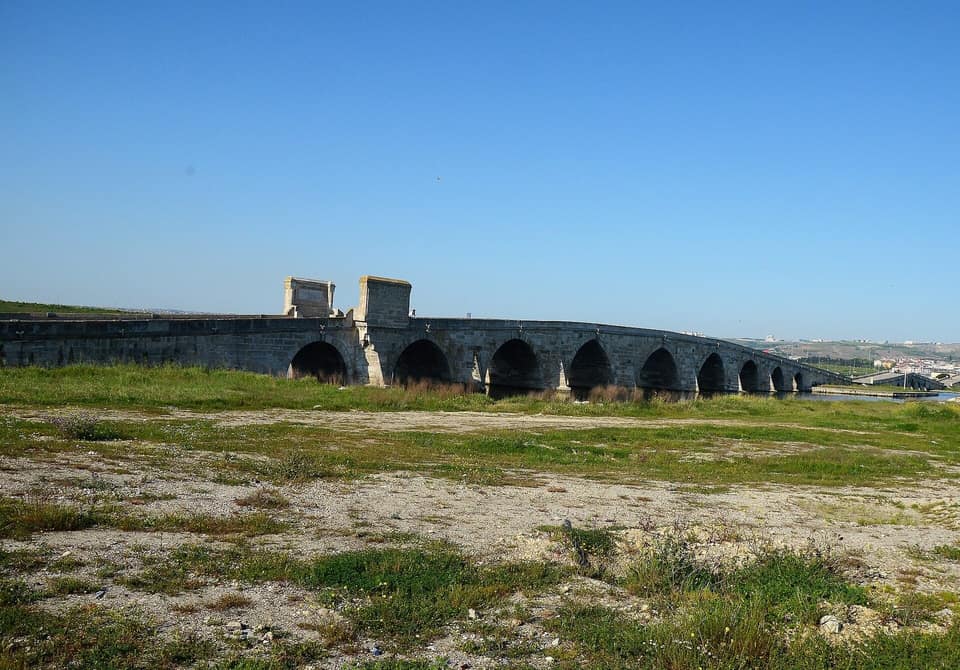
Seen up close, the bridge's structure reveals an ingenuity that is not obvious at first glance. According to the TDV's measurements, its total length is 635.57 metres and its width 7.17 metres. The bridge is made up of four sections that rise and fall. The first section has seven arches and is 157.23 metres long, the second again has seven arches and is 135.10 metres long, the third has five arches and is 101.25 metres long, and the fourth has nine arches and is 183.72 metres long. There are twenty-eight arches in all; the smallest of the pointed arches has a span of 4.50 metres, while the largest, in the fourth section, spans 11.86 metres.
Between the sections there are connecting stretches varying from 15 to 25 metres, and these stretches have no parapets. The TDV writes that this suggests a deliberate choice: in great floods the excess water can spill over these low stretches and flow away without harming the bridge. At the beginning and end of each section stand the bollards typical of Turkish bridges. In the middle of one section, above the widest arch, there are resting benches; at the head of another section two inscription kiosks rise facing each other. The kiosks were built as projecting bays, and their undersides are worked with muqarnas.
The bridge's recent past has also left its mark. According to the TDV, in the 1960s two people who believed treasure was hidden inside broke apart the part of the inscription kiosk bearing Sinan's name; this section and the inscription were later rebuilt. The bridge was repaired in 1970; according to Büyükçekmece District Governorate, the structure was restored again in 1986-1989 and is today the symbol of the district. Because the main traffic passes over the modern bridge a little further on, the historic bridge remains relatively quiet for pedestrians.
A road station at the bridgehead, the Kurşunlu Han
The crossing at Büyükçekmece was more than just a bridge. According to the TDV, in the years when work on the bridge began, Süleyman had a three-spouted fountain built at the bridgehead, and the grand vizier Sokollu Mehmed Paşa had Sinan build a small masjid. The caravanserai beside them was built as one of the road stations on the caravan and army road running from Istanbul to Rumelia. Although it is known from Critobulus that there was an earlier caravanserai on the same site in the time of Mehmed II, no trace of it remains.
It is not known for certain who had the caravanserai built or in which year. However, because its name appears in Tuhfetü'l-mimarin and Tezkiretü'l-ebniye, the lists of Sinan's works, the TDV states that it was most probably built by Sinan in the reign of Süleyman; Büyükçekmece District Governorate and Wikipedia give the date 1566. Evliya Çelebi stayed here in 1659 on his way to Bosnia. During the Second World War the building was used as a military depot, then became a hay store, and it was repaired by the General Directorate of Foundations in 1965-1966.
The plan is simple but functional. The TDV describes the building as a rectangle measuring 41 x 18.50 metres, built of cut stone with courses of brick; the Governorate gives its length as 48 metres. Because its roof was originally covered with lead it took the name Kurşunlu Han, the Lead-Roofed Inn; today it is covered with tiles. Its only door is on the north front, and light enters only through the windows on the south front. On this front there are eight loopholes below and, above them, eight windows alternating between round and pointed arches. The interior is divided in two by ten supports lined up down the middle. Each side wall has eleven fireplaces with twelve cupboard niches between them, and the raised platforms running along the walls were for travellers to spread their bedding. It appears that there was a room on each side of the door on the entrance front; the TDV writes that these may have been the innkeeper's quarters or "pasha rooms" set aside for senior army officers. According to the Governorate, the caravanserai is used today as a venue for cultural and artistic events.
The thirty-two-arched Long Bridge at Silivri
The road's next great crossing is at Silivri. According to the TDV, the bridge over the Silivri stream, about one kilometre west of Silivri, has no inscription; its construction date has been established as 975 (1568) thanks to two documents in the archives. The bridge's name appears in Sinan's lists of works. Crossing the Silivri stream and the wide marshland subject to flooding, the structure is 333 metres long and has thirty-two arches.
The Long Bridge is the product of a different solution from Büyükçekmece. Because the bridge is very long and low, segmental arches were chosen instead of pointed ones, with spans of about 7 metres and piers about 3 metres wide. Since the central piers do not project much, it is possible to see all the arches together at once. Because the bridge stretches along a low valley rather than standing against a particular current, the fronts and backs of the central piers begin with a slight point and soon merge into the body wall. The material is a rough limestone quarried in the surroundings; the parapet stones reach 2.60 metres in length. There is an average slope of about one per cent between the highest point of the bridge and its ends.
The bridge's later history can also be traced in documents. That it was repaired in 1606 by the architect Dalgıç Ahmed Ağa is known from an account book in the Topkapı Palace Museum Archive. Evliya Çelebi mentions the bridge; John Covel, who came to Silivri in 1675, and Paul Lucas, who passed through in 1714, also refer to it. The TDV notes that after being left in ruins for many years, the bridge was repaired in 1984 by the Highways department, with its parapets rebuilt in cement and its end arches damaged in the process, and that the land on its seaward side was divided into plots and built up with houses. Just west of the town, on the old road, there is another small bridge crossing the Karılar stream, but it has not kept its original form.
Suggestions for visiting the bridges
It is possible to see the structures in Büyükçekmece and Silivri on the same day, and going from east to west means following the order of the old road. By public transport you travel from inner Istanbul to Beylikdüzü Sondurak, the western end of the metrobus, and continue from there on İETT buses to Büyükçekmece and Silivri; check routes and timetables on the İETT website. At Büyükçekmece the bridge, the fountain and the caravanserai stand side by side, so it is a good idea to make this the longest stop of the day.
Walking over the Büyükçekmece Bridge is the best way to feel with your own feet the rising and falling profile of its four sections and the parapetless connecting stretches. Do not forget to look at the inscription kiosks and the resting benches. To see the bridge as a whole you need to look from the Gürpınar shore, as in the photographs on Wikipedia; the four sections of the long structure can only be read together from a distance. Because the caravanserai is used today as an event venue, seeing its interior may depend on the events calendar; for visiting conditions, check the latest information with Büyükçekmece Municipality.
In Silivri the Long Bridge stands at the western edge of the town. Lying low in the stream plain, the bridge with its segmental arches and its thirty-two openings set side by side is best seen from the side, from the edge of the flat ground. Since the land the bridge crosses is, in the TDV's words, a marsh subject to flooding, bear in mind that its surroundings may be muddy on rainy days. Comparing the cement parapets added in the 1984 repair with the original stonework is an instructive observation that also shows how a historic structure should not be conserved.
Sources
- TDV İslam Ansiklopedisi, Büyükçekmece Köprüsü, https://islamansiklopedisi.org.tr/buyukcekmece-koprusu
- TDV İslam Ansiklopedisi, Büyükçekmece Kervansarayı, https://islamansiklopedisi.org.tr/buyukcekmece-kervansarayi
- TDV İslam Ansiklopedisi, Uzunköprü (Silivri), https://islamansiklopedisi.org.tr/uzunkopru--silivri
- TDV İslam Ansiklopedisi, Küçükçekmece Köprüsü, https://islamansiklopedisi.org.tr/kucukcekmece-koprusu
- Büyükçekmece District Governorate, Caravanserai and Kanuni Sultan Süleyman Bridge, https://www.buyukcekmece.gov.tr/kervansaray
- Wikipedia (Turkish), Kanuni Sultan Süleyman Köprüsü, https://tr.wikipedia.org/wiki/Kanun%C3%AE_Sultan_S%C3%BCleyman_K%C3%B6pr%C3%BCs%C3%BC
- Wikipedia (Turkish), Büyükçekmece Kervansarayı, https://tr.wikipedia.org/wiki/B%C3%BCy%C3%BCk%C3%A7ekmece_Kervansaray%C4%B1
- Wikipedia (Turkish), Metrobüs (İstanbul), https://tr.wikipedia.org/wiki/Metrob%C3%BCs_(%C4%B0stanbul)
Comments
Be the first to comment