

Seven Centuries of the Galata Tower, from Genoese Bastion to Museum
The story of a tower The Galata Tower is today one of the most familiar shapes on the Istanbul skyline, but to see it only as a viewpoint is to miss most of its story.
 Radar TürkiyeNovember 24, 2026
Sign in to like and rate
The story of a tower
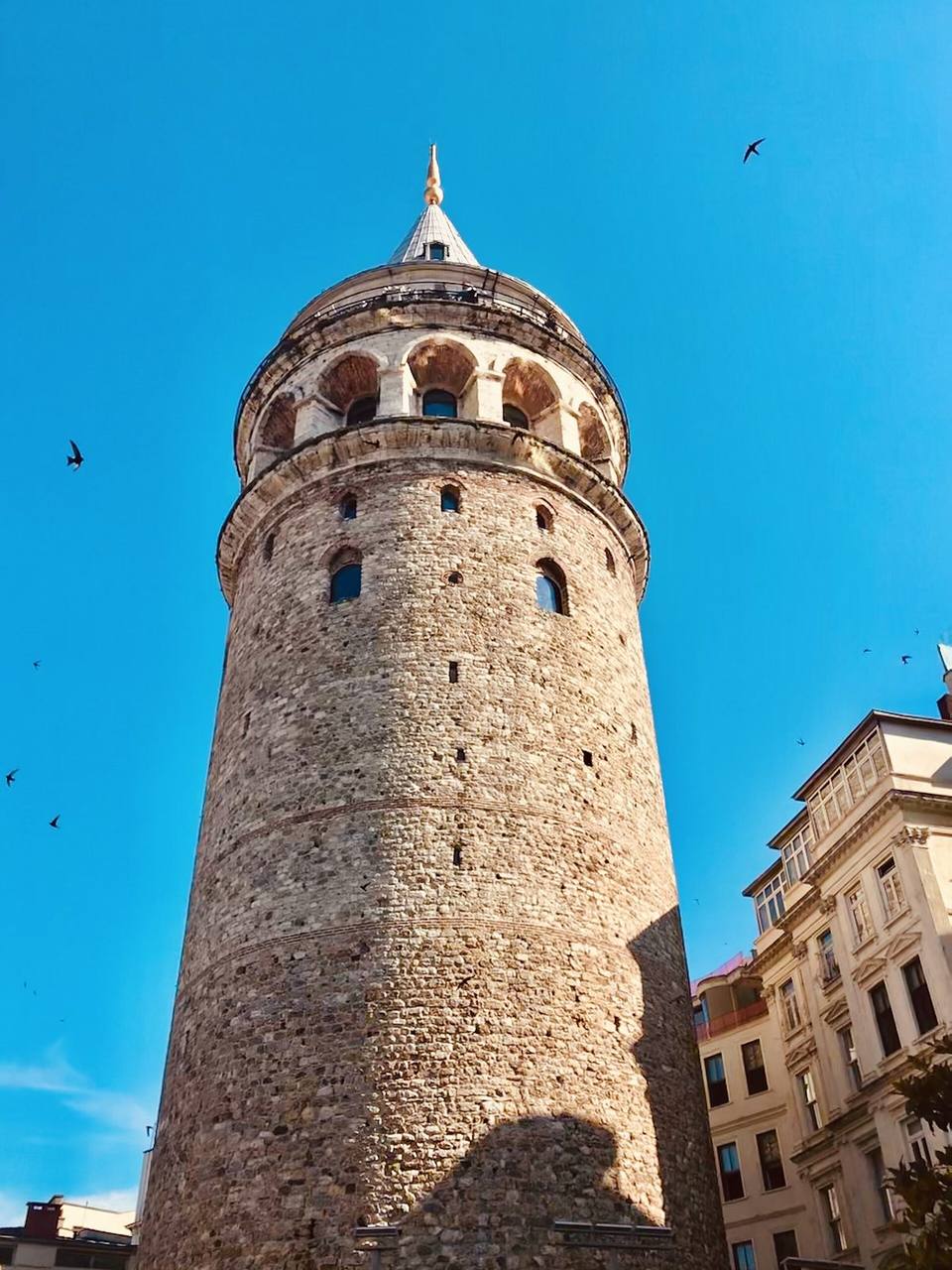
The Galata Tower is today one of the most familiar shapes on the Istanbul skyline, but to see it only as a viewpoint is to miss most of its story. For roughly seven hundred years the tower has been the main tower of a city wall, a prison, a naval storehouse, a home for a military band, a fire watch station and, finally, a museum. The stones and brick bands of its shaft still carry the traces of these changes. Knowing these layers before you climb lets you read the city you see from the top in a different way.
Where the name of the district comes from is not known for certain. The Galata entry of the TDV Encyclopedia of Islam reports the views that the name derives from galaktos, meaning "milk", or from the Italian calata, meaning "stepped road", but adds that its origin has not been clarified. In the Byzantine period the far shore of the Golden Horn was generally called Pera, meaning "the other side". Walled old Galata was the area stretching from today's Karaköy waterfront up to the ridge where the tower stands.
The Genoese colony and 1348
According to the TDV entry on the Galata Tower, the Genoese, of Italian origin, gradually settled in Galata from the 14th century onward and founded a colony there. In that century, when Byzantium had grown very weak, they surrounded their colony with walls and built a tower thicker than all the other bastions at the highest point of the land, 35 metres above sea level, in a spot commanding the entrance of the Golden Horn and the Sea of Marmara. Standing where the walls climbing up from the Golden Horn and the Bosphorus shore met, this tower protected the landward side of the walls. The Byzantines called it Megalos Pyrgos, the Great Tower, while the Genoese named it Christea Turris.
The construction of the tower is tied directly to Byzantium's internal turmoil. According to the same entry, the Genoese administration took advantage of the power struggle between two co-emperors and hurriedly built the tower in 1348, linked it to the walls and deepened the moat. This information comes from the Byzantine historian Nikephoros Gregoras. The Genoese raised the tower once more in 1445 or 1446, and the sources attribute this work to Baldassare Maruffo, the Genoese governor of the time. The museum page of the Ministry of Culture and Tourism also states that the tower was built by the Genoese in the mid-14th century as part of the Galata walls.
The top of the tower after the conquest
After the conquest of Istanbul in 1453, the Genoese handed over the keys of Galata without a fight and received an edict granting them certain rights. According to the TDV entry, this edict stated clearly that the walls would not be demolished, yet as a sign of the new rule the upper parts of the landward walls and about 10 cubits, roughly 7.58 metres, of the top of the tower were taken down. In the great earthquake of 1509, remembered in the sources as the "little apocalypse", the Galata walls and the tower were damaged as well. The repair was carried out under the architect Murad bin Hayreddin and was completed by the middle of 1510.
Anyone looking at the tower from outside today can see the trace of this repair. Two brick bands encircle the shaft at about 13.20 and 17.17 metres above the ground. According to the TDV entry, the upper band in particular is clearly in the Ottoman architectural style, and the pointed brick arches of the fifth floor windows are work of the same period. For this reason the lower two or three storeys of the tower are considered Genoese and the upper part Ottoman. When taking photographs, following the shaft from bottom to top is the easiest way to catch this line where the masonry changes.
Prison, storehouse and the tale of a flight
In the 16th century the tower was one of the places housing prisoners of war who were put to work at the Kasımpaşa Naval Arsenal. The French traveller Pierre Lescalopier, who came to Istanbul in 1574, mentions a strong tower at the highest point of Galata used as a prison. In the first half of the 17th century Evliya Çelebi wrote that the top of the tower was covered with a lead-clad conical roof and that its interior was by then used as a storehouse for the arsenal's ship supplies. In the same period, it is told, Hezarfen Ahmed Çelebi jumped from the tower with artificial wings fastened to his arms and landed at Doğancılar in Üsküdar. This tale is today the best known story of the tower, and most visitors recall it as they look across to the Üsküdar shore.
Band house and fire watchers
From the 18th century onward the tower was assigned to a military band and to fire watchers. The Armenian geographer P. G. İnciciyan wrote that since 1717 a great drum had been beaten in the tower to announce midnight, and that there was a body of watchmen who looked out for fires and alerted the other quarters of the city by beating the drum. In a city of wooden houses this task was vital. In the great fire of 1794 the conical roof of the tower burned. In the repair carried out under Selim III the walls were lowered somewhat and rebuilt, glazed bay windows were added on four sides of the top floor, and a large drum was placed in the tower so that it could be heard from far away.
In the fire of 1831 the tower was ruined once again. In the repair carried out under Mahmud II a large hall lit by round-arched windows was built, above it a balcony with an iron railing, and over that a pointed, lead-clad conical roof. A chronogram poem by the poet Pertev describing the repair was placed above the door. The TDV entry also reports that a traveller who came to Istanbul in the 1830s wrote that the King of Naples had presented the tower with a clock. A travel guide from 1861 records that the tower had eight floors, that the large hall was reached by a staircase of 141 steps and that there was a coffeehouse there. From 1874, while a modern fire brigade was being set up in Istanbul, a fire alarm centre was established at the top of the tower. In a storm in 1875 the conical roof was torn off, and for a while wooden rooms and a flagpole stood in its place.
The 1967 restoration and the tower today
In the winter of 1959-1960 the floors of the wooden rooms at the very top of the tower collapsed when their beams rotted. Istanbul Municipality began work in 1964, and it was decided to return the tower to its appearance between 1833 and 1876. The work, designed by the architect Köksal Anadolu, continued until 1967, and the tower was reopened at a ceremony on 28 September 1967. The pointed conical roof we see today was built with a reinforced concrete frame in this restoration and is slightly less steep than the one of the Mahmud II period.
The dimensions given in the TDV entry show how massive the tower is. At ground level the inner diameter is 8.95 metres, the wall thickness 3.75 metres and the outer diameter 16.45 metres. The stone foundation of the tower sits on rocky ground, and the entrance is reached by a stone staircase. From the main entrance up to the fourth floor, the way up was once a stone staircase set inside the thickness of the wall. Today there is a lift that makes the climb easy.
According to the museum page of the Ministry of Culture and Tourism, the tower was restored again in 2020 by the General Directorate of Foundations. Later reinforced concrete additions and the cafeteria were removed, and the tower opened to visitors as a museum. The museum displays works reflecting every period of Istanbul, which served as the capital of three great empires for about sixteen centuries. The same page also notes that the tower is on UNESCO's tentative World Heritage list together with the Genoese towers of the Mediterranean and the Black Sea.
Tips for visiting the tower
Walking around the foot of the tower for a while before going up is a good start. According to the TDV entry, there was once a wall that curved around the tower and enclosed a courtyard. In 1957 the Bereketzade Fountain, dating from the reign of Mehmed II, was removed from its original site and set into a small surviving section of this wall. After finding the fountain, look at the brick bands on the shaft; you can pick out with your own eyes the place where the Genoese stonework turns into the Ottoman repair.
At the top, as the museum page also stresses, the uppermost floor offers one of the widest panoramic views of Istanbul. The Historic Peninsula, the Golden Horn, the entrance of the Bosphorus and the Üsküdar shore are all seen in a single sweep. From here it is easy to understand why the tower was chosen as a fire lookout.
The museum is run by the Ministry of Culture and Tourism, and the MüzeKart is valid for Turkish citizens. According to the official page, children under 18 must visit the museum together with their parents. Since opening hours, tickets and the conditions for evening visits can change, it is necessary to check the museum's current page before going. The tower is reached on foot from the Karaköy waterfront up the Yüksekkaldırım slope, or from the İstiklal Avenue side via Şişhane. The slopes are steep and narrow, so comfortable shoes help. After the tower, as you walk down to Karaköy along the old Voyvoda Street, today's Bankalar Avenue, you can see in the streets the continuation of Galata's story as a trading district since the days of the Genoese.
Sources
- TDV İslam Ansiklopedisi, Galata Kulesi, https://islamansiklopedisi.org.tr/galata-kulesi
- TDV İslam Ansiklopedisi, Galata, https://islamansiklopedisi.org.tr/galata
- T.C. Kültür ve Turizm Bakanlığı, Galata Kulesi Müzesi, https://muze.gov.tr/muze-detay?SectionId=GLT04&DistId=MRK
- Wikipedia (Turkish), Galata Kulesi, https://tr.wikipedia.org/wiki/Galata_Kulesi
Comments
Be the first to comment